Why Is My Shrink So High? Four Causes, and Most of Them Were Decided on a Drawing
Supermarket shrink has four causes, not one: theft, date expiry, damage and receiving fraud. Each of them is shaped by a decision on a drawing — fixture height, run length, where high-value lines sit, whether the goods-in check can be seen from the office, and how stock is loaded. A sightline is the only loss control with no monthly cost.
Shrink is usually treated as a security budget. A large share of it was decided when the gondola runs were drawn.
That is not an argument against cameras or against counting stock. It is an argument about sequence. By the time a store is trading, the cheap controls have already been spent or thrown away, and everything left costs money every month for the life of the store. A guard is a salary. A monitored system is a subscription. A sightline is a line on a plan, and once it is there it works every trading hour and bills nobody. Most back-of-house problems start before the layout is resolved makes the same point about the back of the building; this is the same argument applied to loss.
Four causes, and only one of them is a thief
The department manuals do not have a chapter called "security". They have a chapter called shrink by cause, and it lists four:
Theft, which concentrates rather than spreads. In a supermarket the losses cluster on a small handful of lines: fragrance, razors, batteries, small electrical items, premium cosmetics, and the high-value kiosk lines at the front. Almost everything else in the building is too bulky, too cheap or too awkward to be worth taking.
Date expiry — stock thrown away because it went out of date on the shelf. This is shrink in every sense that matters to the profit line, and there is no thief anywhere in the story. It is a rotation and range-depth problem.
Damage and handling — product bruised, crushed, broken or spoiled between the delivery vehicle and the shopper. Over-deep produce displays, hot light on fresh, glass in the wrong place, stock double-handled because the route was long.
Receiving fraud and short deliveries — stock invoiced and never received, or received and never recorded. Losses here do not walk past a camera on the shop floor because they never reach the shop floor.
Manage the store on margin after shrink rather than gross margin, as the manuals insist, and these four sit side by side in the same column. Design for only the first one and three-quarters of the problem is untouched.
Theft: height and run length decide what can be seen
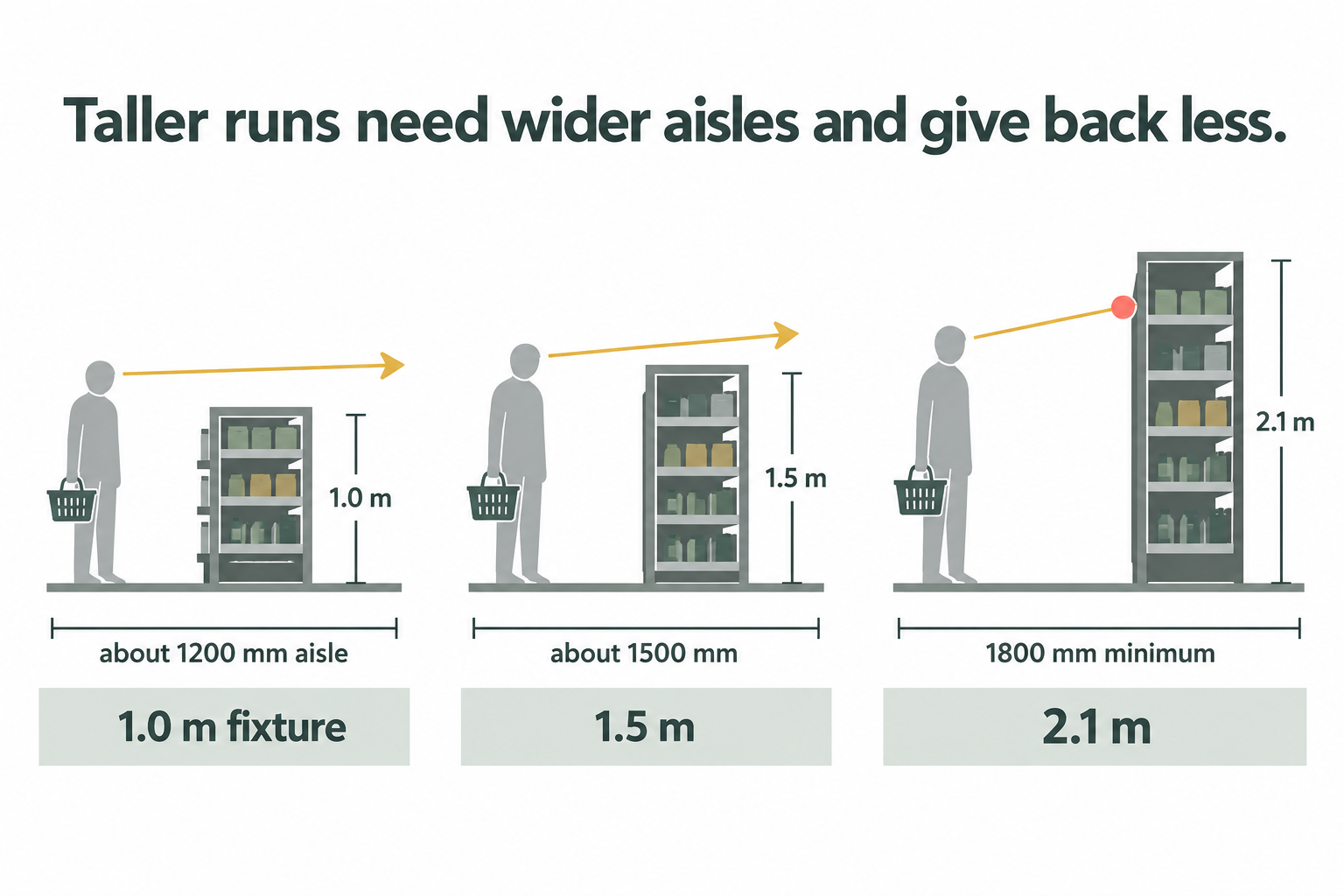
Height buys facings and costs sightline, and it takes the aisle width with it.
Start with what a person standing in the store can actually see, because that is the control that never sends an invoice.
Two drawing decisions set it. The first is fixture height. A full-height ambient gondola run at around 2.1 m blocks every sightline across the store; the same category on a mid-height run does not. The trade is real — height is facings, and facings are sales — so the answer is not low fixtures everywhere. It is knowing which runs are buying you stock capacity and which are only buying you a wall.
The height decision drags the aisle with it, which is the part usually missed. The GRD circulation standard sets the comfortable aisle in front of merchandise by fixture height: roughly 1200 mm in front of a 1.0 m island, about 1500 mm at 1.5 m, and 1800 mm minimum in front of a full-height 2.1 m gondola, interpolating between. The legal fire-egress and accessibility floor is around 1200 mm and is never the design target. So a taller run does not only blind the store — it demands a wider aisle to avoid the canyon effect, and it takes that width from somewhere else. Lowering a run can therefore buy back sightline and floor at once.
The second decision is run length. A long unbroken gondola run is a corridor with no eyes on it. Breaking a run — a cross-aisle, a gondola end, a lower section, a promotional break — restores a line of sight through the store and creates a cross-merchandising point at the same time. Runs are built from repeating bays, 914 mm on the traditional three-foot system or 1000 mm metric, so a break is a bay decision taken early, not a demolition later. Standardise one bay system per store and the break can be moved with a pen.
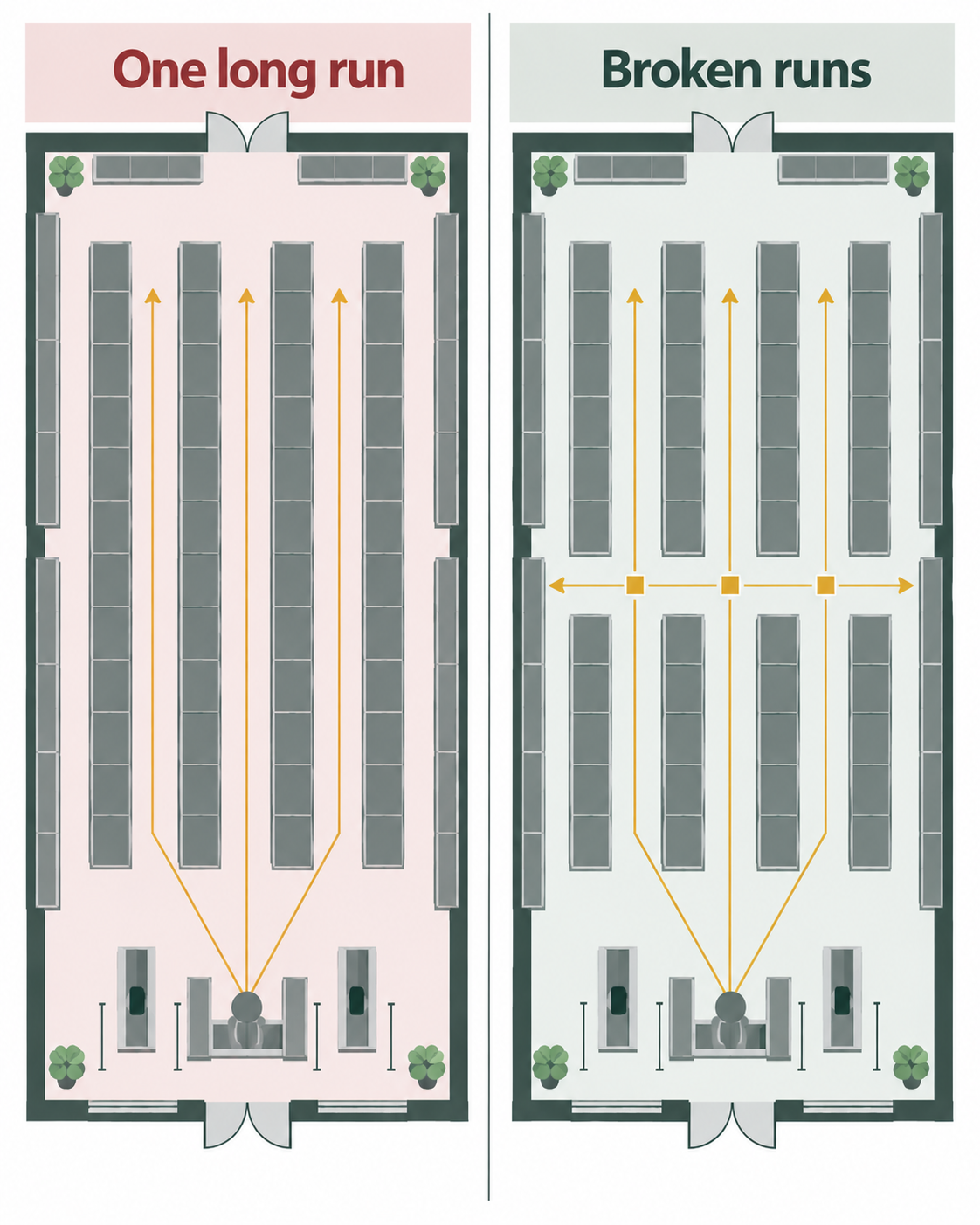
Breaking a run restores a line of sight and creates a cross-merchandising point in the same decision
Neither of these costs anything at drawing stage. Both are close to impossible to change once the fixtures are on site, the lighting is set out above the aisles and the floor finish has been laid to the run.
Theft: put the small valuable things where someone already stands
Placement is the other half, and it runs against a common instinct.
The high-risk lines in a supermarket are few and they are known: fragrance and premium cosmetics, razors, batteries and small electrical, and the kiosk lines at the front such as airtime and gift cards. The manuals are blunt about them — secure or sightline, every time, and cover receiving for the same lines.
The instinct is to scatter them, on the theory that a thief has further to walk and the risk is spread. In practice scattering means nobody can see any of them at once. Concentrating those lines into one supervised area — within the sightline of a station a manager or an assistant already occupies for other reasons — means one pair of eyes covers the whole exposure, and it does so while the person is doing the job they were already being paid to do. That is the difference between a control that costs nothing and a control that costs a wage.
It has a cost, and it should be named rather than hidden. Concentrating those lines breaks some adjacency: a fragrance block pulled into the beauty feature is no longer sitting in the aisle it cross-sells from. Whether that trade is worth it depends on what the lines are losing now. It usually is, on the handful of SKUs where loss is genuinely concentrated, and it usually is not for anything else — which is the point. This is a decision about a few metres of the store, not a philosophy for the whole floor.
Two things follow on the drawing. The manager's station, the service point or the counter has to be positioned for the view, not only for the work — the manuals treat "manager sightline: a view over the operation and any served point" as a design requirement, not a preference. And where cameras go in, they go over the positions the drawing has already identified as the exposure. Equipment covers what the layout could not. It should not be asked to cover what the layout gave away for free.
Shrink also walks out the back
Loss at the receiving door never reaches a shelf, so it is never counted as missing from one.
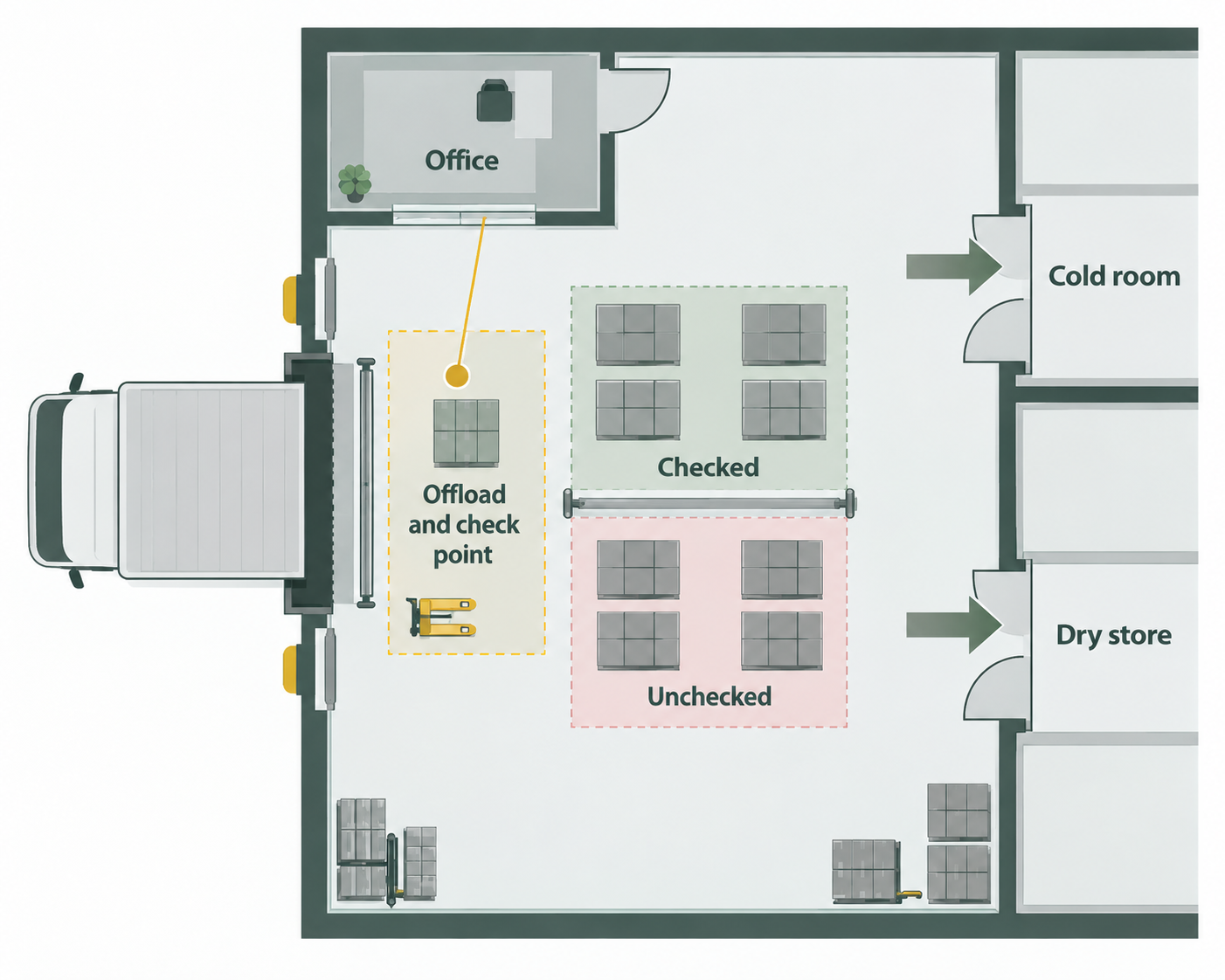
The goods-received office looks straight onto the check, and checked stock never shares a zone with unchecked.
The control the manuals describe is drawn, not written down. Every delivery is checked against the order and captured at a GRV station at the offload point, and the GRV office overlooks that station — a window with a clear line of sight onto the place the check happens. Checked and unchecked stock are physically separated, so that what has been counted cannot quietly merge with what has not. High-value and controlled lines are secured immediately on arrival rather than standing in the bay.
Every one of those is a position, an opening or a partition on a plan. None of them is equipment. A store that runs its goods-in check out of sight of the office is relying entirely on the honesty of whoever is holding the clipboard, and the manuals name receiving as a high-risk point precisely because that is a lot to rely on.
There is a second loss route out of the back: the reverse route that empties, returns, recalls and waste travel on. Baled cardboard and used cooking oil both have resale value, which makes the waste area a place stock leaves from as well as rubbish. It needs controlled access and coverage for the same reason a spirits store does. the receiving article covers the door in, including the segregation of the checked from the unchecked.
Date shrink is a route problem, not a discipline problem
In the fresh departments, the stock thrown away is frequently a larger number than the stock taken.
Date shrink comes from two things: range deeper than the turnover can carry, and rotation that is hard to do. The layout fix for both is the same principle — the case or the run is loaded from behind, so the oldest date moves to the front without anyone unpacking the display in front of a shopper. FIFO back-loading is a replenishment-route decision taken on a plan: it needs a back-of-case access route, it needs the back-up store near the run it serves, and it needs a route to the back for the stock that is being marked down or thrown, so waste does not travel back across the case.
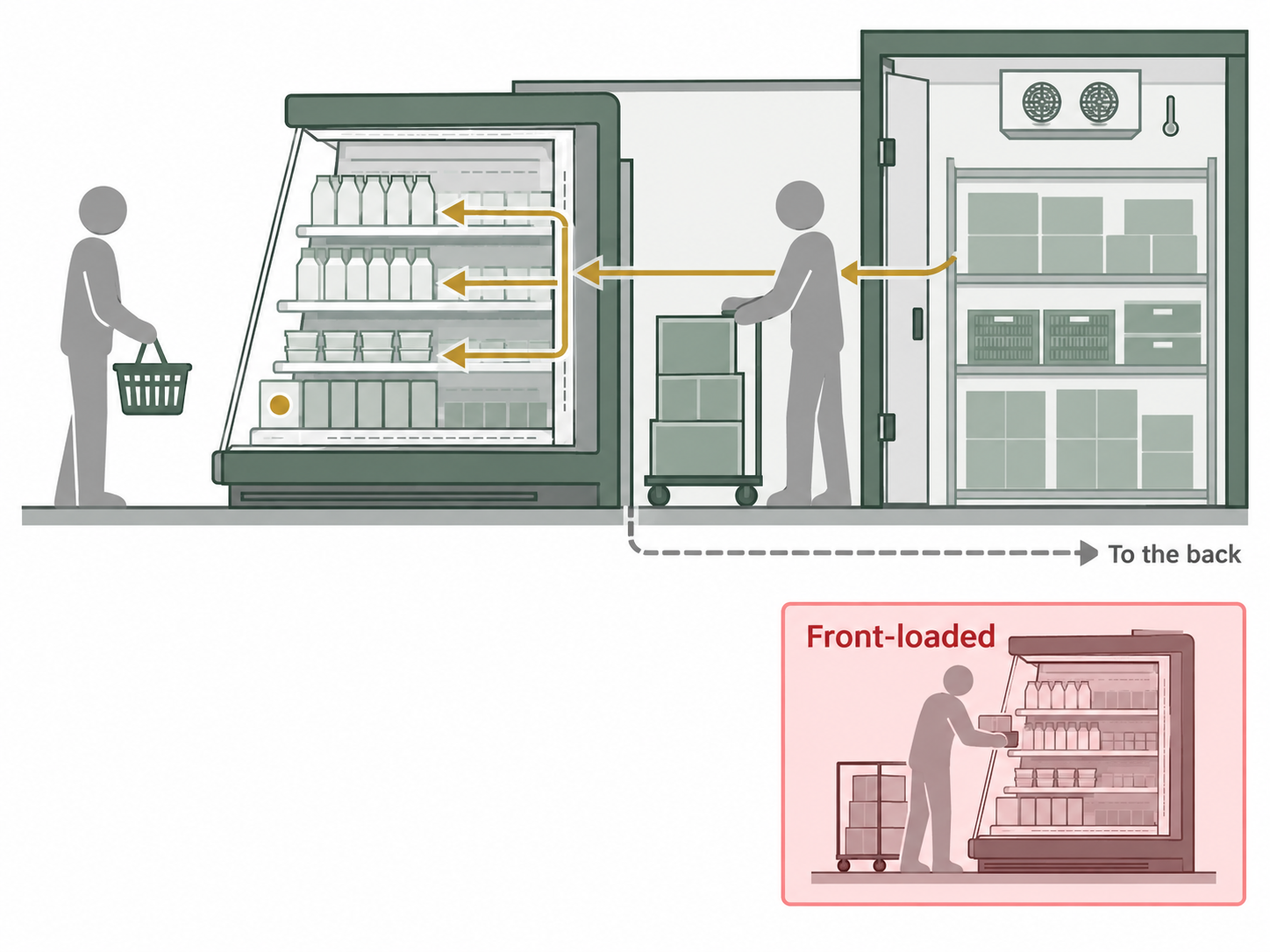
A case loaded from behind rotates itself; a case loaded from the front stops being rotated.
Range depth is the other half, and it is set at space-allocation stage rather than by the buyer. A chilled case sized for more range than the department actually turns will produce date shrink permanently, no matter how good the rotation is, because the oldest units at the back of a slow facing cannot sell in time. More space doesn't mean more sales covers the allocation side of that. The dairy article covers what happens when the cold store behind the case is the constraint.
The same logic runs the other way in the chilled chain. Stock that stands on a hot dock while it is checked has already lost shelf life before it reaches the case, so the dock-to-cold-room route is a date-shrink decision as much as a cold-chain one — The cold chain article follows that route in full.
Damage shrink is built into a display decision
Damage is the quietest of the four. Product that is bruised, crushed, broken or spoiled between the vehicle and the shopper never appears in a security report and rarely appears in a meeting, but it is written off all the same.
The manuals trace it to four design decisions.
Over-deep displays. Produce stacked deeper than it can be shopped bruises at the bottom, under the weight above and under every hand that goes through it. Shallow display standards exist for exactly this reason.
The wrong fixture. Loose produce belongs at the top and primary access level, where it can be selected, replenished and culled easily, with pre-packed lower down. Invert that and both handling damage and culling discipline suffer.
Hot light and heat spill. Lighting chosen without regard to heat cooks the stock slowly all day. So does a bakery oven or a refrigeration condenser discharging into a produce area.
Long or double-handled routes. Every extra move between the delivery and the display is another chance to drop something. The fragile categories pay first: glass fragrance, compacts, eggs.
None of these is a staff failing. They are all decisions someone made on a drawing, and every one of them can be made differently at no cost before the fixtures are specified.
What the front end has to be able to see
The front end is where the last of the shop-floor loss happens — items that bypass the scan, walk-outs at the door, and the under-ring, void and refund end of it.
The layout's job here is narrow. Give the front end a controlled exit rather than an open edge. Put the tills where that exit is covered by someone already working. Keep enough circulation behind the tills for a supervisor to move and see; the standard puts that at roughly 1800 mm in a small store and up to about 2500 mm in a larger one. Keep the high-value kiosk lines behind the counter rather than self-served. And leave space for a packer, because the packer who speeds the lane also improves scan integrity.
What the drawing should not try to do is choose the system. Exit control, EAS and camera coverage are specified by people who do that for a living, against a store that has already been laid out to make their job small. The checkout article covers sizing the front end properly, which is a separate argument with the same cause.
Scale it to the store
A small or convenience store has the easiest version of this problem and usually the worst version of the answer. One person can see the whole floor if the fixtures let them, so fixture height is the entire argument: keep the runs low enough to see over from the till, keep the handful of high-value lines behind or beside the counter, and make sure goods-in is not round a blind corner. No system will beat that, and none is needed.
A mainstream supermarket needs the full set: height and run-length discipline in the centre store, a concentrated and supervised high-value area, a manager station positioned for the view, a GRV station overlooked by the office with checked and unchecked separated, back-loaded chilled cases with a back-of-case route, and a controlled exit with circulation behind the tills.
A large or hypermarket store adds supervision points rather than new ideas — more stations, more cross-aisle breaks, more than one GRV point with controlled marshalling — because a single sightline cannot cross that much floor and pretending otherwise is how large stores end up with large security budgets.
One rule holds at every size: the layout should reduce the problem to the size the store can afford to supervise. Everything beyond that is a running cost.
The takeaway
Stand at your busiest till and look. How much of the store can you actually see from there? Then walk to wherever the manager genuinely spends the day and do it again.
Then check five things on the drawing. That the tallest runs are tall because they need the capacity, not by default, and that their aisles were widened to match. That no gondola run goes the full length of the store without a break. That the small high-value lines sit in one place within somebody's working sightline rather than scattered across four aisles. That the GRV office window looks onto the point where deliveries are actually checked, with somewhere to put the checked stock that is not where the unchecked stock is. And that every chilled case can be loaded from behind, with a route to the back for what comes off.
If most of those are wrong, the shrink figure is not telling you about your staff or your suburb. It is telling you about the plan.
If you are holding a layout now and want to know which of these it already gives away, a store layout review reads exactly that off the drawing — run lengths and heights against the sightlines they leave, where the high-value lines sit relative to where anyone stands, what the goods-in office can see, and whether the chilled cases can be rotated from behind. Or get in touch and describe the store; the till test above is usually enough to say whether the problem is a layout one.
FAQ
1. What actually causes shrink in a supermarket?
Four things, and only one of them is a thief. Theft, which in a supermarket concentrates on a small set of lines rather than spreading across the range: fragrance, razors, batteries, small electrical items, premium cosmetics and the high-value kiosk lines at the front. Date expiry, which is stock thrown away because it went out of date on the shelf. Damage and handling, which is product bruised, crushed or spoiled between the delivery vehicle and the shopper. And receiving fraud or short deliveries, which is stock invoiced and never received, or received and never recorded. The last three involve no shop-floor thief at all, so a store that manages shrink purely as a security problem leaves most of the causes untouched. The design test is to manage the store on margin after shrink rather than gross margin, because that puts all four in the same column.
2. How does store layout affect shrink?
It decides what can be seen and how easy the right handling is. Fixture height and gondola run length set the sightlines across the shop floor, so a store full of full-height runs with no breaks is a set of corridors nobody can see along. Where the few high-value lines sit decides whether one person covers the whole exposure or none of it. Whether the goods-in check happens within sight of the office decides how much can go wrong at the receiving door. Whether a chilled case can be loaded from behind decides whether rotation actually happens. And how deep a display is stacked decides how much product is damaged before it sells. Every one of those is a line on a drawing that costs nothing to draw differently before the fixtures are ordered, and a great deal to change afterwards.
3. Why are sightlines cheaper than security?
Because a sightline has no monthly cost. A guard is a salary and a monitored system is a subscription, and both continue for the life of the store. A sightline is a decision about fixture height, run length and where the manager's station sits, and once it is on the plan it works every trading hour and bills nobody. That is not an argument against cameras or exit control, which are specified by people who do that for a living. It is an argument about sequence: lay the store out so that the exposure is as small as it can be, and then buy equipment for what is genuinely left over. Doing it the other way round means paying every month for a problem the drawing created for free.
4. Should high-value lines be spread out or grouped together?
Grouped, in one supervised area within the working sightline of a station somebody already occupies. The instinct is to scatter fragrance, razors, batteries and small electrical items so that the risk is spread, but scattering means nobody can see any of them at once. Concentrating them means one pair of eyes covers the whole exposure while the person is doing the job they were already being paid to do. It has a real cost, which is that some of those lines lose the adjacency they cross-sell from, and that trade should be made deliberately on the handful of lines where loss is genuinely concentrated rather than applied to the whole store. The front-end kiosk lines such as airtime and gift cards follow the same rule and sit behind the counter rather than being self-served.
5. How do you stop stock going missing at the receiving door?
With three things drawn on the plan rather than three procedures written down. First, a goods-received station at the offload point itself, so every delivery is checked against the order and captured where it lands. Second, a goods-received office that overlooks that station, with a window giving a clear line of sight onto the place the check happens. Third, physical separation of checked and unchecked stock, so what has been counted cannot quietly merge with what has not. High-value and controlled lines are secured immediately on arrival rather than standing in the bay. A store that runs its goods-in check out of sight of the office is relying entirely on the honesty of whoever is holding the clipboard, and losses there never reach a shelf to be counted as missing.
6. Is date-expired stock counted as shrink?
Yes, and in the fresh departments it is frequently the larger number. It comes from two causes, both of them layout decisions rather than discipline failures. The first is rotation that is hard to do: if a chilled case cannot be loaded from behind, rotating it means unpacking the display in front of a shopper, so it stops happening. The fix is a back-of-case replenishment route, the back-up store near the run it serves, and a route to the back for markdown and waste so that it does not travel back across the case. The second is range deeper than the turnover can carry, which is set at space-allocation stage: a case sized for more range than the department actually turns will produce date shrink permanently, however good the rotation is, because the oldest units at the back of a slow facing cannot sell in time.
