Most Back-of-House Problems Start Before the Layout Is Truly Resolved
Most back-of-house problems in supermarkets, bakeries, and QSR projects do not start on site.
They start much earlier, when the planning is moving forward but key operating decisions are still not properly resolved.
By the time the real weaknesses become obvious, the layout has often already been approved, services are being coordinated, equipment positions are being assumed, and the project is starting to harden around decisions that were never fully tested.
That is why so many late-stage changes are not really late surprises. They are early issues that were carried too far.
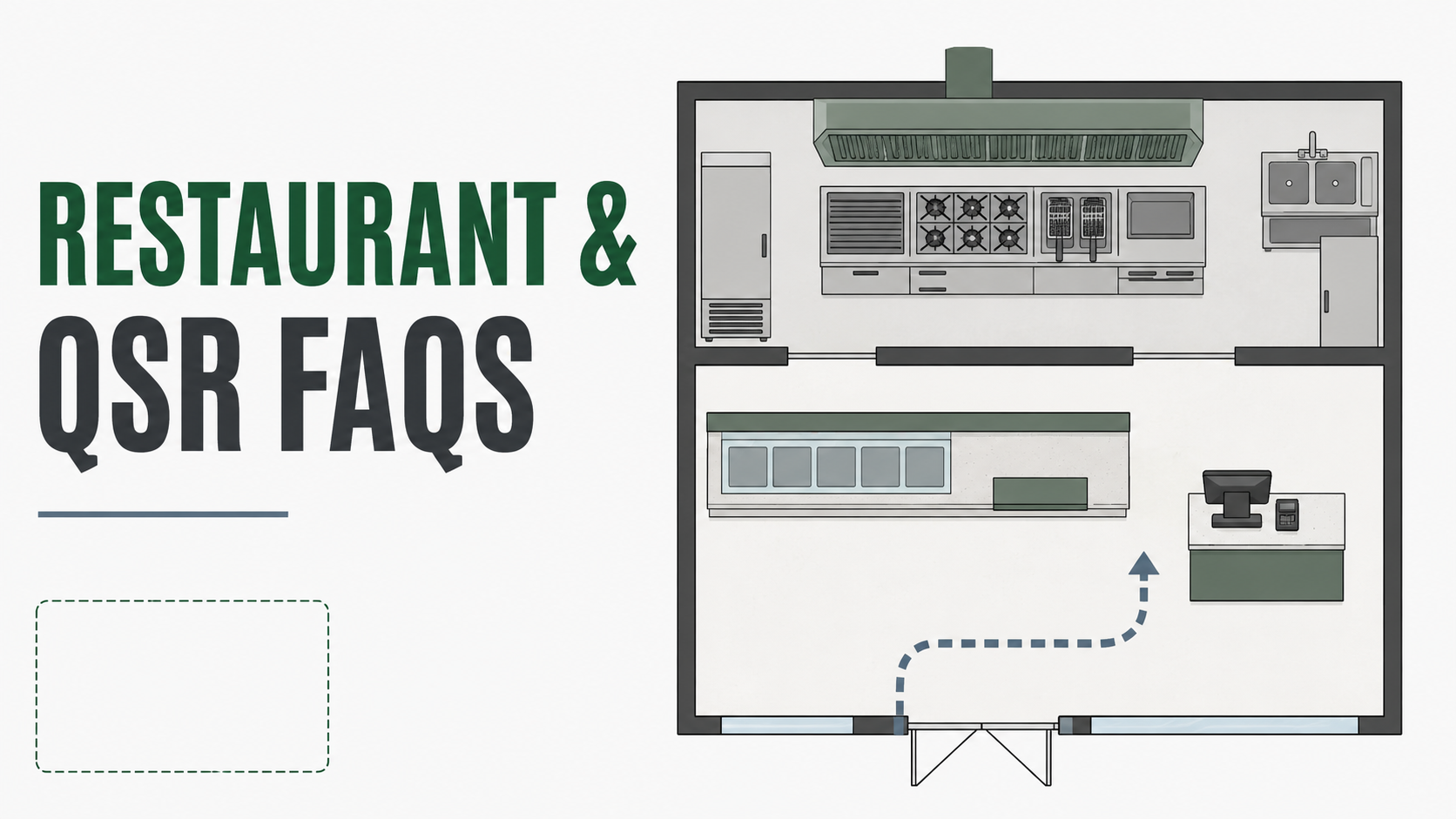
A back-of-house layout is only as good as the decisions behind it
A drawing can look complete long before the operation behind it is properly thought through.
That is one of the biggest reasons back-of-house areas become expensive to fix later. The plan may already show rooms, walls, doors, drains, counters, cold rooms, prep areas, and service routes, but the real operating logic is still unresolved.
This is where projects start getting into trouble. Senior decision-makers may approve the broad direction early, while the departmental managers or operators who will actually have to run the environment only become involved once too much has already been fixed. In other cases, they are involved, but not with enough authority to challenge decisions properly.
That usually leads to the same result: the people who must live with the operation only raise objections once they realise they are the ones who will carry the consequences.
Decision points and sign-off stages matter more than most teams admit
One of the first things that needs to be clear in planning is who can make which decisions, when they must make them, and what level of sign-off is still open at each stage.
If that is vague, the project tends to drift into false agreement. It looks as though everyone is aligned, but in reality some of the most important operating decisions have either not been taken properly or have been accepted without enough challenge.
This happens often in new developments. The owner, development team, or senior corporate leadership may discuss and approve a direction early. Then, much later, the bakery manager, butchery manager, production lead, or store operations team gets a closer look at what has actually been planned. By then, the authority gap is already working against them.
They may accept the plan outwardly, but once the project starts getting closer to execution, practical problems appear and changes start coming in late.
Those late changes are usually treated as disruption. In reality, they are often the first honest reaction to unresolved planning.
The operating model must be settled before the layout can really work
Back-of-house planning cannot be done properly until the operating model is clear.
That starts with a simple but critical question: what is each department actually going to do, make, store, receive, and sell?
In a bakery, the difference between a scratch bakery and a buy-in bakery changes almost everything. If bread and confectionery are produced in-house, the space, equipment, extraction, storage, ingredient handling, and waste requirements are very different from a model built mainly around bought-in product.
In butchery and service-food environments, the same applies. Whether product arrives as carcass, primals, portion-controlled supply, or ready-packed lines affects refrigeration sizing, stock handling, receiving methods, and production flow.
In QSR, the questions are just as important. Is the operation focused on fast assembly, cooked-to-order service, grab-and-go, catering, or a mixed model? Will orders be served only through the main counter, or is there a separate service point? How much display, prep, holding, wash-up, and packaging space is actually needed?
Until those decisions are properly resolved, the drawing may still be moving, but it is moving on assumptions.
Receiving, storage, and stock flow need to be planned as a system
A back-of-house layout only works properly when receiving, storage, issue, production, and merchandising are linked as one system.
That means the team needs to be clear on how stock will arrive, in what form it will arrive, where it will be received, where it will be stored, and how it will move into preparation, production, and final display.
In a supermarket, that may mean deciding whether service departments hold their own stock in dedicated refrigeration and storage, or whether they draw from shared or central store stock. That decision directly affects day-store sizing, movement routes, handling time, and labour efficiency.
In a bakery, bought-in product may reduce part of the production requirement but increase storage demand. In a butchery or kitchen environment, the form in which product is received changes refrigeration volume, handling equipment, and internal movement.
In QSR, the same principle applies even if the scale is smaller. If the storage model is not clear, the prep and service spaces will be compromised almost immediately.
When these decisions are not settled early, what looks like a layout issue later is usually a stock-flow issue that was never resolved properly in the first place.
Shared and dedicated support spaces must be thought through properly
Projects often try to improve efficiency by sharing support spaces between departments.
Sometimes that works well. Sometimes it creates avoidable conflict.
Cold rooms may be shared between bakery and kitchen, or between different service departments. Wash-up areas may be combined. Storage areas may be centralised rather than dedicated.
There can be valid reasons for that. It may save area, simplify construction, or improve equipment use. But it only works if the logistics, access, hygiene requirements, and stock ownership are all properly understood.
A shared room that works badly is not efficient. It is just a smaller problem drawn as a bigger compromise.
Access, staffing, and operating hours affect planning more than teams expect
Operating hours and staffing patterns have a direct effect on back-of-house planning.
A bakery may start long before the main store opens. That means staff are entering the building during off-hours and need a controlled route into the department. They may need access to toilets, washrooms, changing space, or certain support areas while the rest of the store remains closed and secure.
Butchery or production staff may work on a different rhythm again. Some start with the store. Some finish earlier once production reduces. Each of those patterns affects supervision, security, access control, and staff circulation.
These are not secondary operational details. They influence where staff enter, what they can access, how security is maintained, and whether the back-of-house routes make sense at all.
A poor layout often shows itself in small but telling ways. Bakery staff entering through the main customer entrance before trading starts. Butchery staff in bloody aprons moving through public areas. Team members walking across the wrong part of the store simply because no proper back-of-house route was created.
Those are not staff-discipline problems. They are planning problems.
Waste, hygiene, and movement routes cannot be left until later
Waste removal is one of the clearest examples of a decision that must be planned early.
Every production or service environment creates movement that is not customer-facing: waste leaving prep areas, packaging removal, greasy wash-up, food waste, cleaning activity, and staff circulation between work zones.
If those routes are not considered early, the result is usually one of two things. Either waste and dirty movement start crossing clean production paths, or the sales floor becomes an accidental service route.
That is where hygiene, presentation, and operational discipline all start coming under pressure.
The same applies to the way staff move between departments, stores, wash-up areas, and external service points. Good back-of-house planning separates the movement that should never be visible from the movement that supports trading. Poor planning forces them together.
Services planning must follow the operation, not fight it later
Many of the most expensive back-of-house corrections come from services that were left too vague too long.
Electrical planning is a good example. The location of sub-distribution boards matters. Cable lengths and cable sizes affect cost. The longer the heavy run to the wrong place, the more money the project burns without adding value. Planning service points properly from the start is not just a technical issue. It is a cost-control issue.
Drainage is another common failure point. Kitchens, bakeries, wash-up zones, and butchery areas all depend on sensible floor drain and waste-line positioning. External grease trap locations also matter. If the drainage logic outside the building is not understood early, internal department positions can end up fighting the shortest and cleanest route to disposal.
The same pattern appears in air conditioning and extraction. Office and back-of-house areas may need split units, but poor planning leaves condensation lines with no sensible route to the outside. That leads to ugly exposed pipe runs, hygiene problems, and patchwork fixes.
Extraction is similar. Long duct runs increase resistance, drive fan requirements up, and often create unnecessary noise and coordination problems. If the route is not planned early and kept short where possible, the result is usually more cost, more disruption, and a poorer operating environment.
Bakery utilities show the same issue from another angle. Ovens may be electrical or diesel-fired. That choice changes the infrastructure requirement. Diesel-fired equipment may require day tanks, safe access for filling, and sensible external positioning. Those decisions cannot be treated as add-ons once the planning is already too far advanced.
Equipment planning is not something to leave for later procurement
One of the most common planning failures is treating equipment as if it only becomes relevant once the layout is already set.
In reality, equipment requirements help determine the room itself.
The team needs to understand what equipment will be used, how it will operate, what services it requires, what cleaning access it needs, and how it will be maintained.
Electrical loads, gas points, diesel supply, water, drainage, extraction, floor drains, service clearances, and access widths all depend on this.
Floor drains are a simple example, but they are often badly handled. A drain positioned too close to a freezer, or a waste run routed below a freezer where freezing conditions can make that drainage point useless, is not a small drafting error. It is a planning failure that creates maintenance, hygiene, and operating problems later.
The same applies throughout the department. If equipment is not understood early, service points end up in the wrong place, cleaning becomes awkward, access is compromised, and the layout starts working against the department instead of supporting it.
Fit-out sequencing also needs to be considered before the room is closed in
Some of the most avoidable site issues happen because nobody tested the installation sequence early enough.
Large bakery ovens are a good example. Once walls are built, routes narrow, and finished spaces are closed in, getting major equipment into position becomes far more difficult. Sometimes the equipment should be installed before a wall is completed. Sometimes special access or even forklift movement must be planned for during fit-out.
If the team only starts asking those questions once construction is underway, the project is already carrying avoidable risk.
Why late changes happen so often
Late changes usually appear to be the problem. Most of the time, they are not the real problem.
They are the moment when unresolved planning finally collides with operating reality.
That may happen because the wrong people signed off too early, because departmental managers were brought in too late, because the operating model was never properly defined, because receiving and storage logic was left vague, because services were assumed rather than tested, or because equipment and installation requirements were treated as matters for later.
When that happens, the project reaches a point where somebody finally sees the practical consequence clearly enough to object.
The difficulty is that by then, every correction costs more.
What should be resolved before a back-of-house layout is treated as fixed
Before a supermarket, bakery, or QSR back-of-house layout is treated as properly resolved, the project should be clear on at least the following:
who makes which decisions, and who signs off what
which departmental managers or operators must review the plan before it hardens
what each department will actually produce, prepare, receive, store, and sell
whether stock is bought in, processed in-house, or handled through a mixed model
how receiving will work and what form product arrives in
where stock will be stored, and whether storage is dedicated or shared
how stock moves from receiving to storage, prep, production, and merchandising
staffing patterns, operating hours, and off-hours access requirements
staff circulation, security, and access that avoids unnecessary movement through public areas
waste routes and hygiene separation
whether wash-up is shared or dedicated
where sub-DBs, grease traps, extraction routes, air conditioning drainage, and service runs should go
what equipment is required and what utility and maintenance access it needs
whether installation sequencing affects how rooms, walls, or routes should be built
If those issues are still vague, the layout may look complete on paper while the operation behind it is still unstable.
Final thought
A back-of-house layout is not resolved just because the drawing has been approved.
It is only resolved when the operating decisions behind it have been tested properly, signed off by the right people, and translated into a layout, service strategy, and movement system that can actually work.
That is why most back-of-house problems do not begin with construction mistakes. They begin when the planning moves ahead faster than the operational decisions that should be shaping it.
Need help applying this to a live supermarket or QSR project?
See Services or Contact Grove Retail Design.
FAQs
Why do most back-of-house problems start before construction?
Because they begin in planning, not on site. Most back-of-house problems are early issues carried too far. The layout gets approved, services are coordinated and equipment positions are assumed while key operating decisions stay unresolved. By the time the weaknesses show, the project has hardened around decisions that were never properly tested.
What must be settled before a back-of-house layout can work?
The operating model. Back-of-house planning cannot be done properly until each department's role is clear: what it will produce, prepare, receive, store and sell. In a bakery, a scratch model versus buy-in changes space, equipment, extraction, storage and waste. Until those decisions are resolved, the drawing is still moving on assumptions.
How should receiving, storage and stock flow be planned?
As one system. A back-of-house layout only works when receiving, storage, issue, production and merchandising are linked. The team needs to know how stock will arrive, in what form, where it is received and stored, and how it moves into prep, production and display. What looks like a layout issue later is usually an unresolved stock-flow issue.
Why do late-stage changes happen so often on retail projects?
Late changes are usually the moment unresolved planning meets operating reality. They happen because the wrong people signed off too early, departmental managers were brought in too late, the operating model was never defined, or services and equipment were assumed rather than tested. By then, every correction costs more.
When should equipment be considered in back-of-house planning?
From the start, not left for later procurement. Equipment requirements help determine the room itself. Electrical loads, gas points, diesel supply, water, drainage, extraction, floor drains, service clearances and access widths all depend on it. Leave it late and service points land in the wrong place, cleaning becomes awkward and access is compromised.
How do staffing patterns and operating hours affect the layout?
Directly. A bakery may start long before the store opens, so staff enter during off-hours and need a controlled route to toilets, changing and support areas while the store stays secure. Butchery and production staff work different rhythms. These patterns shape where staff enter, how security is maintained and whether back-of-house routes make sense at all.
