Waste Is a Route, Not a Corner — and the Cardboard Is an Income
Supermarket waste is a route through the building, not a place at the end of it. It runs in seven steps: separate at source, collect, process, store, wash down, remove, reconcile. Draw the route first and the waste hub falls out of it — separation points where waste is made, a baler at the cardboard volume, a compactor the vehicle can reach, sealed organics, a drained wash-down enclosure. Draw a pen in the leftover corner and every one of those steps fails at once.
The waste area is usually the last rectangle on the yard plan and the only one nobody argues about. It is also the one back-of-house area that can pay for itself, and the one most likely to shut a fresh department down. Both of those come from the same decision: whether the streams were separated where the waste was made, or mixed in one pen because mixing was easier than walking. Most back-of-house problems start before the layout is resolved— and the back door is where the cheapest of those problems to fix on a drawing turns into the most expensive to live with.
Seven steps, and every one of them is a line on the drawing
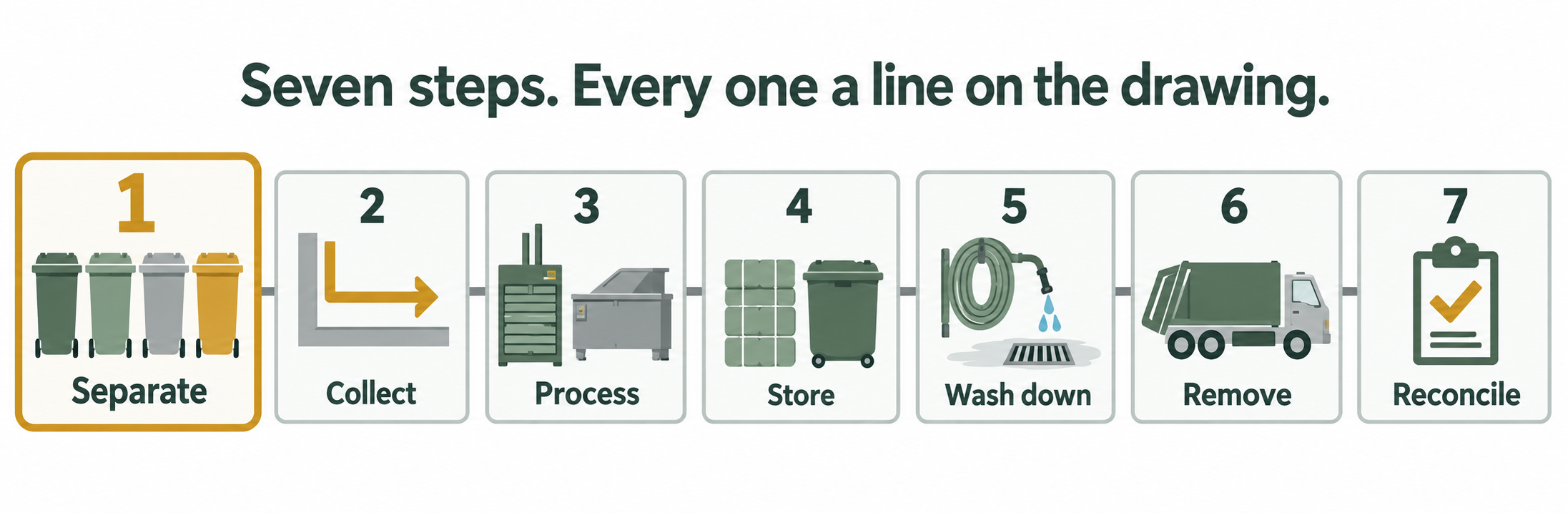
Each step has to be clear before the next one can be drawn.
The manuals set the waste chain out as a sequence, in the same way the selling floor has a shopper journey. Each step has to be clear before the next one can be drawn.
1. Separate at source. Streams are split where the waste is made — the grocery aisle, the butchery, the bakery, the produce prep, the front end — not sorted later. Organic, cardboard, plastics, glass, general, used cooking oil, hazardous. Mix them here and nothing downstream recovers: the cardboard is contaminated and unsaleable, the recyclables are landfill, and the separation-at-source obligation is unmet.
2. Collect and move. Waste travels to the hub on the clean reverse route — the same route empties and returns take — and it never crosses incoming food or the cold-chain path. This is a clean/dirty boundary drawn on a plan, not a housekeeping instruction. The receiving article covers the same route from the other direction.
3. Process. Cardboard is baled. General waste is compacted. Used oil goes to a sealed tank. Organics are sealed and, in heat, chilled. Processing is what cuts the volume, and volume is what haulage is billed on.
4. Store. Bales in a fire-separated bale store. General waste in the compactor. Organics in the sealed or chilled store. Recyclables in separated cages, dry and clean. Hazardous in a labelled quarantine. Each stream has its own home, or it ends up in the nearest one.
5. Wash down. A sealed, drained enclosure with a washable floor that falls to the drain. This is where the crate, pallet and trolley wash bay sits too, because they share the water and the drainage.
6. Remove. A licensed contractor uplifts — the compactor by hook-lift or roll-on-roll-off, the bales, the oil, the hazardous waste under manifest. The vehicle needs a hardstand, an approach and a turning move that does not collide with a delivery.
7. Reconcile and divert. Recyclable income is recorded, organics diversion is recorded, and the manifests are filed. This is the step that turns the waste area from a cost centre into a line somebody in the office can actually see.
Miss any step on the drawing and the store improvises it after opening, usually with labour.
Separation at source is the decision everything else depends on
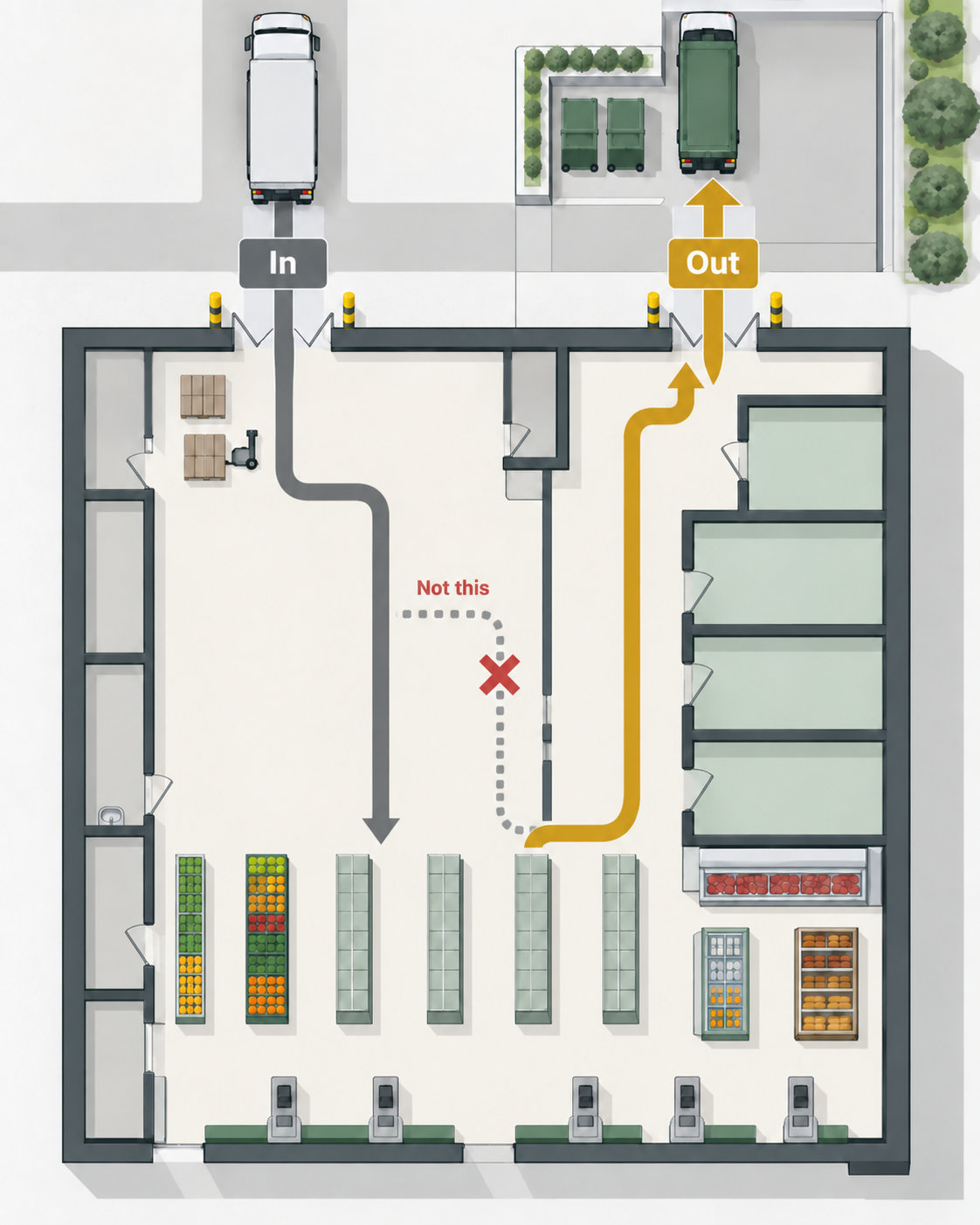
Waste leaves on its own route and never crosses the food coming in.
Everything above rests on step one, and step one is a design problem, not a discipline problem. Staff mix waste when mixing is the easy option: when the right bin is round a corner, when the bins are unlabelled, when there are six streams and four bins, when the cardboard has to be carried past three departments to reach the baler.
So the drawing has to make separation the path of least resistance. Clear, signed stream points at each point of generation. The hub sited where the volume is generated, not where the space was left over. Short, direct reverse routes wide enough for the bin or the pallet that has to travel them — the fire-egress and accessibility minimum of around 1 200 mm is the floor, not the design target, and the working width comes from the project aisle schedule.
Get that wrong and the consequence is not untidiness. It is the loss of every recyclable stream's value, a compliance exposure under national waste legislation and Extended Producer Responsibility, and an organics stream that cannot be diverted because it is full of plastic.
Cardboard: the biggest volume, and the only waste stream that pays
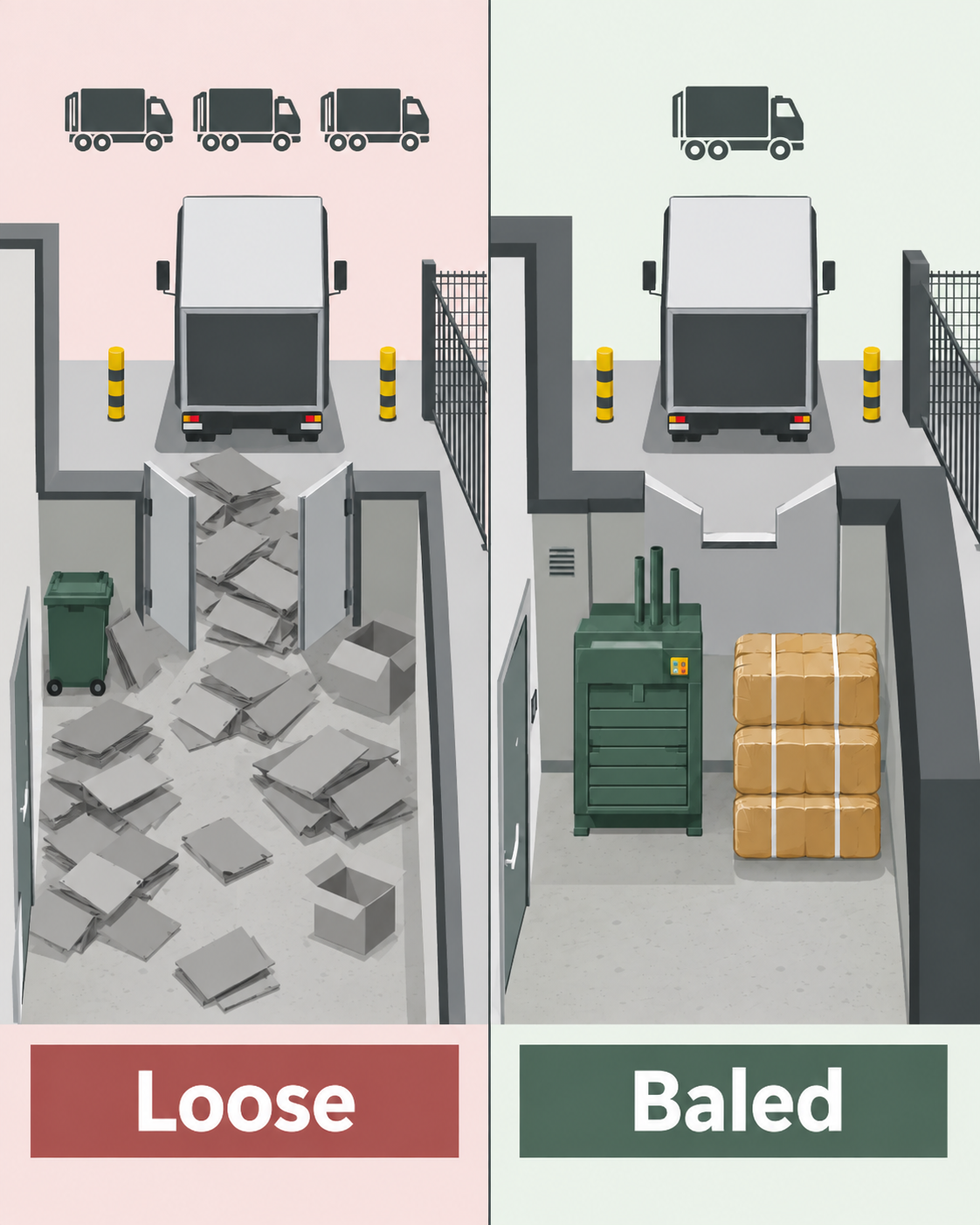
Baling cuts the volume, cuts the trips, and turns a disposal cost into a stream a recycler pays for.
Cardboard is the largest single volume of waste a supermarket produces, and it is the one stream with a buyer at the end of it. Loose, it fills the yard, blocks the door, and is billed as general waste by the trip. Baled, it is a product that a recycler collects and pays for.
That turns one machine into a commercial decision rather than a housekeeping one. A vertical baler cuts the volume, so the number of general-waste uplifts falls; it converts a disposal cost into a recycling income; and it takes the cardboard off the floor so the reverse route stays clear. The capital is real, and so is the return — but only if three things are true on the drawing.
The baler sits where the cardboard volume is, so nobody carries flattened cartons across the building. It has power — the manual is specific that the baler and compactor are intermittent power loads that have to be in the electrical design early, not added later. And the bales have a fire-separated store near the machine, because a stack of baled cardboard is a significant fire load and it is going to sit somewhere until the recycler comes.
Bales also have theft value, as does used cooking oil. The area needs access control and camera coverage for the same reason a spirits store does.
Organics: the stream that decides whether the back door is a problem
Wet and organic waste is the small volume that causes the large trouble. It is the pest driver, the odour driver, and the one stream with a regulatory deadline attached.
In a hot climate it rots on the day it is thrown away. The manual's answer is unambiguous: sealed bins, a chilled organic-waste store where the climate needs one, and frequent removal. A chilled waste store is a small continuous refrigeration load and has to be in the refrigeration brief from the start, not discovered later — but it is the difference between a back door that smells and a back door that does not, and it is the difference between a fresh department that passes an inspection and one that does not.
There is a second reason to design it in now. The organic-to-landfill ban is already in the Western Cape for 2027 with national intent behind it, which means organic waste has to be diverted to compost or digestion rather than sent to landfill. A store designed with mixed organics in a general pen has no route to that, and retrofitting the separation, the sealed store and the contractor arrangement is far more expensive than allowing for them on the first drawing.
Alongside it sit the streams nobody remembers until they are a problem: used cooking oil, which goes to a sealed tank and a licensed collector and never to a drain; hazardous and controlled waste — tubes, batteries, e-waste, expired stock — which is quarantined, labelled and manifested; and confidential waste, which is secured and shredded, a data-protection obligation as much as a waste one.
The wash bay, the drain and the interceptor
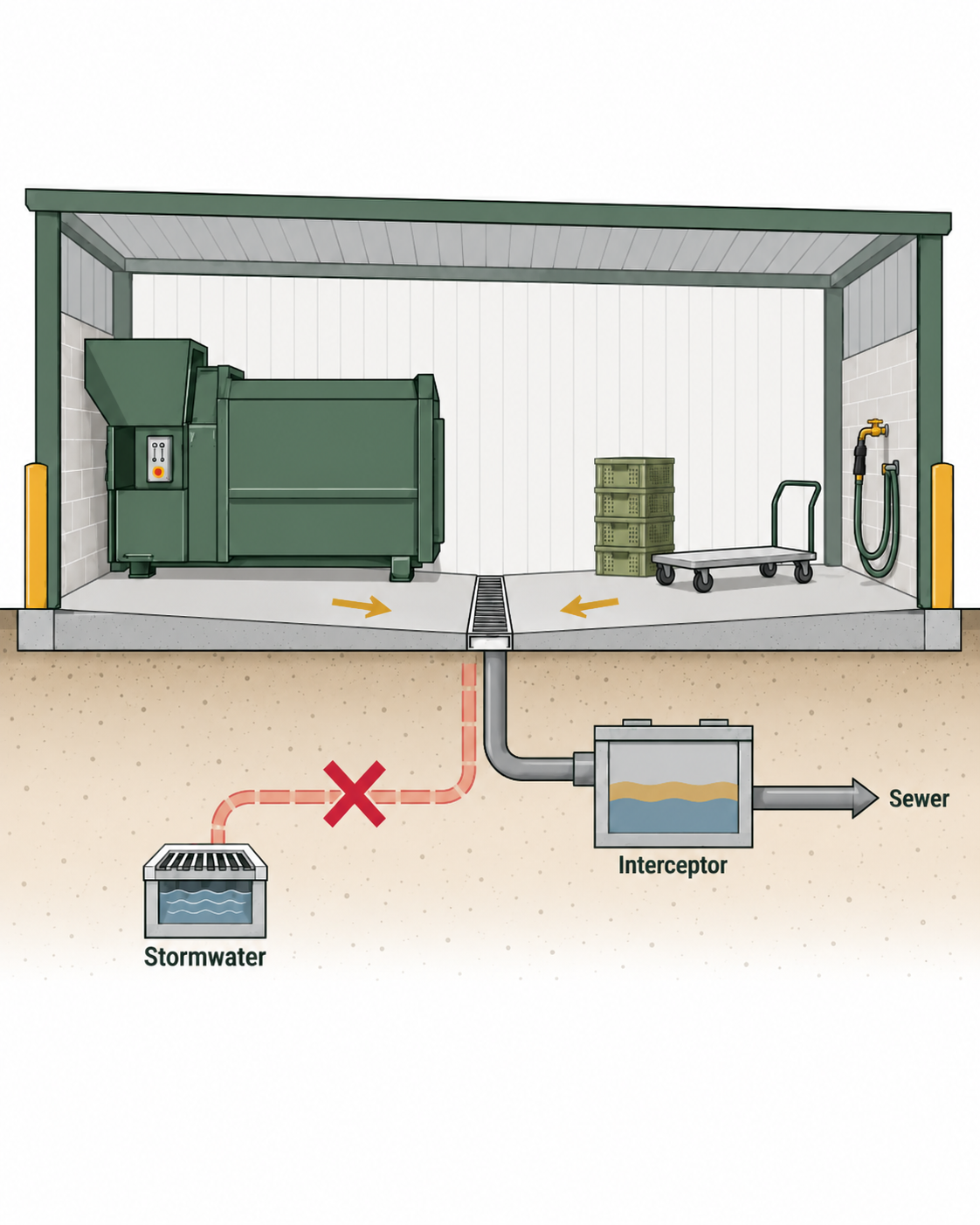
Leachate and wash-down water go to sewer through an interceptor, and never to the stormwater drain.
The waste area is a wet area, and the single most common civil mistake is treating it as a dry one.
Compactor leachate and wash-down water both have to go to sewer through a solids and grease/oil interceptor. Never to stormwater. The floor is sealed, washable and falls to the drain — the floor-finishes article covers the specification. And the crate, pallet and trolley wash bay sits beside the waste area precisely so it can share that water and that drainage, rather than becoming a second wet area somewhere else on the site with its own drain run.
This is the part of the waste hub that cannot be fixed after the slab is poured. Falls, drain positions and the interceptor are civil work, and they have to be frozen before the pour along with the power for the baler and the compactor, the water for the wash-down, and the refrigeration for the chilled organic store.
The vehicle is part of the design, not an afterthought
The last step in the chain is a truck, and it is the step most often left to chance.
The refuse vehicle needs a hardstand it can stand on, an approach it can make, and a time at which it is not competing for the same yard as a delivery. The compactor has to be positioned where a hook-lift or roll-on-roll-off can actually reach and lift it. The bales and the oil need their own uplift access. Vehicle type and uplift frequency are contractor confirmations on a real project, and they belong in the assumptions log with a name against them — but the shape of the answer has to be on the yard plan before the yard is set out, because a compactor the truck cannot reach is a compactor that has to be moved.
Where the yard is shared with a landlord or a centre, the same questions are asked of them: where the waste point is, who separates, what the timing is, and who holds the contracts.
Scale it to the store
The manual is explicit about what is core and what is optional by format, and it scales sensibly.
A small or convenience store needs separated bins with clear stream points, a small baler, a sealed organic bin, a wash-down point and contractor access. A compactor, a chilled organic store and an oil tank are optional until the volume justifies them — but the separation and the wash-down are not optional at any size.
A mainstream supermarket needs the full hub: a baler with a fire-separated bale store, a static compactor with hardstand and vehicle access, a sealed and chilled organic store, recycling cages, a used-oil tank, a hazardous quarantine and a wash-down enclosure with the wash bay beside it.
A large or hypermarket store adds capacity rather than new ideas — multiple compactors, a larger baler, fuller separation, organics diversion arrangements and recorded income tracking.
One rule holds at every size: ambition has to match the operating capacity the store can actually fund. A separation system with more streams than the staff can service goes back to being one mixed pen within a month.
The takeaway
Take the yard plan and trace one carton and one bag of fish waste, from the department that generates them to the vehicle that takes them away. Every step in that walk should exist on the drawing.
Then check five things. That there is a labelled stream point where the waste is made, not just at the hub. That the route from there to the hub never crosses the receiving door or the cold-chain path. That the baler sits where the cardboard volume is and the bale store is fire-separated. That the organic store is sealed, chilled if the climate needs it, and close enough to be used. And that the wash-down and the compactor drain to sewer through an interceptor, with the falls drawn — not to the stormwater grating in the middle of the yard.
If the yard plan shows one rectangle labelled "bins", the waste route has not been designed. It has been deferred to the staff, who will solve it every day for the life of the store.
If you are holding a plan now and are not sure whether the back door was designed or left over, a store layout review reads exactly that off the drawing — the stream points, the reverse route against the food-intake path, the baler and compactor positions against the vehicle access, and where the wash-down water is going. Or get in touch and describe the yard and who collects; that is usually enough to say whether the cardboard is a cost or an income.
FAQ
1. How should a supermarket waste area be planned?
As a route, not a place. Waste moves through a supermarket in seven steps: it is separated at source in the department that makes it, collected and moved on a clean reverse route that never crosses incoming food, processed so the volume falls, stored by stream, washed down, removed by a licensed contractor, and then reconciled so recycling income and organics diversion are recorded. Draw that route first and the hub falls out of it — where the separation points go, where the baler and the compactor sit, where the organic store is, where the wash-down drains and where the vehicle stands. A single bin pen in the leftover corner of the yard fails all seven steps at once.
2. Why does a supermarket need a cardboard baler?
Because cardboard is the biggest single volume of waste a supermarket produces and the only stream with a buyer at the end of it. Loose cardboard fills the yard, blocks the reverse route and is billed as general waste by the trip. Baled cardboard takes up a fraction of the space, cuts the number of general-waste uplifts and is collected by a recycler as a product rather than as refuse, so a disposal cost becomes an income line. Three things have to be right on the drawing for that to work: the baler sits where the cardboard volume is generated, it has power designed in from the start, and the bales have a fire-separated store near the machine, because baled cardboard is a significant fire load.
3. Where should the waste area be in a supermarket?
At the back or service-yard side, on the clean reverse route from the sales floor and receiving, and firmly away from the food-intake and cold-chain path. That is a clean/dirty boundary and it is drawn on the plan, not managed by housekeeping. It also has to be reachable by the waste vehicle, with a hardstand and an approach coordinated with deliveries so the refuse truck and the delivery truck never need the same space at the same time. The crate, pallet and trolley wash bay sits beside it so the two share wash-down water and drainage rather than creating a second wet area elsewhere on the site.
4. How should a supermarket handle organic and food waste?
In sealed bins, chilled where the climate needs it, and removed frequently. Organic waste is a small volume that causes most of the trouble at the back door: it rots quickly in heat, and it is the driver of both pests and odour. A chilled organic-waste store is a small continuous refrigeration load, so it belongs in the refrigeration brief from the start rather than being discovered later. There is also a regulatory reason to design it in now — the organic-to-landfill ban is already set for 2027 in the Western Cape with national intent behind it, which means organics have to be diverted to compost or digestion, and a store with organics mixed into a general pen has no route to that without retrofitting.
5. Where does supermarket wash-down water and compactor leachate go?
To sewer, through a solids and grease/oil interceptor — never to stormwater. The waste area is a wet area, and the floor is sealed, washable and laid to fall to the drain. Compactor leachate and the water from washing down the enclosure both carry solids and grease, so the interceptor is what stands between the store and a blocked drain or an illegal discharge. Falls, drain positions and the interceptor are civil work and have to be frozen before the slab is poured, along with the power for the baler and compactor, the water for the wash-down and the refrigeration for the chilled organic store.
6. What waste streams does a supermarket need to separate?
Cardboard, plastic film, mixed plastics and cans, glass, wet or organic food waste, used cooking oil, general landfill waste, hazardous or controlled waste such as fluorescent tubes, batteries, e-waste and expired stock, and confidential waste. Each needs its own clearly identified point at the place the waste is generated, because separation cannot be recovered downstream: once streams are mixed, the cardboard is unsaleable, the recyclables become landfill and the organics cannot be diverted. Used oil goes to a sealed tank and a licensed collector and never to a drain, hazardous waste is quarantined and removed under manifest by a licensed contractor, and confidential waste is secured and shredded.
