Price Perception and the Value Wall: How a Shopper Decides Your Store Is Good Value
Direct answer: Shoppers judge value from a few things they see early: gondola ends in the entrance sightline, a value wall on the main route carrying genuinely cheap everyday lines, and plain was, now and save tickets. Build promotions in dedicated outlets so the fixed shelf plan stays intact, and keep the hero deal in stock.
A shopper comes in for the week's basics: bread, milk, maize meal, oil. They are not going to read every ticket in the store. They look at what is in front of them as they walk in, and they decide from that whether this is a store that looks after their budget.
That decision shapes the rest of the visit. A shopper who has decided the store is sharp on price forgives a lot on the lines they do not check. That protects margin on everything else.
The decision is made from the drawing: what is in the entrance sightline, what sits on the main route, and how clearly each price is shown.
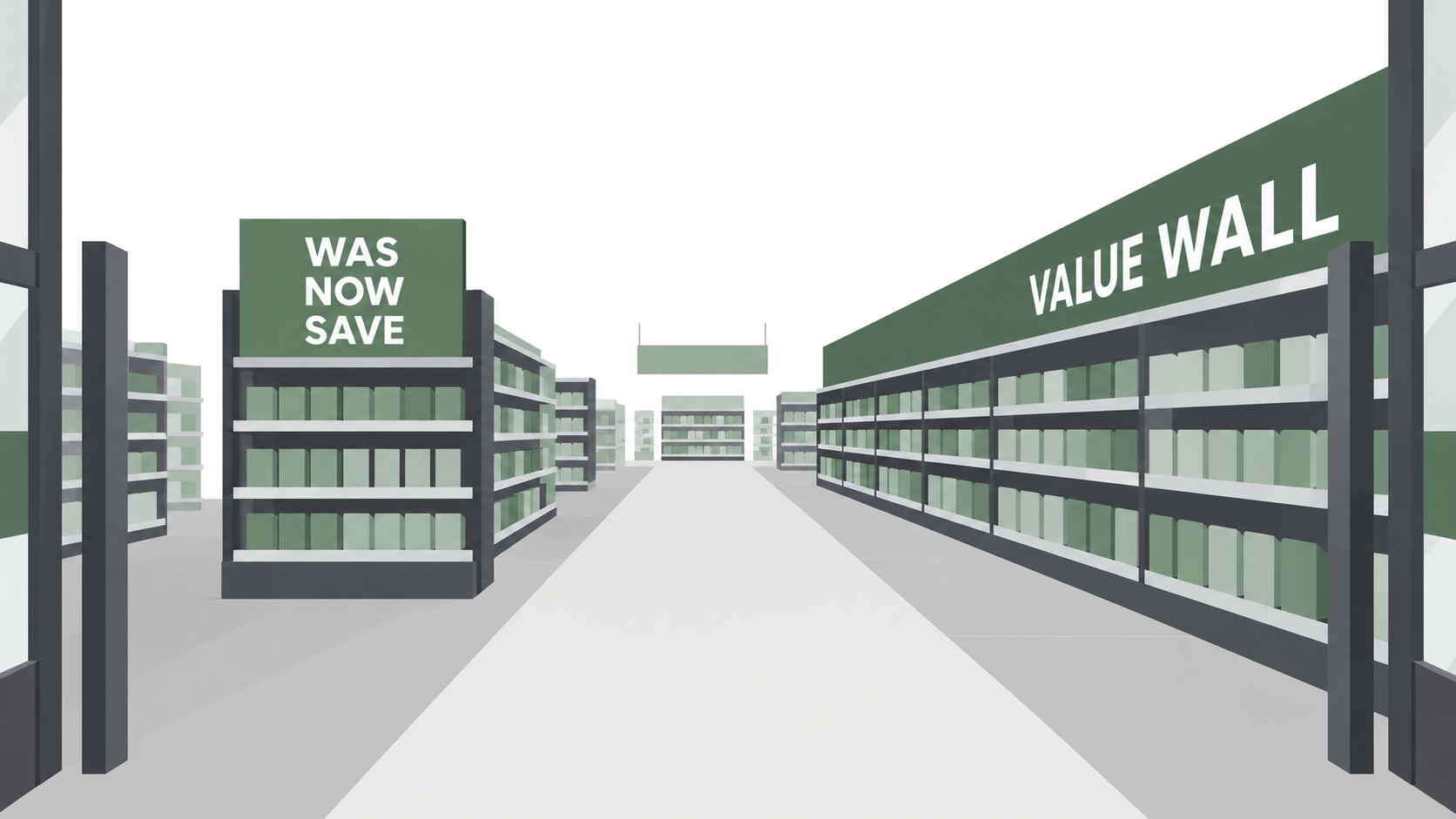
A shopper decides whether the store is good value from what they can see from the entrance.
Start at the door: gondola ends in the entrance sightline
The gondola end is the most-seen selling space in the store. The first design question is whether the shopper can see it from the entrance.
Position the ends so the best of them are visible from the door. It is not always possible, because columns, the trolley bay and the front-of-store plan all compete for the view. It should always be the intent. An end that is seen from the door sets the price story before the shopper has chosen a direction. An end behind a return fixture or a display is only seen by those who are already deep in the store.
Walk the plan from the entrance, along the sightline a shopper would take, and mark the ends you can see. If the answer is none, move the drawing, not the deals.
The value wall: top lines on the main route, and genuinely cheap
A value wall is a run of shelving modules on the main traffic route that carries the store's top 20 or so lines on permanent value display. In a South African mainstream store that is the short list shoppers buy every week and know the price of. The lines rotate over time, but they stay within the store's top 50.
Three rules make it work.
It sits on the main route. The wall earns its place from the traffic that passes it. Put it where most shoppers walk, not in a side aisle.
The prices are genuinely sharp. A value wall carrying ordinary prices loses its meaning quickly, and shoppers stop believing it. If the lines cannot be priced sharply, do not call it a value wall.
The lines are the ones shoppers know. Pick them from sales ranking, not instinct. Rotate within the top 50 so the wall stays fresh and stays honest.
The wall also carries the brand message of the store. Lighting should be even, bright and clean, so the wall reads as value, not as a feature display.
Promotions go in dedicated outlets, not in the shelf plan
Each promotion needs a home that is not borrowed from the fixed planogram. Take facings from the shelf plan for every deal and the shopper cannot find the range they came for, the shelf plan needs a reset, and labour goes into rebuilding it afterwards.
Give promotion its own outlets, and scale them to the store:
Convenience: on-shelf promotion tickets and, where there is room, one gondola end.
Neighbourhood supermarket: gondola ends, power modules, a value wall and a seasonal zone.
Large supermarket: all of the above, a larger seasonal zone and some palletised promotion.
Hypermarket: the full set, including a dedicated palletised promotion zone served by pallet-handling equipment.
A power module is one full shelving bay given to a single product, always a key value line on promotion. It sits in the relevant category aisle with a big price. Its job is volume on a hero deal.
A seasonal zone is a changeable outlet near the entrance or a feature position for back-to-school, festive and Easter, so seasonal stock never flexes the shelf plan.
Do not force a palletised zone into a convenience store, and do not leave it out of a hypermarket.
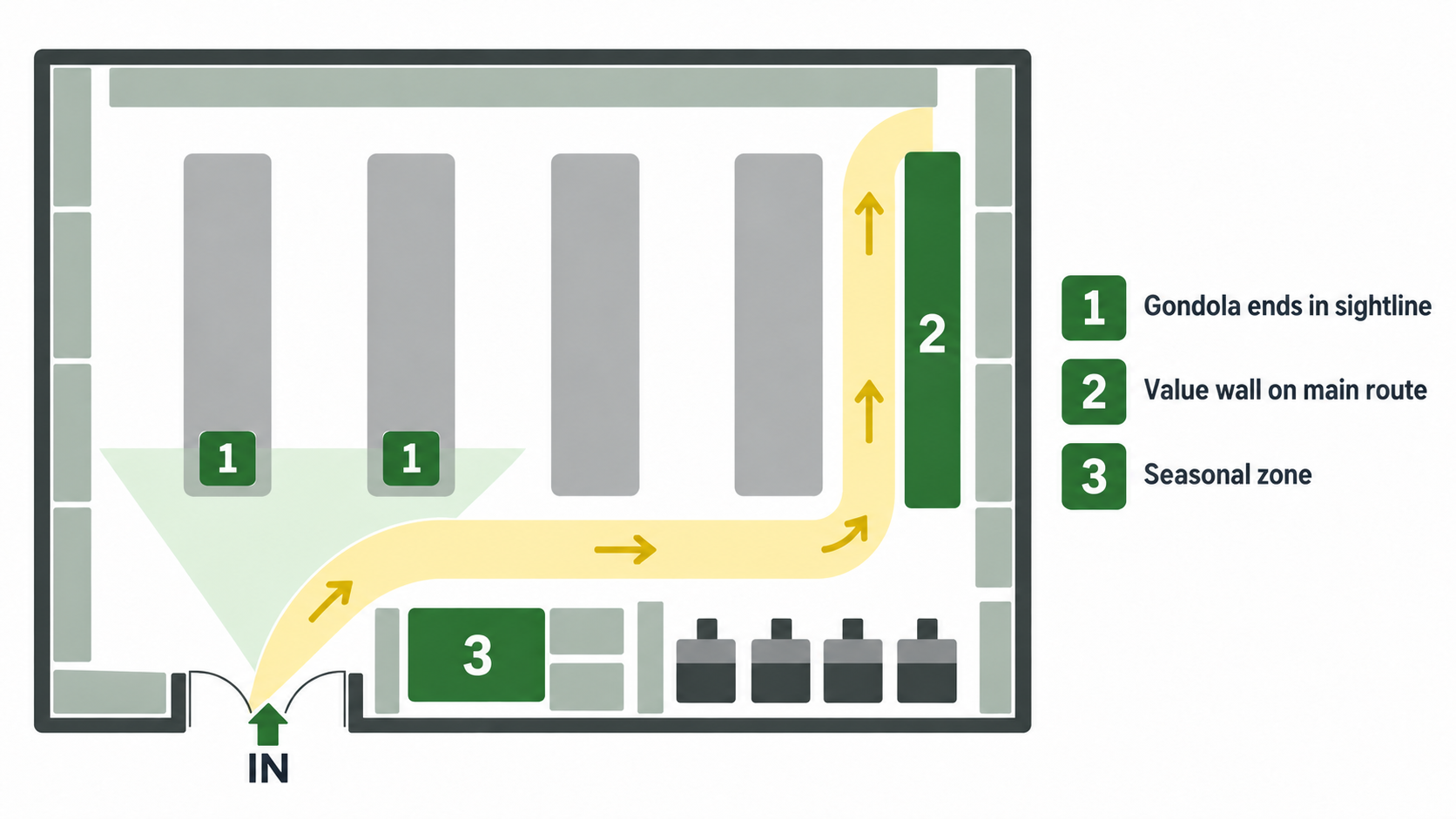
Ends in the entrance sightline, the value wall on the main route, and a seasonal zone as a dedicated outlet.
Say the price plainly
A deal that cannot be read in a glance has not been communicated. Use big, plain was, now and save tickets on ends and power modules. The shopper should be able to read the price and the saving from the aisle, without stopping or picking the product up.
Clever graphics slow the read. The price and the saving are the message.
Get the basic ticket layer right before adding anything else. The shelf ticket, with the price and the unit price clear, is where a shopper confirms the impression the ends and the wall have made. A store that shouts value on the end and hides the price on the shelf undoes its own work. See Shelf ticket and unit pricing for the shelf ticket.
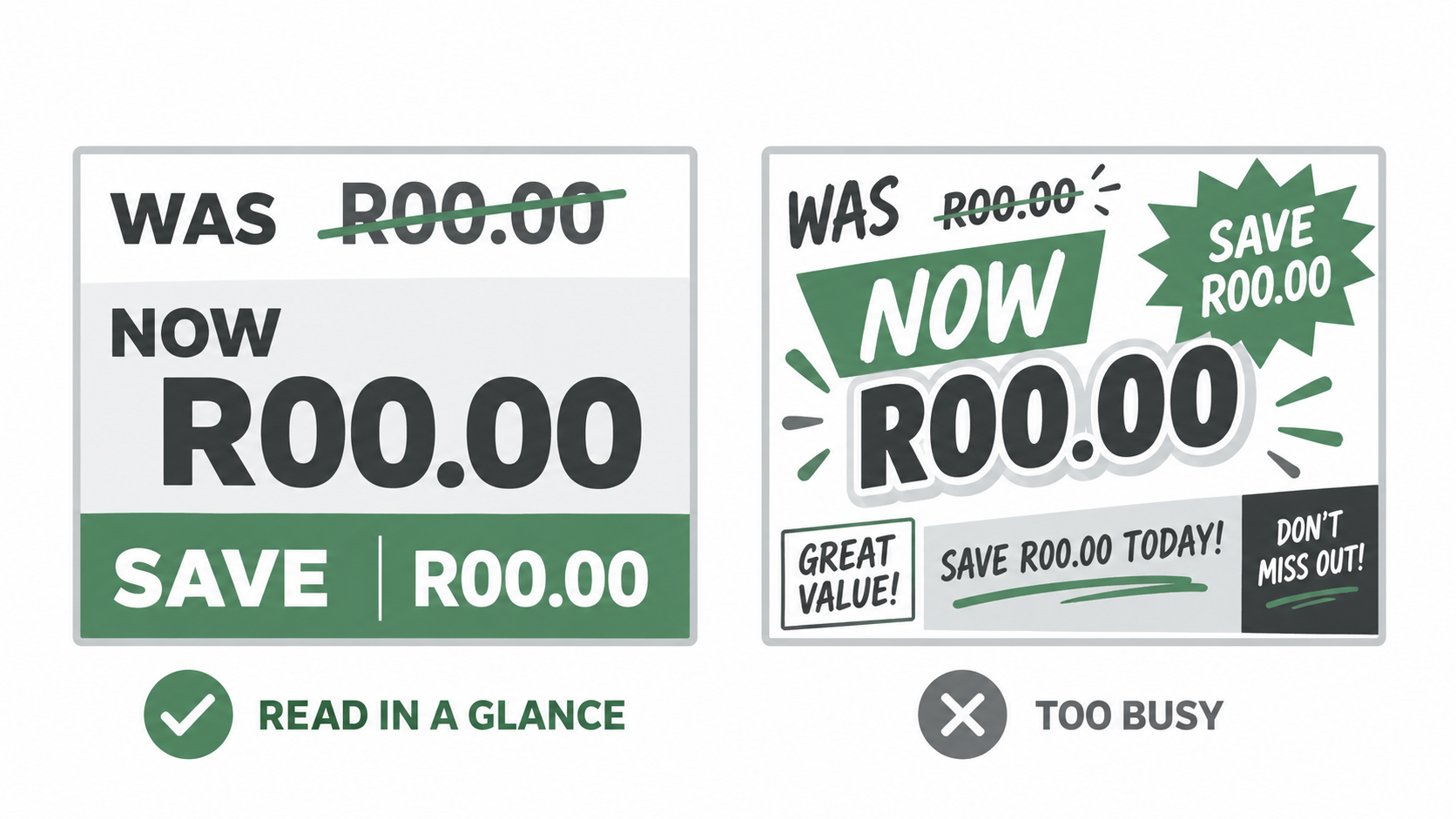
A shopper should read the price and the saving from the aisle without stopping.
Keep the hero deal in stock
A power module or palletised deal is only worth the space while the product is on it. An empty hero bay tells the shopper the deal was never real.
Order promotion stock to forecast and replenish the hero deal to demand. Plan the build and the change-over, particularly for seasonal and palletised displays, because labour goes into building, pricing, refilling and dismantling them. Define the exit for seasonal stock before it arrives, so it does not become markdown stock after the event.
What the drawing has to carry
The entrance sightline marked on the plan, with the gondola ends visible from it.
The value wall drawn on the main route, with its line count stated.
Dedicated promotional outlets scaled to the store: ends, power modules, seasonal zone and, in larger stores, a palletised zone with its handling clearances.
A signage and price-communication plan: front-of-store value messaging, end headers, was, now and save tickets.
Accent lighting for the ends and even, bright lighting for the wall on the reflected ceiling plan.
Regulated lines (wine, pharmacy) kept in their permitted zones, even when a promotion would sell more elsewhere. See Wine room vs gondola run.
The takeaway
Stand at your front door and look in. Mark every gondola end you can see, and note whether the value wall is on the route the shopper walks. If the answer is "I cannot tell", the plan is the first thing to fix. Then check that every promotion has its own outlet and that the tickets can be read from the aisle.
Related reading:
How to lay out a store to drive sales: plan the route, not the rooms
More space doesn't mean more sales: how to split a supermarket floor by department
How to plan a supermarket wine department: room vs gondola run
Shelf ticket and unit pricing article
Planning a new store or a refit? A layout review reads the entrance sightline, the main route and the promotional outlets off your plan. Book a store layout review with Grove Retail Design, or get in touch.
FAQ
How does a supermarket look cheap to shoppers? Shoppers judge price from a few signals, not every ticket. Put gondola ends where they can be seen from the entrance, run a value wall on the main route with genuinely cheap lines, and use plain was, now and save tickets. Keep promotions in dedicated outlets so the fixed shelf plan stays intact.
What is a value wall in a supermarket? A value wall is a run of shelving modules on the main traffic route that carries the store's top 20 or so lines on permanent value display. The lines rotate but stay within the store's top 50. It only works if the prices are genuinely sharp, because shoppers stop believing a wall that is not.
Where should gondola ends go to drive sales? Gondola ends should, wherever possible, be visible from the entrance, because that sightline is where price perception starts. It is not always achievable, but it should be the design intent. Keep the deals on the end honest and bold, and never hide the best ends behind a display or a till queue.
How should a supermarket run promotions without disrupting the shelves? Build every promotion in a dedicated outlet: a gondola end, a power module, the value wall, a seasonal zone or, in larger stores, a palletised zone. Do not steal facings from the fixed shelf plan for each deal. The range shoppers came to find stays put, and the promotion still gets seen.
What is a power module? A power module is one full shelving bay given to a single product, always a key value line on promotion. It sits inside the relevant category aisle with a big price and strong availability. Its job is volume on a hero deal, so the one failure to avoid is running out of stock.
