How to Plan a Supermarket Wine Department (Room vs Gondola Run)
Wine on a standard gondola gets walked past. Wine in a room of its own gets shopped. That is the whole argument for planning a supermarket wine department properly — but wine is also the one department where you do not get to start with the merchandising, because the law draws the first line on the plan.
In South Africa a supermarket sells wine, and only wine, under a grocer's wine licence. That licence carries conditions that govern the design before a single commercial decision: the wine may be sold only from a demarcated area, that area must be able to close shut and become inaccessible to the public outside permitted hours — after hours and on Sundays or restricted trading days — and the licence application needs a dimensioned floor plan showing it. Beer and spirits are not sold under a grocer's wine licence at all; they need a separate, licensed bottle store. And the exact trading hours, the distance rules and the conditions vary from province to province and municipality to municipality, so every one of them is confirmed with the provincial Liquor Authority and a licensing attorney before the design is frozen. None of it is assumed.
Here is the part most layouts miss: that legal boundary is not a nuisance to work around — it is the opportunity. The law already forces you to draw a bounded, closable space for wine. The commercial move is to make that space a room.
Start with the licence — it draws the first line
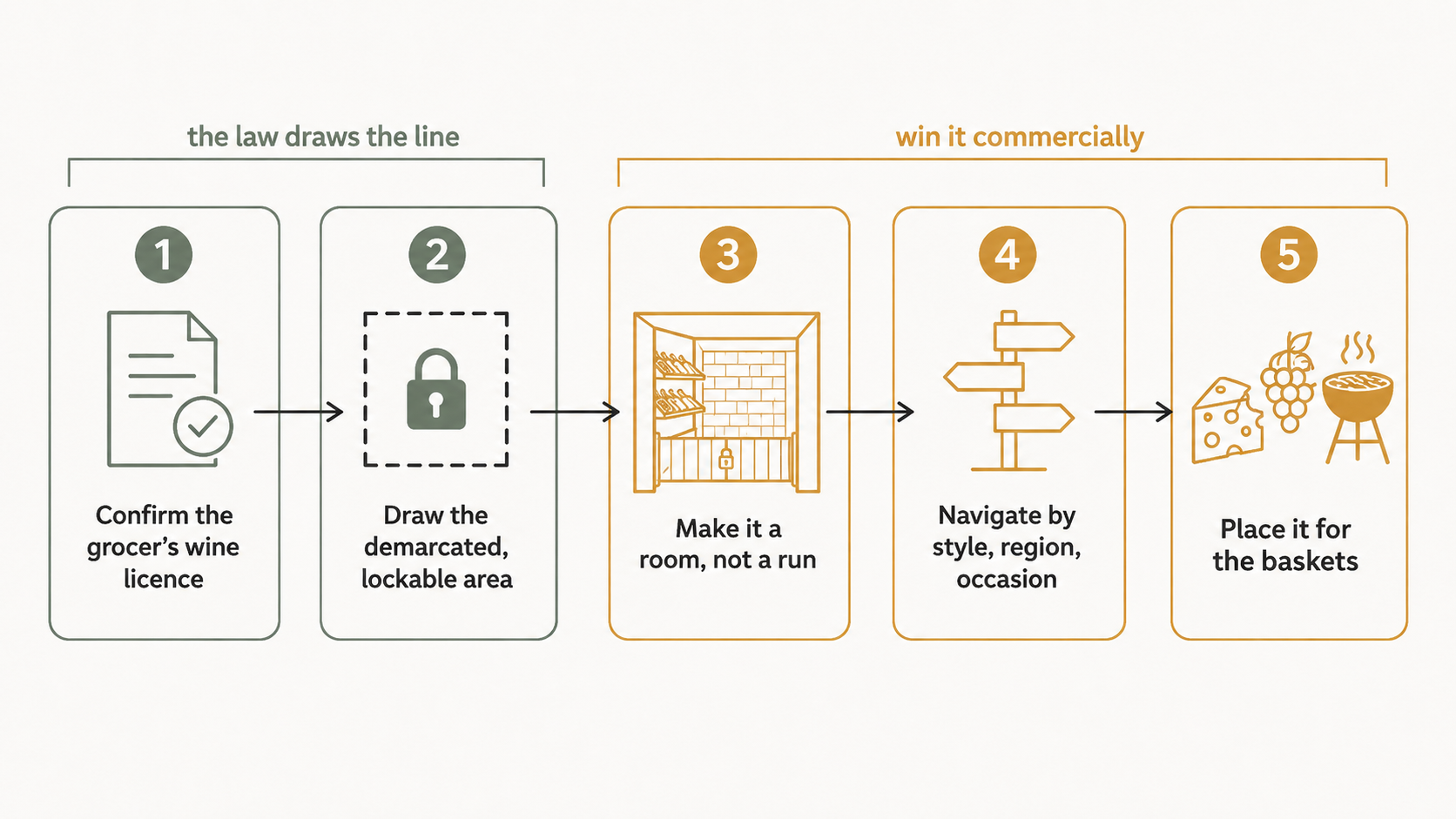
The order that keeps a wine department legal and commercial — confirm the licence and draw the lockable demarcation first, then win it as a room.
Before you place a fixture, confirm what the grocer's wine licence permits and requires for this store, in this province. The controlling conditions are consistent in principle: wine only; a demarcated area; that area closable and inaccessible outside permitted hours; and a dimensioned plan for the application. What varies — and what you must confirm rather than assume — is the detail: the permitted trading hours and days, any distance rules (proximity to a bottle store, a school or a place of worship), and the specific demarcation and closure the local authority will accept.
Get this confirmed early, with the provincial Liquor Authority and a licensing attorney, because it is the one department where an unconfirmed assumption can cost the store its right to trade. A layout that does not show a demarcated, lockable area can delay or refuse the licence — and a store that opens unable to legally sell wine has lost the department before it started. Draw the boundary and the closure in from the first line, and the licence design is a line on a plan. Retrofit them after the layout is issued, and you are re-demarcating and re-drawing a whole area late.
Turn the demarcation into a room, not a fenced-off run
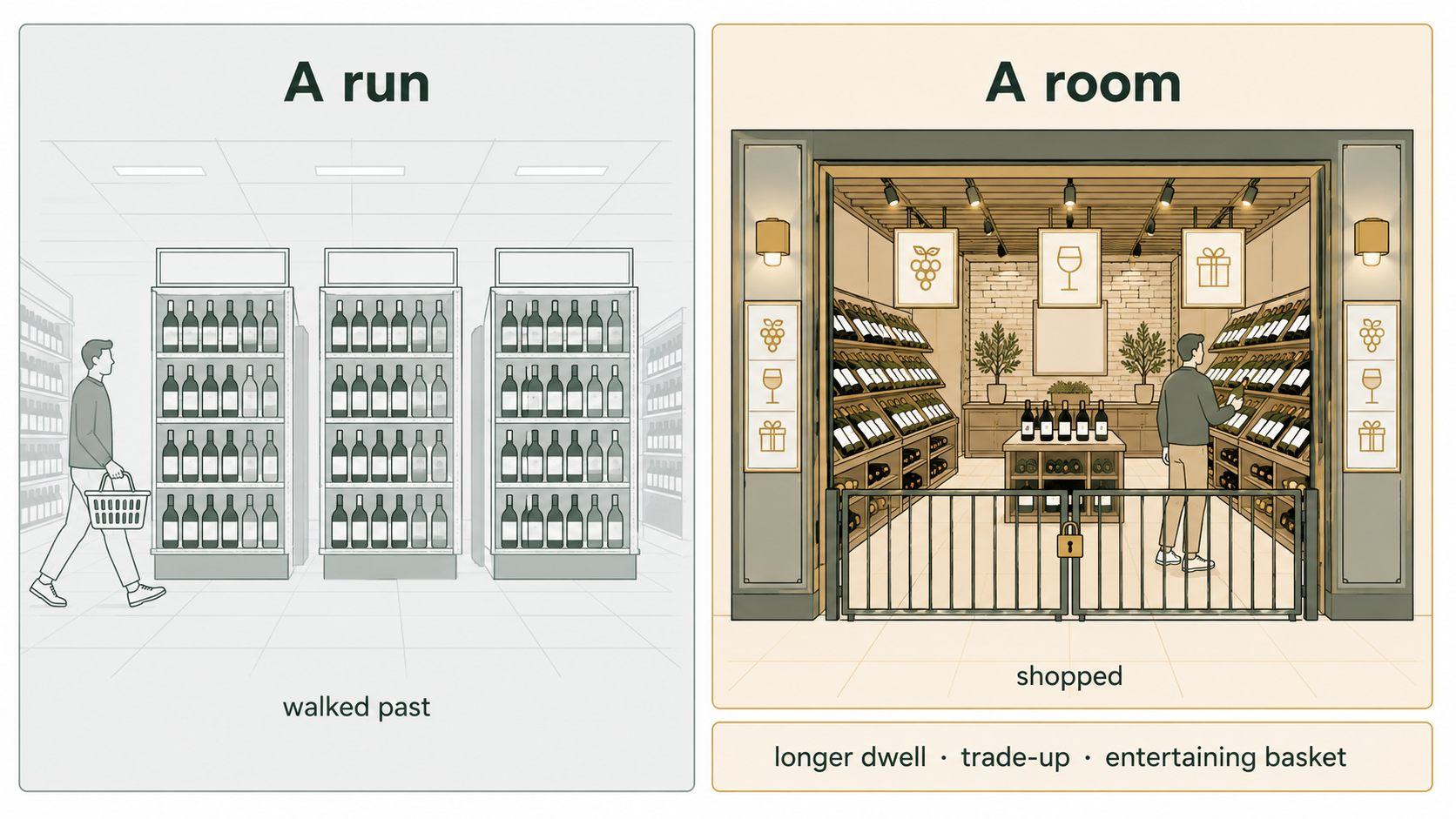
A run gets walked past; a room gets shopped — the same bottles earn more given a bounded space, longer dwell and a bigger entertaining basket.
The law makes you bound and close the wine area. That is exactly the boundary a good wine department wants anyway. So do not spend it on a stretch of the same grocery gondolas with a roller shutter bolted across the end. Spend it on a room.
A defined wine space with its own finishes — a different floor or ceiling treatment, warmer or more considered lighting, timber or a feature back wall, its own signage tone — signals quality and invites a browse the moment a shopper reaches it. It reads as a place that takes wine seriously, which in a wine-producing country is exactly the authority a supermarket wants to borrow. And because the room is bounded, the shopper who steps into it has left the weekly-shop mindset and entered a browse — which is where dwell, trade-up and the entertaining basket all live.
The closure the licence demands then does double duty: a lockable shutter or gate that seals the room after hours and on restricted days is the same boundary that gives the department its identity by day. The requirement becomes the design. That is the difference between wine as three more gondolas and wine as a room — and it is why the room earns more.
Match the ambition to the LSM — not every store wants a room
The room is the high-LSM case, and the exception is worth naming, because wine is one of the most LSM-dependent departments in the store. How much floor wine earns — and whether a room is the right call at all — follows the catchment's spending power. In a high-LSM store, wine can carry real depth: an estate ladder, a proper room with its own finishes, navigation by region and occasion. It pays for the space. In a low-LSM store the wine display is far smaller and the range shallower, and a full room may simply not be worth the floor or the spend. The licence still requires a demarcated, lockable area — that part never changes — but that area can be modest.
Where a room is not justified, change the navigation to match: merchandise by price. Give the shopper clear price bands — an entry tier, a middle, a step-up — so the ladder they actually shop is visible at a glance, rather than a region-and-occasion scheme built for a browse that a small display cannot support. The licence-first rule and protecting the stock do not change; what changes is the ambition and the way you help the shopper choose. Size the wine to the LSM, and in a lower-LSM store let price, not a room, do the navigating.
Navigate by style, region and occasion — not a wall of labels
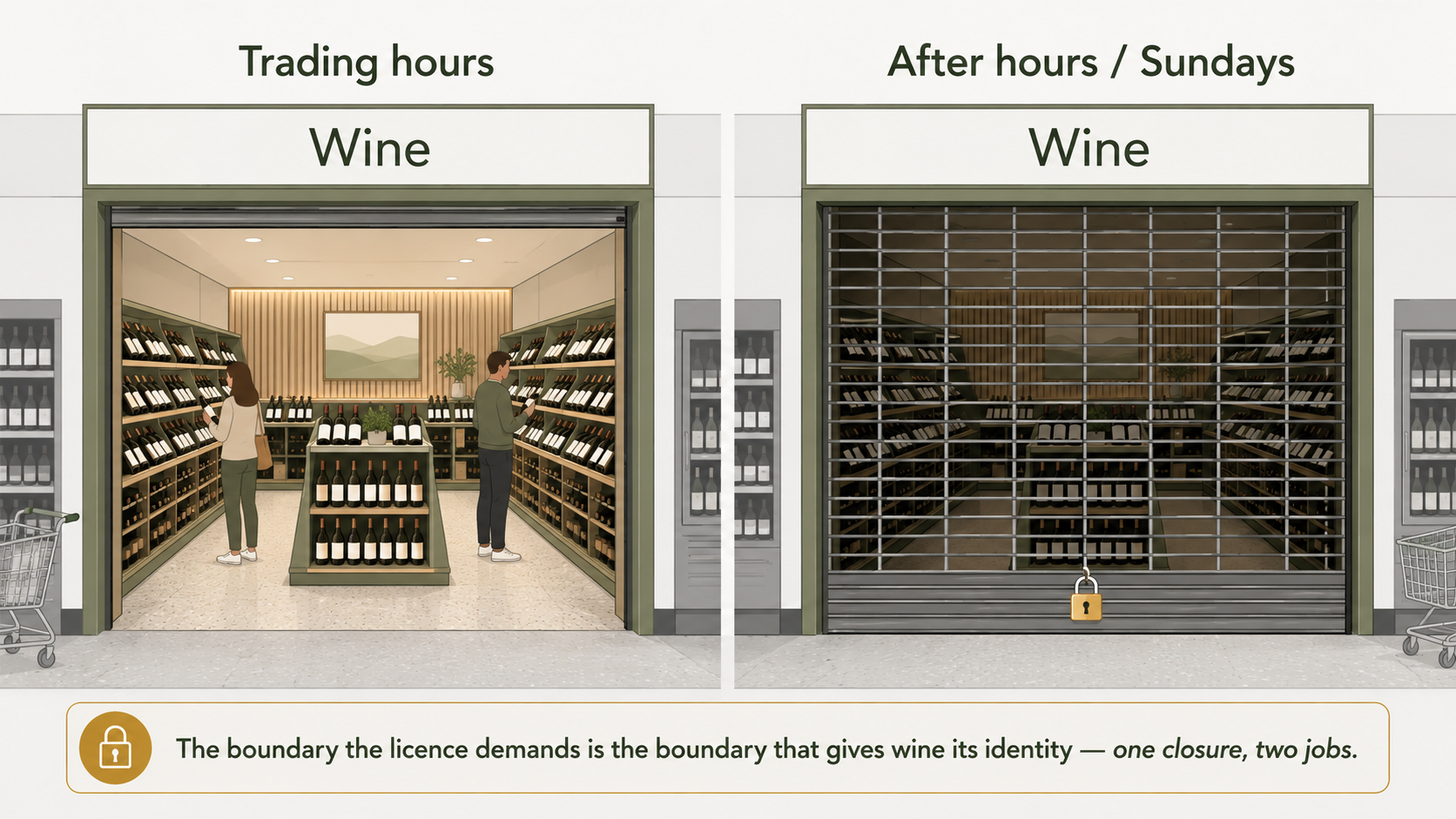
One closure, two jobs — the lockable boundary the grocer's wine licence demands after hours is the same boundary that gives the department its identity by day.
Inside the room, the enemy is a wall of labels a shopper cannot read. Wine over-faces people fast: hundreds of near-identical bottles, no way in. The department earns its dwell when the shopper can find their way by how they actually choose — by style (red, white, rosé, bubbles), by region or by occasion (the braai, the gift, the midweek bottle, the something-special). Clear, confident navigation with genuine wine-country authority beats an undifferentiated wall every time, and it is what lets a shopper trade up from the everyday bottle to the estate one, because they can now see the ladder.
This is signage and layout doing commercial work: it is the difference between a shopper grabbing the one label they recognise and leaving, and a shopper browsing the styles, finding the occasion and building a basket. In a smaller, lower-LSM display where price bands are carrying the navigation instead, the principle is the same — make the ladder the shopper actually climbs visible at a glance.
Place it for the baskets — inside a boundary that locks
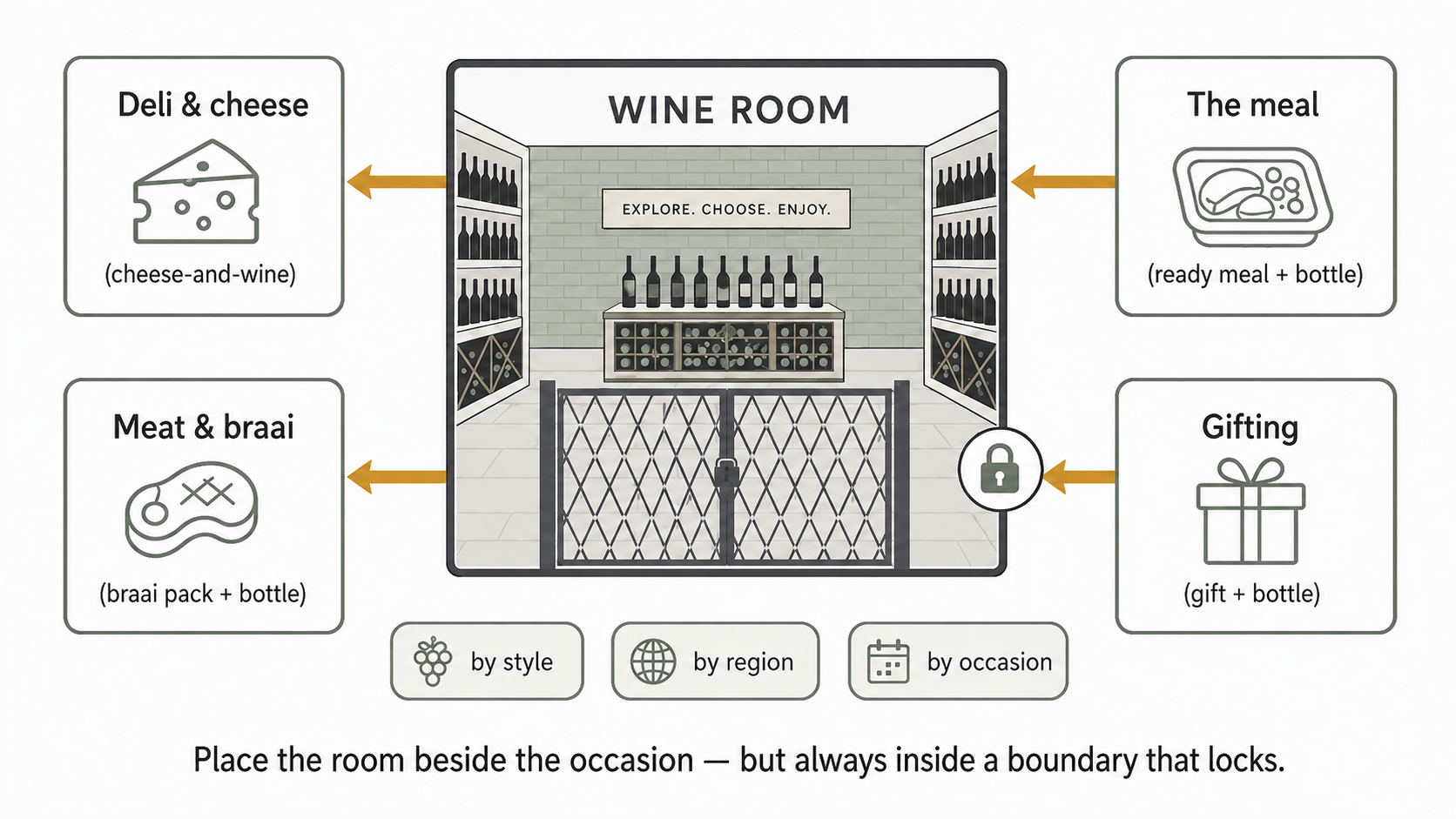
Wine completes an occasion — placed beside the cheese, the braai, the meal and gifting, it lifts the whole basket, all while staying inside a boundary that locks.
Wine does not sell in isolation, and it should not be planned in isolation. Its natural baskets are the cheese and the deli platter, the meat and the braai, the ready meal, and gifting — wine completes an occasion. So position the wine room to cross-sell with those departments: near the deli and cheese, within reach of the meat and braai lines, close enough to the meal that a shopper building supper or a get-together picks up the bottle without a special trip. Keep the controlled sale point — the till that enforces age — where it suits the front-end and the room's single supervised exit.
The one non-negotiable running through all of it: the whole area stays inside a boundary that can be closed off after hours. Place wine for the cheese-and-wine and the braai basket, but never at the cost of a demarcation that cannot be sealed shut when the licence says it must be. The good news is that a well-planned room does both at once — it sits beside the baskets it pullsand closes in one move at the end of the day.
Protect the stock — cool, low-light and in sightline
Wine is damaged by heat and light, and it is a theft target at the premium end. Both are design decisions. Keep the room out of direct sun and away from heat sources, and light it with cool, low-UV, low-heat lighting that renders the bottle honestly without cooking the whites and the bubbles under a hot downlight. Where the store chills white, rosé and Cap Classique for the grab-and-go occasion, that chilled case follows the shared refrigeration standards like any other cabinet — placed so it holds temperature rather than fighting the room.
Security is the other half. The premium and estate lines — the ones that carry the trade-up margin — belong in sightline or secured, never tucked out of any supervised view where they can walk. A single controlled sale point, a supervised room and covered receiving keep the high-value stock and the compliance both under control. Design the sightline in; do not rely on catching it later.
Judge it on margin after shrink, not gross on a bottle
Wine is a low-labour, low-energy department — it is packaged retail, not a production counter, so there is no cook line, no extract, no heavy staffing. What it is judged on is margin after shrink, and its shrink has two main causes, both of them design and range decisions rather than bad luck: breakage (glass handled and displayed carelessly) and slow-moving lines (range depth that outruns the catchment's actual demand). Plan the handling and the display to limit breakage, range the premium depth to what the catchment will genuinely buy, and the after-shrink margin holds. Over-range the estate wall for an LSM that will not support it and the slow lines quietly eat the department's profit.
The takeaway
Take one thing to your next wine drawing: confirm the grocer's wine licence conditions — the demarcation, the lockable closure and the dimensioned plan — with the provincial authority and a licensing attorney before the layout is frozen, and design that legally-required boundary as a room, not a fenced-off gondola run. The navigation, the signage and the finishes can all be revised at a cost. A wine area that cannot be sealed shut when the licence demands it, or a plan that does not show the demarcation the application needs, can cost the store its right to trade — and that is the one wine mistake there is no cheap fix for.
[CTA block]
Planning or replanning a wine department? A layout review will tell you whether the demarcation and lockable closure the grocer's wine licence needs are actually on the plan, whether the room is placed for the entertaining basket, and whether the stock is protected from heat, light and theft — before anything is drawn for approval. Start with a layout review or get in touch.
1. How do you plan a supermarket wine department?
Plan it from the licence forwards, then win it as a room. In South Africa a supermarket sells wine, and only wine, under a grocer's wine licence, so the first decisions are legal ones: the wine must be sold from a demarcated area, that area must be able to close shut and become inaccessible to the public outside permitted hours, and the licence application needs a dimensioned floor plan showing it — with the exact hours, distances and conditions confirmed with the provincial Liquor Authority and a licensing attorney, because they vary by province and municipality. Once the licence conditions are confirmed, turn the demarcation the law requires into a bounded room with its own finishes and identity rather than a fenced-off run of grocery gondolas, navigate it by style, region and occasion, place it for the cheese, braai and meal baskets while keeping the whole area inside a boundary that locks, and protect the stock from heat, light and theft. Getting the licence and the lockable demarcation right first is what stops the department being redrawn late or the store's right to trade being put at risk.
2. What are the rules for selling wine in a South African supermarket?
A supermarket sells wine under a grocer's wine licence, and that licence has design-controlling conditions. Only natural wine may be sold — beer and spirits are not permitted under a grocer's wine licence and need a separate, licensed bottle store. The wine may be sold only from a designated, demarcated area, and that area must be able to be closed off and rendered inaccessible to the public outside permitted hours, meaning after hours and on Sundays or restricted trading days. The licence application requires a dimensioned floor plan showing the demarcated area. The trading hours and days, any distance rules such as proximity to a bottle store, school or place of worship, and the specific closure the authority will accept all vary by province and municipality, so every one of them is confirmed with the provincial Liquor Authority and a licensing attorney before the design is frozen. None of these is assumed — this is the one supermarket department where an unconfirmed assumption can cost the store its right to trade.
3. Is supermarket wine better as a separate room or on gondolas in the grocery run?
As a room. Wine on a standard gondola in the main grocery run gets walked past like tinned goods; wine given a bounded space with its own look and feel gets browsed. And the choice is not really a choice, because the grocer's wine licence already requires a demarcated area that can close shut after hours — the law forces a boundary either way. The commercial move is to spend that legally-required boundary on a proper room, with its own finishes, lighting and signage tone, rather than on a stretch of the same shelving with a shutter bolted across the end. A room signals quality and authority, which matters in a wine-producing country, and it holds shoppers longer. Longer dwell in wine is the chance to trade a shopper up from an everyday bottle to an estate one and to build the whole entertaining basket, not just sell a single bottle — which is why the room earns more than the run.
4. Does every supermarket need a wine room?
No — wine is one of the most LSM-dependent departments in the store, so the ambition has to match the catchment's spending power. In a high-LSM store, wine earns real depth and a full room with its own finishes, navigated by region and occasion, pays for the floor it takes. In a low-LSM store the wine display is far smaller and the range shallower, and a full room may not be worth the floor or the spend — the grocer's wine licence still requires a demarcated, lockable area, but that area can be modest. Where a room is not justified, change the navigation to suit: merchandise by price, giving clear price bands — an entry tier, a middle and a step-up — so the ladder the shopper actually shops is visible at a glance, rather than a region-and-occasion scheme built for a browse a small display cannot support. Size the wine to the LSM: let a room and occasion-led navigation do the work in a high-LSM store, and let price bands do it in a lower-LSM one.
5. Where should wine go in a supermarket layout?
Position the wine room to cross-sell with the departments whose baskets it completes — near the deli and cheese, within reach of the meat and braai lines, and close enough to the meal and gifting that a shopper putting together supper or a get-together picks up the bottle without a special trip. Wine completes an occasion, so it earns most when it sits beside the occasion. The controlled sale point that enforces age sits where it suits the front-end and the room's single supervised exit. The non-negotiable through all of it is that the whole area stays inside a boundary that can be closed off and locked after hours, as the grocer's wine licence requires — so place wine for the cheese-and-wine and braai baskets, but never at the cost of a demarcation that cannot be sealed shut. A well-planned room does both: it sits beside the baskets it pulls and closes in one move at the end of the day.
6. How should supermarket wine be stored and lit to avoid damage?
Keep it cool, out of direct sun and away from heat sources, and light it with cool, low-UV, low-heat lighting. Wine is damaged by heat and light, so the room must not sit in a sun-trap or under hot downlights that cook the whites and the Cap Classique while rendering the bottle. Lighting follows the shared GRD lighting standard — chosen to show the product honestly without heating or fading it. Where the store chills white, rosé or Cap Classique for the grab-and-go occasion, that chilled case follows the shared refrigeration standards and is placed so it holds temperature rather than fighting the room. Alongside the environment, plan the handling and display to limit breakage, because breakage is one of the two main causes of wine shrink and it is a handling and display decision, not bad luck.
7. How do you build a bigger basket with wine?
By merchandising wine as the completer of an occasion, not as an isolated category. Wine's natural baskets are cheese and the deli platter, meat and the braai, the ready meal, and gifting — so place the wine room near those departments and navigate it by occasion as well as by style and region, so a shopper building a get-together, a braai or a gift can see the bottle that finishes it. Cheese-and-wine is the clearest cross-merch in the store; the braai pack and the bottle to go with it is close behind. This costs no extra floor — it is a placement and navigation decision — and it is where wine stops being a single-bottle grab and starts lifting the whole entertaining basket, trading the shopper up from the everyday bottle to the estate one in the process.
8. How do you reduce shrink in a supermarket wine department?
Design out the two main causes: breakage and slow-moving lines, plus theft at the premium end. Breakage is a handling and display decision — plan the fixtures and the flow so glass is handled and merchandised carefully rather than knocked. Slow lines are a range decision — range the premium and estate depth to what the catchment will genuinely buy, because an estate wall built for an LSM that will not support it quietly eats the department's profit in stock that will not move. Theft is a sightline and security decision — keep the premium and estate lines, the ones carrying the trade-up margin, in sightline or secured, run a single controlled sale point that enforces age, and cover receiving. Wine is judged on margin after shrink, not on the gross margin of a single bottle, so controlling breakage, slow lines and theft by design is what protects the department's real profit.
