Supermarket Frozen Department Design: Why Frozen Should Not Feel Like the Dead End of the Store
The frozen department is often treated as a back-of-store necessity.
It gets freezer doors, category headers, stock depth and enough refrigeration to hold the range.
But in many supermarkets, the frozen department can do more commercial work than that.
Planned properly, it can support stock-up shopping, family value, quick meals, ready meals, pizza, frozen vegetables, frozen proteins, desserts, ice cream, premium ranges and plant-based products.
The problem starts when the frozen department is planned as refrigeration space first and a shopping mission second.
A frozen department works best when the shopper understands the range before opening the freezer door. That means the layout, category blocking, signage, door sequence, freezer case layout and adjacencies need to work together.
Poor frozen planning creates cold storage.
Good frozen planning creates a shopping mission.
The same product-first discipline applies across all refrigerated categories.
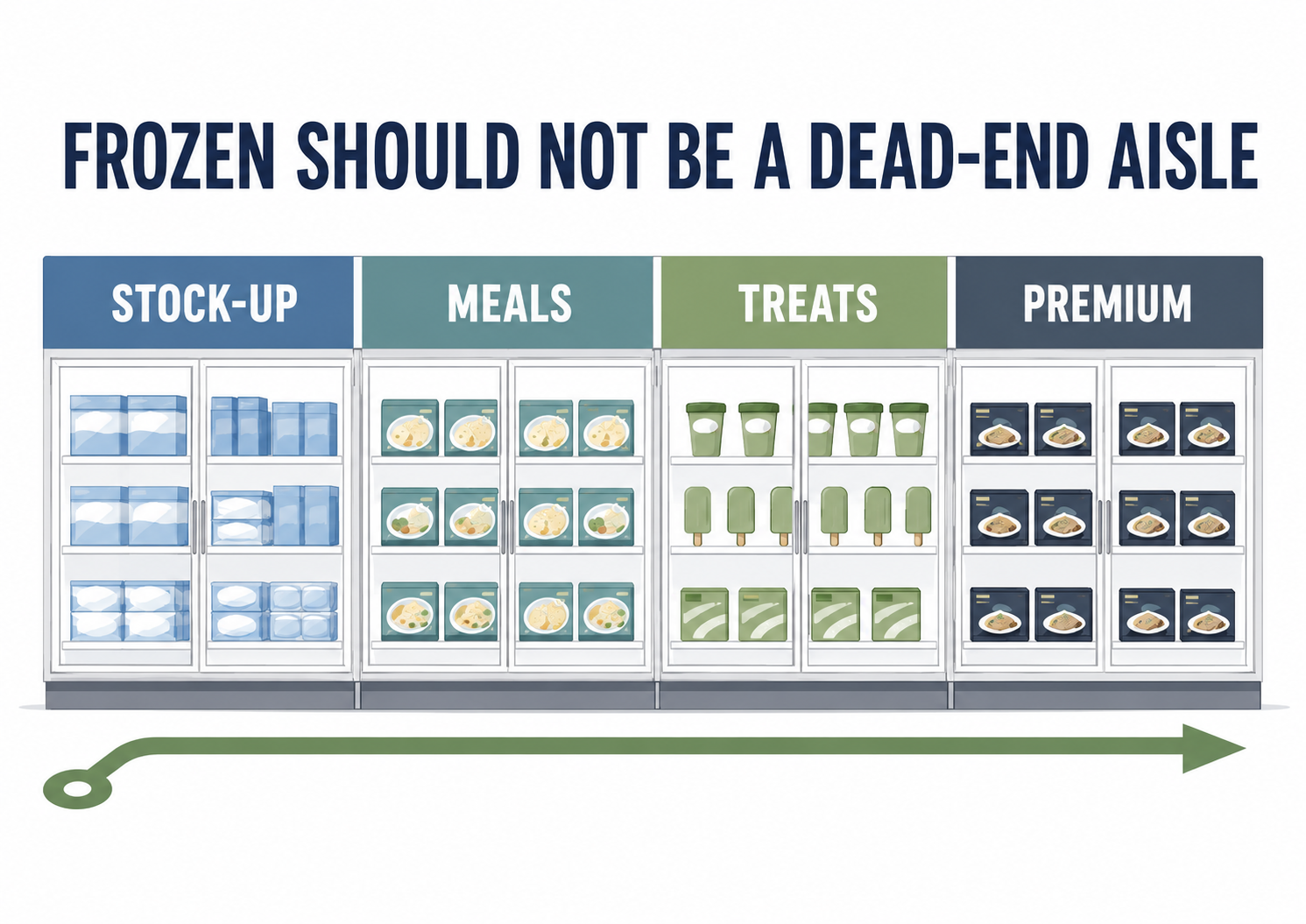
Frozen should be planned as a clear shopping zone, not just a wall of freezer doors.
Frozen Is Often Treated Too Functionally
The frozen department is easy to under-plan because it can look simple from the outside.
Freezer cases go against a wall. Products sit behind doors. There is usually no service counter, no visible preparation, no production theatre and no obvious staff interaction.
So the department often becomes a functional refrigeration zone.
That can be expensive.
A store may have enough freezer doors, but if meals, value packs and desserts are not clearly separated, the shopper still experiences the freezer layout as one cold wall.
The department may hold stock, but it does not help the shopper make decisions.
The common problems are practical:
Freezer cases are placed where space is available.
Categories are blocked around supplier logic instead of shopper logic.
Signage is too weak.
Door sequence is confusing.
Ready meals are hidden inside a generic frozen foods department.
Premium and value ranges are mixed without clear reason.
There is no visible link between frozen and the rest of the basket.
These are not only presentation issues.
They affect sales, shopper flow, add-on buying and return from the space. They can also lead to wasted capex if the wrong freezer layout is installed before the retailer has properly decided what the frozen department must do.
That is where supermarket layout planning needs to start earlier than the fixture decision.
Start With the Shopper Mission
The frozen department should not be planned only by product type, supplier grouping or freezer capacity.
It should be planned around how customers shop.
A useful frozen foods department usually has several shopper missions working at the same time.
Shopper mission - Frozen range examples - Planning implication
Stock-up: Vegetables, chips, proteins, bulk packs. Clear value blocking and trolley access.
Meal solution: Ready meals, pizza, quick dinners. Visible meal block and links to fresh sides.
Treat / impulse: Ice cream, desserts, seasonal products. Position where stopping and add-on buying make sense.
Premium / special diet: Plant-based, halaal-certified, gelato, premium meals. Clear separation and better visual control.
Planning principle:
The shopper should understand the frozen department before opening the freezer door.
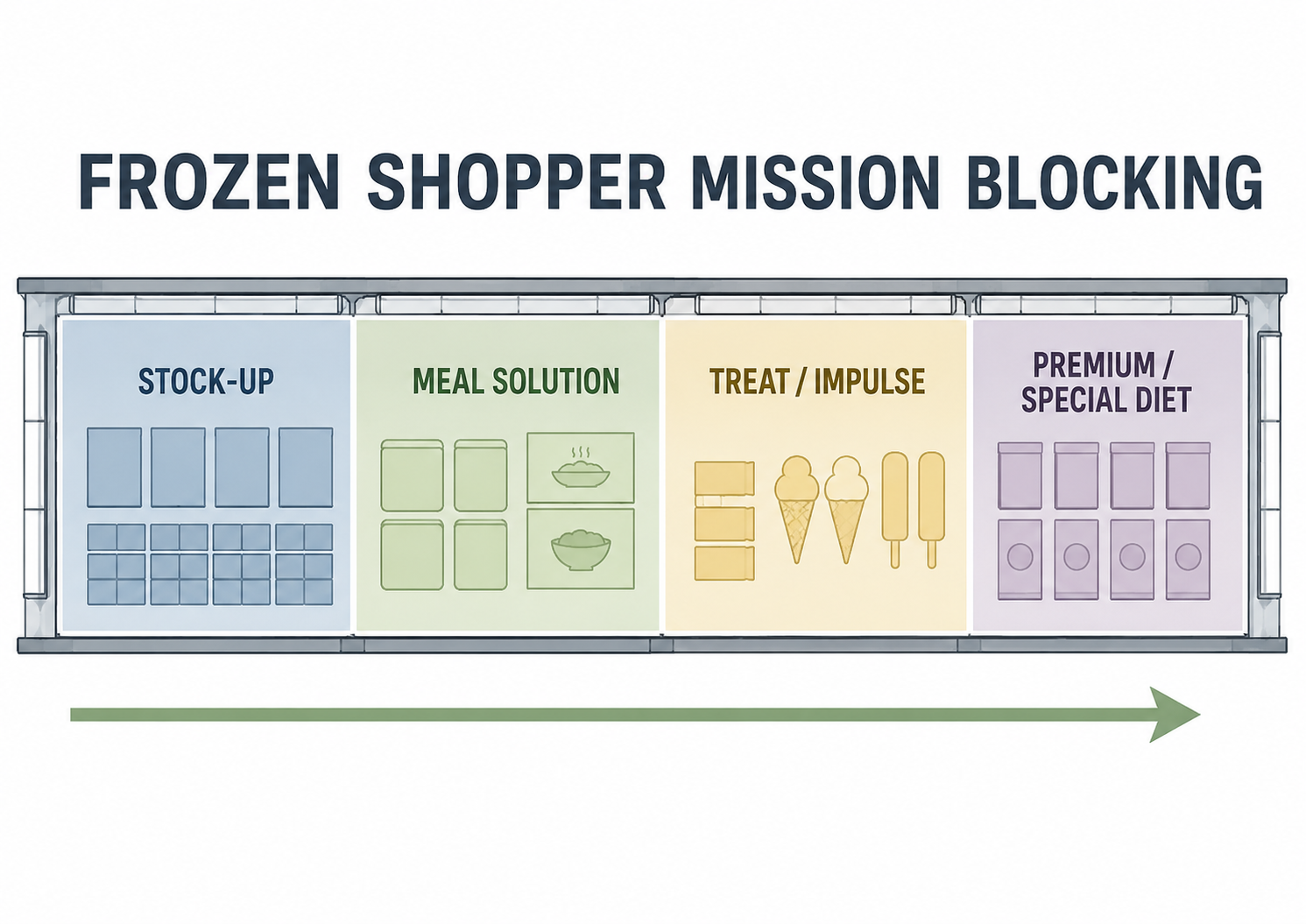
A frozen department is easier to shop when the main missions are clear before the freezer door opens.
That does not mean every frozen department must become large or premium.
A value-led store may need frozen to work hardest as a stock-up and family-value department.
A convenience-led store may need ready meals, pizza, frozen snacks and quick dinners to carry more weight.
A premium supermarket may need clearer space for desserts, speciality frozen, gelato, plant-based ranges and better-quality prepared meals.
The role of the department should decide the space, range, signage, case type and adjacency logic.
Freezer Doors Slow the Shopper Down
Freezer doors change how people shop.
With open shelving, shoppers can scan the range quickly. With freezer doors, the shopper first has to understand what is behind the door, then decide whether it is worth opening.
That creates decision friction.
The department should answer four questions quickly:
Where are the everyday staples?
Where are the meal solutions?
Where are the treats and desserts?
Where are the premium, special-diet or value ranges?
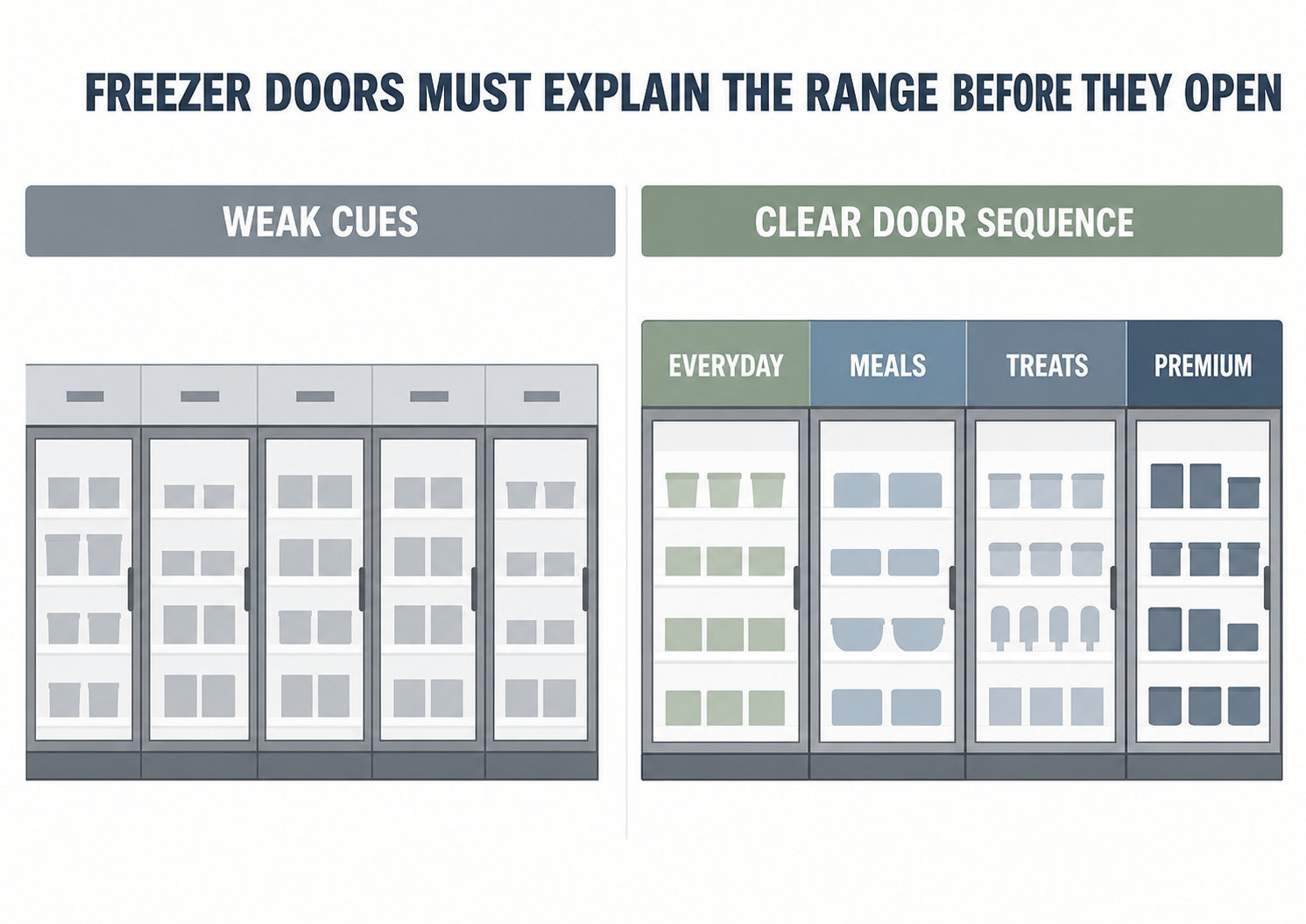
Clear category headers help the shopper understand the range before opening the freezer door.
If those answers are not visible from the aisle, the shopper has to work too hard.
Too many frozen departments look like a long wall of similar doors with weak category cues. That may be neat, but it is not always clear.
The signage needs to work before the door opens.
The blocking needs to make sense from left to right.
The value and premium ranges need clear separation.
Ready meals should be visible as a meal solution, not buried as another frozen sub-category.
The frozen department is already physically colder and slower to shop than many other departments. The planning should reduce shopper effort, not add to it.
Frozen Can Build the Basket
The strongest frozen departments do not only sell frozen products.
They help customers complete a basket.
This is the commercial centre of the department.
Ready meals can link to salads, fresh sides, sauces and bakery rolls.
Ice cream can link to desserts, bakery and seasonal occasions.
Frozen vegetables can link to proteins and family meal planning.
Frozen breakfast products can link to coffee, dairy and convenience missions.
Premium frozen can support trade-up shopping where the customer wants quality and convenience with less preparation time.
That is why the frozen department should not be separated from the rest of the store thinking.
A frozen pizza area may work harder when the shopper can easily add a salad, drink or dessert.
A frozen vegetable section may work harder when it supports meat, chicken, fish or family meal deals.
An ice cream range may work harder when it is linked to desserts, bakery occasions or seasonal shopping.
Ready meals may work harder when the wider store also supports prepared foods and meal solutions.
[Internal link placeholder: prepared foods and meal solutions → Prepared Foods blog article]
This affects basket size.
It affects shopper convenience.
It affects how much return the retailer gets from existing floor area.
The question is not only:
“What frozen range do we stock?”
The better question is:
“What job should the frozen department do in this store?”
In a value-led supermarket, frozen may need to support family stock-up.
In a convenience-led supermarket, it may need to support quick dinners and immediate meal decisions.
In a premium supermarket, it may need to support ready meals, desserts, speciality ranges and trade-up products.
In a neighbourhood supermarket, it may need to do several of these jobs, but with clear structure.
The danger is trying to make the frozen department do everything without giving the shopper a clear way to understand it.
When every frozen product is treated the same, the department becomes a cold wall of boxes.
When the missions are clear, the shopper can see why the department is worth stopping for.
The Operating System Still Has to Work
The frozen department can be commercial, but it cannot ignore operational control.
Frozen has practical consequences that cannot be fixed by signage or merchandising.
Freezer storage behind the sales floor should be close to the freezer cases.
The replenishment route should be short.
The cold chain must be protected between storage and display.
Cases should not be filled above the safe fill level inside the case.
Date-based stock rotation needs discipline.
Defrost water needs a planned drainage route.
Energy use needs to be considered before equipment decisions are locked in.
The freezer case layout should match the range, the store role and how the department will run.
This is where the frozen department becomes different from normal grocery shelving.
A weak grocery layout may create poor visibility or slow shopping.
A weak frozen layout can create stock loss, temperature problems, ice build-up, high running cost, defrost issues and rework during fit-out.
That is why frozen decisions should be resolved early.
The department affects services, drainage, refrigeration capacity, electrical loads, freezer storage behind the sales floor, maintenance access, pricing and fit-out coordination.
If these decisions are left too late, the project team may only discover the problem when pricing, coordination or site work has already started.
This is also why refrigeration decisions should not be separated from layout logic, and why working drawings and fit-out coordination work better when the main department decisions are already clear.
What to Check Before Redesigning Frozen
Before changing a frozen department, the retailer should not start with the number of freezer doors.
Start with the job the department must do.
A practical frozen department review should cover four areas.
1. Shopper Mission
Check whether the frozen department has a clear role in the store.
Is it mainly a support department for core staples?
Is it a mainstream frozen foods department with a full range?
Is it a destination area with premium, ethnic, plant-based, dessert or ready-meal ranges?
Which shopper missions should it support: stock-up, meal solution, treat, value, premium or special diet?
2. Door Sequence
Check whether the shopper can understand the department from the aisle.
Are the main categories easy to see before the door opens?
Does the left-to-right sequence make sense?
Are value, premium and meal-solution ranges clearly separated?
Are the most important categories visible in the strongest positions?
3. Basket Links
Check how frozen connects to the rest of the store.
Do ready meals link to salads, sides, sauces or bakery?
Do frozen vegetables support proteins and family meals?
Do ice cream and desserts connect to bakery, seasonal occasions or entertaining?
Do frozen breakfast products connect to coffee, dairy or convenience shopping?
The goal is not to force cross-merchandising everywhere. The goal is to make the strongest basket links easy for the shopper to understand.
4. Operating Control
Check whether the department can operate properly after the layout is approved.
Is the freezer storage close enough to the sales floor cases?
Is the replenishment route short and practical?
Are safe fill levels understood?
Is date-based stock rotation practical?
Has defrost drainage been planned?
Has energy use been considered early enough?
Are sales reviewed after waste, labour and energy costs?
Have the right decisions been made before layout, pricing and fit-out work begin?
This is where the information needed before starting a supermarket layout becomes important. Frozen should not be resolved only after the cases have been selected.
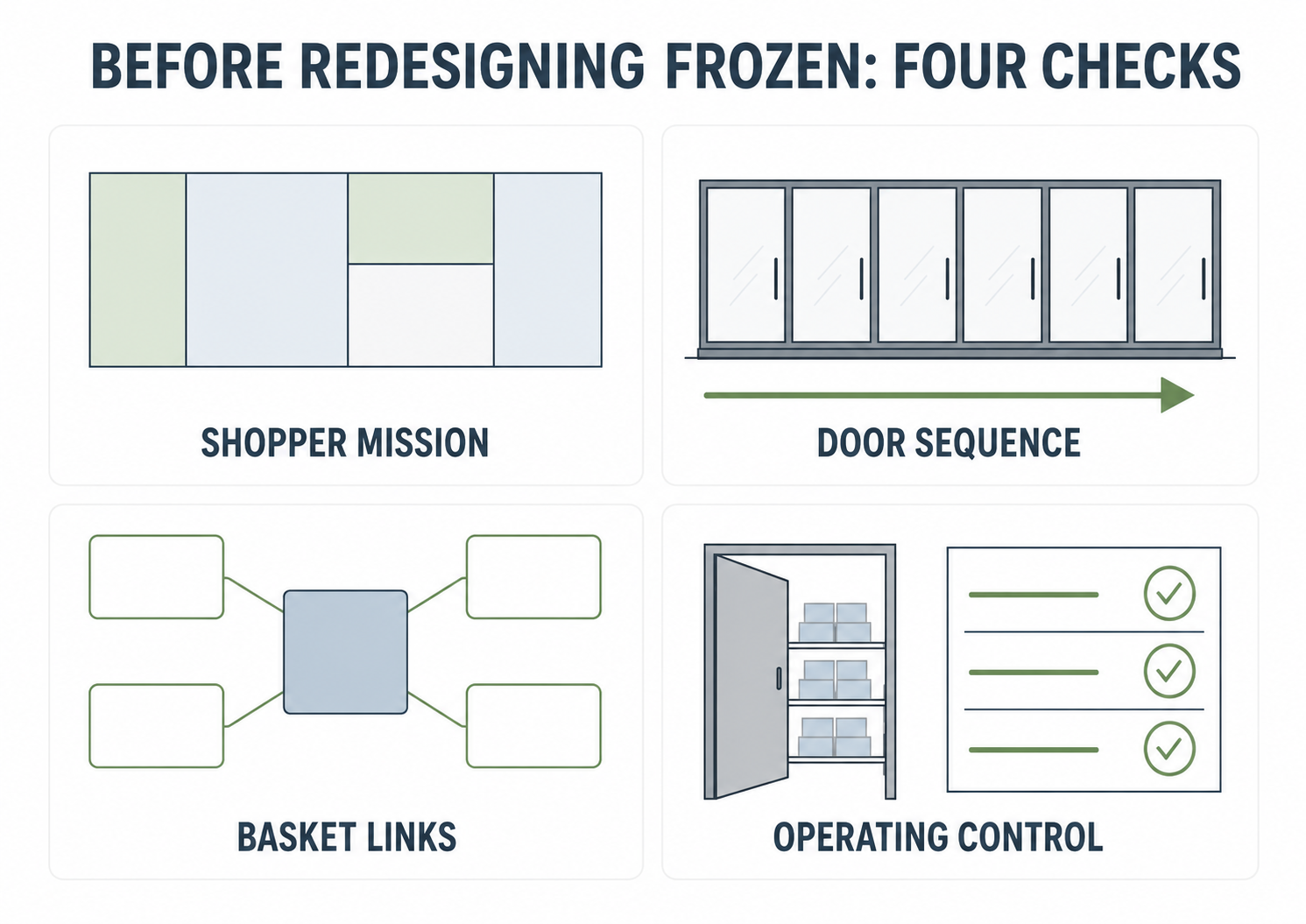
Before redesigning frozen, review the shopper mission, door sequence, basket links and operating control.
Frozen Should Not Be the Dead End of the Store
The frozen department should not feel like the dead end of the supermarket.
It should not be a long wall of doors that customers only visit for emergency stock, bulk packs or one familiar item.
A strong frozen department is clear, controlled and commercially useful.
It helps the shopper understand the range.
It supports value, convenience and meal planning.
It builds useful links to the rest of the basket.
It protects the cold chain behind the scenes.
Frozen may be one of the coldest departments in the store, but it should not be one of the least considered.
Good frozen department planning turns cold storage into a department that earns its place.
Planning a supermarket layout or reviewing an existing frozen department?
Before deciding how many freezer doors are needed, first decide what job the frozen department should do in the store.
The layout, signage, range blocking, basket links and operating support should all be clear before the department is fixed in pricing, working drawings or fit-out.
Grove Retail Design can help review these decisions before they become harder to change.
