Supermarket Prepared Foods Design: Why the Department Must Be Planned Before the Counter
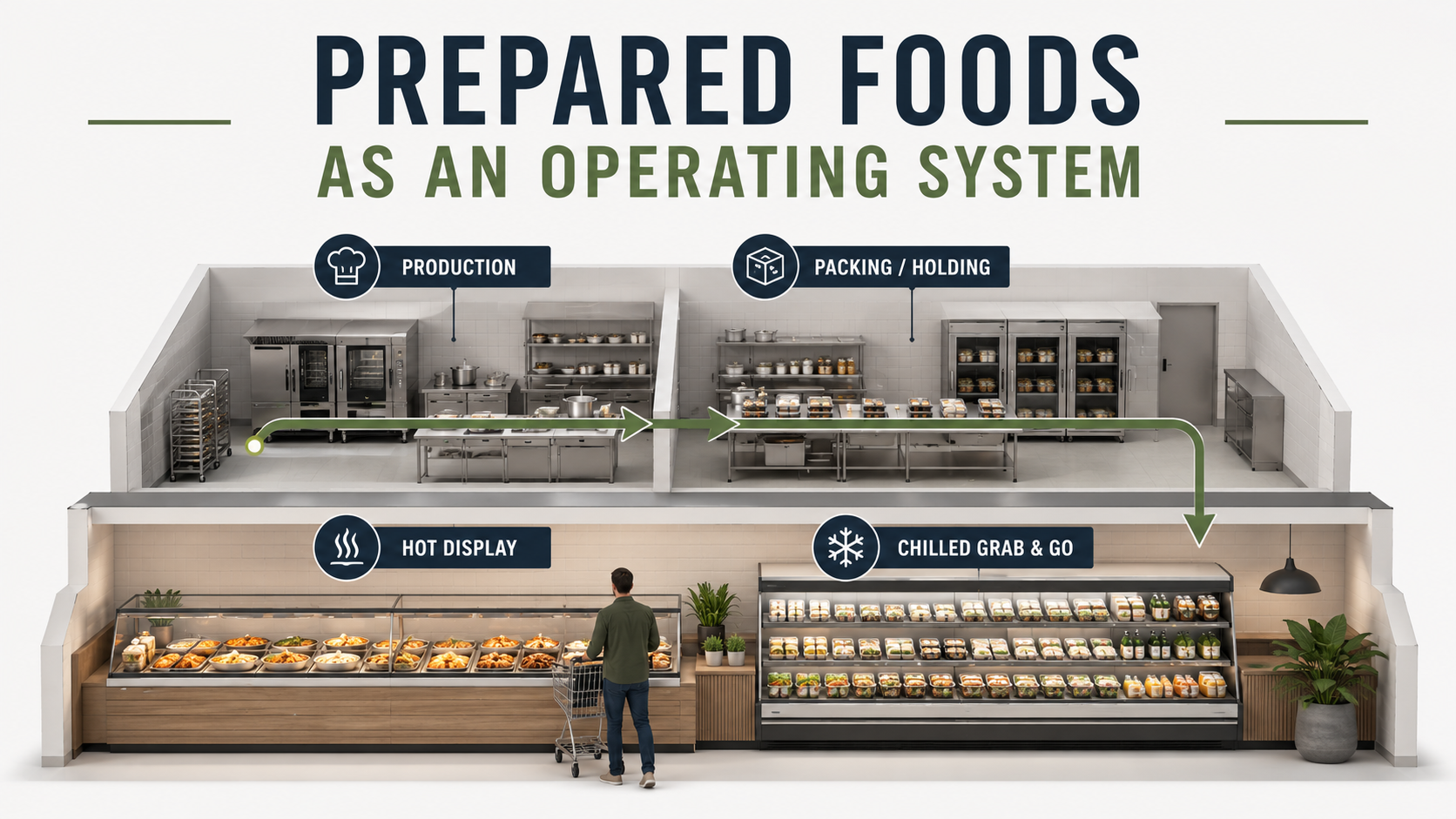
Prepared Foods should be planned as a full operating system, not only as a customer-facing counter.
Good supermarket prepared foods design should start before the hot counter is drawn. The department needs to be planned around the customer mission, product range, display method, service model, production rhythm and back-of-house support.
Prepared Foods can become one of the strongest departments in a supermarket.
It can create daily traffic. It can support lunch and dinner missions. It can help customers solve a meal problem quickly. It can increase basket size. It can also make a supermarket feel more active, more useful and more relevant to the local catchment.
This article is written for supermarket owners, independent food retailers, developers and project teams reviewing a Prepared Foods, Kitchen, Hot Food or Ready Meals department before layout approval.
But it can also become one of the most expensive departments to operate badly.
The problem is often not the counter design alone.
The problem is that the department has been planned as a counter instead of as a complete operating system.
A supermarket Prepared Foods department is not just a hot-food counter. It is a small food-production, foodservice and retail selling system inside the store. It must connect customer demand, product range, production, holding, packaging, display, service model, signage, lighting, labour, cleaning, maintenance and capex. This is why supermarket layout and department planning should be resolved before the department is treated as a finished counter design.
When those parts are not planned together, the department may look good on opening day but fail in daily trade.
Quick answer: A Prepared Foods department should be planned as a supermarket kitchen layout, customer-facing foodservice point and retail display department at the same time. The counter should be the result of the operating logic, not the starting point.
Why a supermarket Prepared Foods department is different from normal categories
Most supermarket departments are mainly retail display categories.
The product is bought, received, merchandised, replenished and sold.
Prepared Foods is different.
It combines three operating worlds:
Operating world: What it means in Prepared Foods. Why it matters. RetailCustomers must see, understand, compare and buy the offer. Poor visibility, weak signage or confusing layout can kill sales even when the food is good. Foodservice: Food may be served, portioned, packed or handed over by staff. Queueing, labour, service speed and customer trust affect conversion. Production Food is prepared, cooked, held, packed, cleaned and replenished. Weak back-of-house support creates daily operational failure.
This is why Prepared Foods cannot be designed as a normal display department.
The department may need to handle roast chicken, fried chicken, curries, rice, pap, stews, vegetables, soups, pies, sandwiches, wraps, salads, chilled ready meals, family trays, platters and sauces.
Not every store should sell all of these.
The range must match the customer, the catchment, the labour available, the equipment, the storage, the display capacity and the shrink-control discipline.
A broad range can look attractive on paper. It can become expensive if the operation cannot produce it, hold it, display it and sell it reliably.
Supermarket hot food counter design should not start with the counter
Many Prepared Foods departments are designed from the front backwards.
A counter is drawn.
Equipment is fitted behind it.
A menu is added later.
Signage is added when the department is almost built.
Operations are then expected to make the layout work.
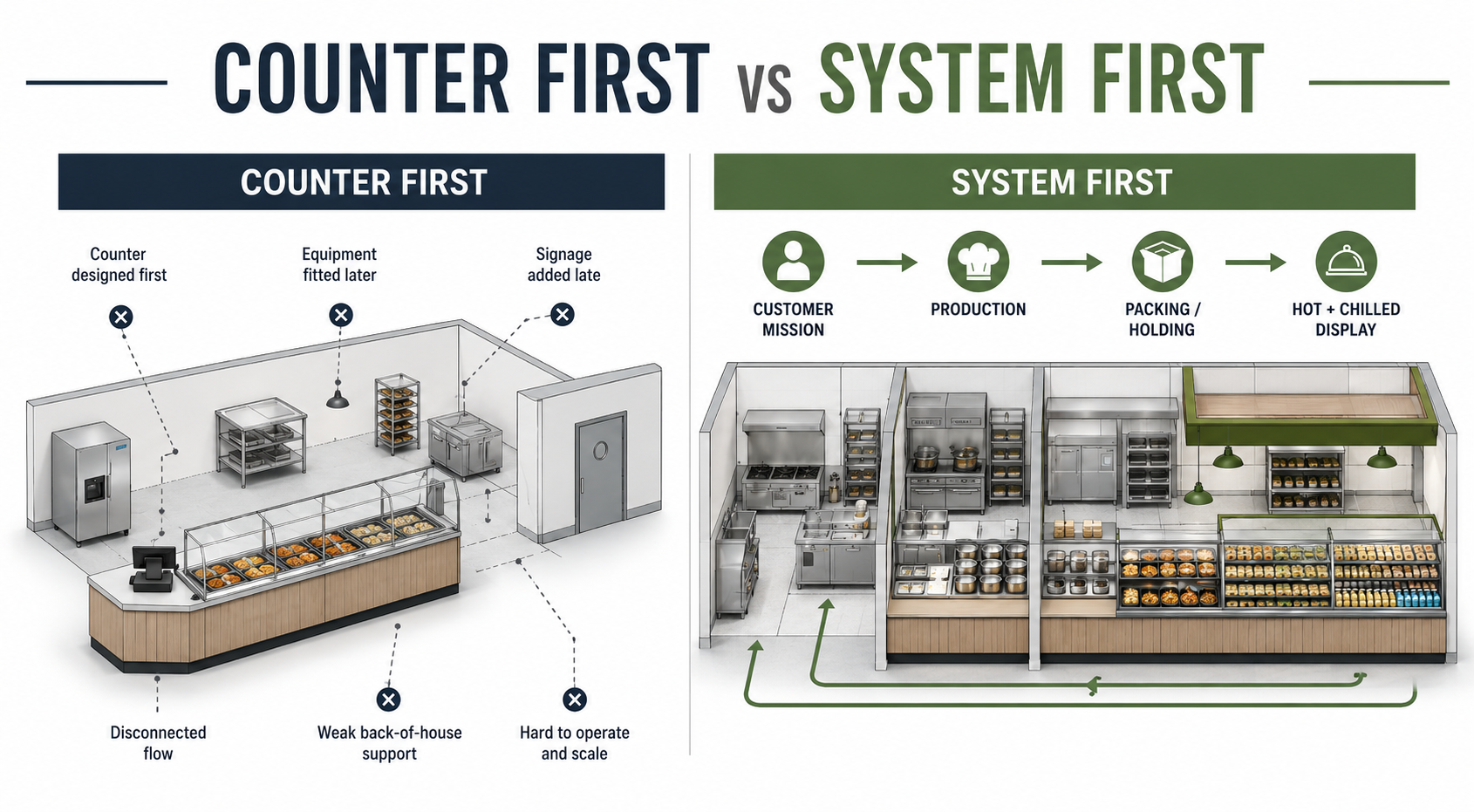
The counter should be the result of the operating logic, not the starting point.
That is the wrong sequence.
Before the counter is designed, the owner should be clear on the commercial role of the department.
Is it a support department?
Is it a meal-solution department?
Or is it a destination department?
Each answer leads to a different design.
Support department, meal-solution department or destination department?
A support department adds convenience to the normal grocery trip.
It may suit a lower-volume store, a store with limited lunch trade, or a supermarket where the core offer is roast chicken, basic hot meals and a small amount of grab-and-go food. It should be compact, visible, easy to operate and not overbuilt.
A meal-solution department goes further.
It helps the customer build lunch, dinner or a family meal. It may connect hot proteins with sides, chilled ready meals, salads, rolls, drinks and desserts. This type of department must be planned around basket building, not only individual product sales.
A destination department is a stronger investment.
It may be justified where there is proven lunch trade, strong roast chicken demand, office or commuter traffic, weekend family meal demand, cultural food demand or a premium chilled ready-meal opportunity.
The risk is overbuilding the front of the department without enough production, holding, packing, cleaning and labour support behind it.
The owner should not approve destination-level capex unless the demand, staff skill and operating capacity support it.
If customers will eat in store, check the supermarket seating area before the counter position is fixed
Design the supermarket kitchen layout around the customer mission
Prepared Foods does not serve one customer mission.
The same department may need to serve:
breakfast
lunch
dinner replacement
value meals
immediate snacks
premium convenience
planned meals for later
family top-up meals
catering and platters
Each mission changes the layout.
A lunch customer usually wants speed. They need clear product blocking, visible prices, fast service, grab-and-go options and a queue that does not block the main aisle.
A dinner customer may want a complete meal. They need to see mains, sides, salads, rolls, sauces, drinks and desserts as part of one buying logic.
A family customer may need larger packs, trolley space, clear meal deals and packaging that can carry food home properly.
A premium convenience customer may look for better packaging, clear labels, freshness cues, ingredient confidence and a calmer buying experience.
A commuter customer may want a fast hot meal or a packed item they can buy with minimal waiting.
This is where department planning links directly to commercial return.
Prepared Foods should not only sell food. It should support the shopper’s mission and help build the basket.
If the meal is scattered across the store, the customer may buy only the main item. If the department is planned properly, the customer can move from chicken to sides, from hot food to salads, from ready meals to desserts, from lunch to drinks, and from family packs to bakery or grocery add-ons.
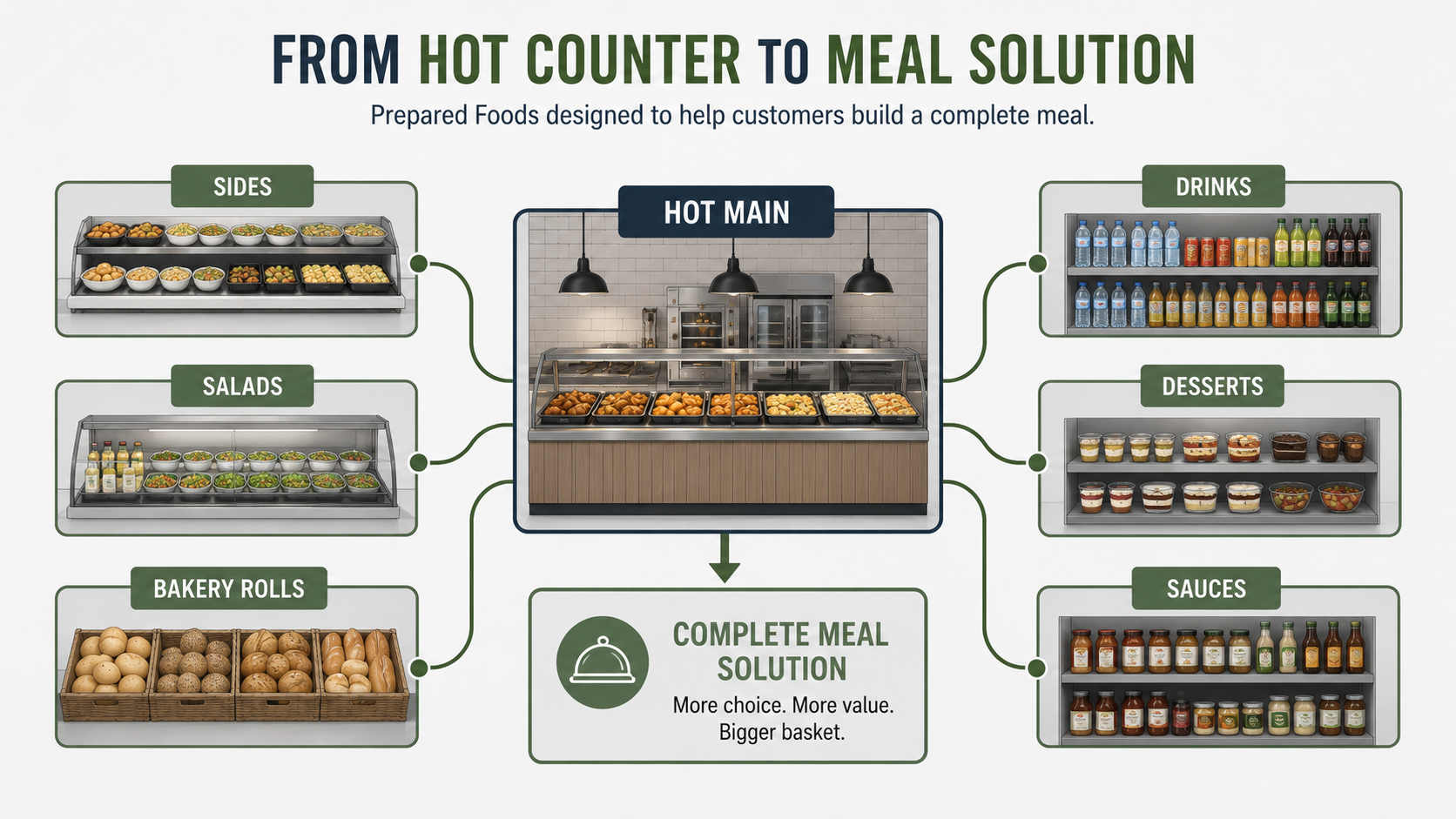
Prepared Foods can build the basket when mains, sides and meal add-ons are planned as one customer mission.
Product range must come before kitchen equipment
The product range decides the department.
Equipment does not decide the department.
A store selling roast chicken, fried chicken, rice, pap, curry and value meals needs a different system from a store selling premium salads, wraps, chilled ready meals and platters.
Range affects:
prep space
cooking equipment
hot holding
chilled holding
freezer storage
packing and labelling
display method
service model
staff skill
cleaning
shrink
services
capex
The danger is starting with a standard equipment list or copying another store’s layout. This is one reason many back-of-house planning failures only become visible after the department starts trading.
That may ignore the local customer, the trading volume, the service model, the production rhythm and the available labour.
A better method is to classify the range first:
Range layerMeaningDesign responseCore rangeProducts expected every day and central to sales.Must drive equipment, display, labour and storage.Flexible rangeSeasonal, promotional or rotating items.Should use existing systems where possible.Trial rangeProducts being tested before permanent investment.Should not drive permanent capex too early.
This protects the store from buying specialist equipment for unproven products.
It also helps avoid range creep.
Range creep is common in Prepared Foods. The department starts with a few clear products, then slowly becomes a kitchen, deli, takeaway counter, salad bar, chilled meal producer and catering service at the same time.
That may be possible in some stores. But only if the back-of-house, staff, storage, holding, packaging, display and cleaning systems grow with the range.
Hot, chilled and frozen Prepared Foods displays serve different purposes
Display method is not just a cabinet choice.
It is a commercial and operational decision.
Hot display sells immediacy. It works when the customer wants food now and when the product turns quickly enough to stay fresh-looking.
Chilled display supports grab-and-go, ready meals, salads, sandwiches, wraps, fruit pots, desserts, platters and heat-and-eat meals. It allows customers to buy prepared food without joining a hot-food queue. This also needs proper refrigeration and chilled display planning, because the cabinet is only one part of the system.
Frozen display can support planned convenience, batch production, longer selling life and waste control. It can work for soups, sauces, ready meals, pies and family meal components.
Each method has a different weakness.
Hot food can deteriorate visibly. Chicken dries out. Fried food softens. Rice clumps. Pap skins over. Curry oil separates. Vegetables lose colour. A long hot counter may look impressive when full, but become a shrink problem if turnover is too slow.
Chilled food depends heavily on packaging, labelling, date control, rotation and display visibility. A chilled cabinet near the kitchen is not enough. The packing, labelling and replenishment system behind it must also be planned.
Frozen prepared meals can disappear into a generic freezer aisle if the meal-solution identity is not clear.
The question is not: “Which cabinet do we have space for?”
The question is: “Which display method suits the product, the mission, the holding life and the expected turnover?”
The Prepared Foods selling model must be clear
The selling model decides how the customer physically receives the food.
A Prepared Foods department may use:
serviced counter
assisted self-service
self-service hot display
chilled grab-and-go
pre-packed hot meals
order-and-collect
hybrid model
These are not styling choices. They are operating systems.
A serviced counter gives portion control and staff interaction, but it creates labour and queue pressure.
Chilled grab-and-go reduces counter pressure, but it shifts labour into preparation, packing, labelling and rotation.
Assisted self-service can work well in many supermarkets because customers can see the food and choose quickly, while staff still control portioning, hygiene, packaging and display condition.
Order-and-collect may suit platters, family trays and weekend meals, but it needs an order point, staging space, holding space and a collection process.
Most strong Prepared Foods departments are hybrid.
For example:
hot meals may be assisted service
roast chicken may be sold from a hot merchandiser or served counter
sandwiches and salads may be chilled grab-and-go
chilled ready meals may be self-service packed
family trays may be order-and-collect
The danger is customer confusion.
Each route must be clear. Customers should understand where to order, where to collect, what is self-service, what is staff-served, where to pay and how to avoid joining the wrong queue.
Prepared Foods production rhythm must be tested through the day
Prepared Foods is not static.
A department that looks correct at 10:00 can fail at 12:30 or 17:30.
The layout must support the full operating day:
early receiving and preparation
breakfast
pre-lunch build-up
lunch peak
afternoon reset
dinner replacement
closing, markdown and waste
weekend, month-end and festive peaks
Hot display should not depend on one large opening batch. In many cases, better control comes from production waves: smaller replenishment cycles that keep product fresher and reduce tired display.
But production waves need support.
They require cooking capacity, hot holding, staff routes, trolley space and timing discipline.
Chilled grab-and-go has a different rhythm. It shifts work into early production, packing, labelling, date control, chilled staging, replenishment and markdown.
The owner should ask whether the plan has been tested against the difficult moments, not only the quiet ones.
Lunch peak must be physically tested.
Dinner replenishment must be planned.
Closing, waste, dirty return and cleaning must be shown.
Back-of-house planning decides whether the front can perform
A strong counter with weak back-of-house support is a common Prepared Foods failure.
The front may look good, but the operation behind it cannot keep up.
Common missing support areas include:
cold storage
freezer storage
dry ingredients
packaging storage
raw prep
vegetable or salad prep
cooking line
hot holding
chilled holding
packing and labelling
dirty landing
wash-up
waste holding
trolley parking
cleaning equipment storage
These areas are not optional details.
They decide whether the department can operate every day.
If the front has a long hot counter, chilled ready meals, sandwiches, family trays, platters and order-and-collect, then the back must have enough production, holding, packing, storage, wash-up, waste and staff movement to support it.
Do not sacrifice the back-of-house to make the counter longer.
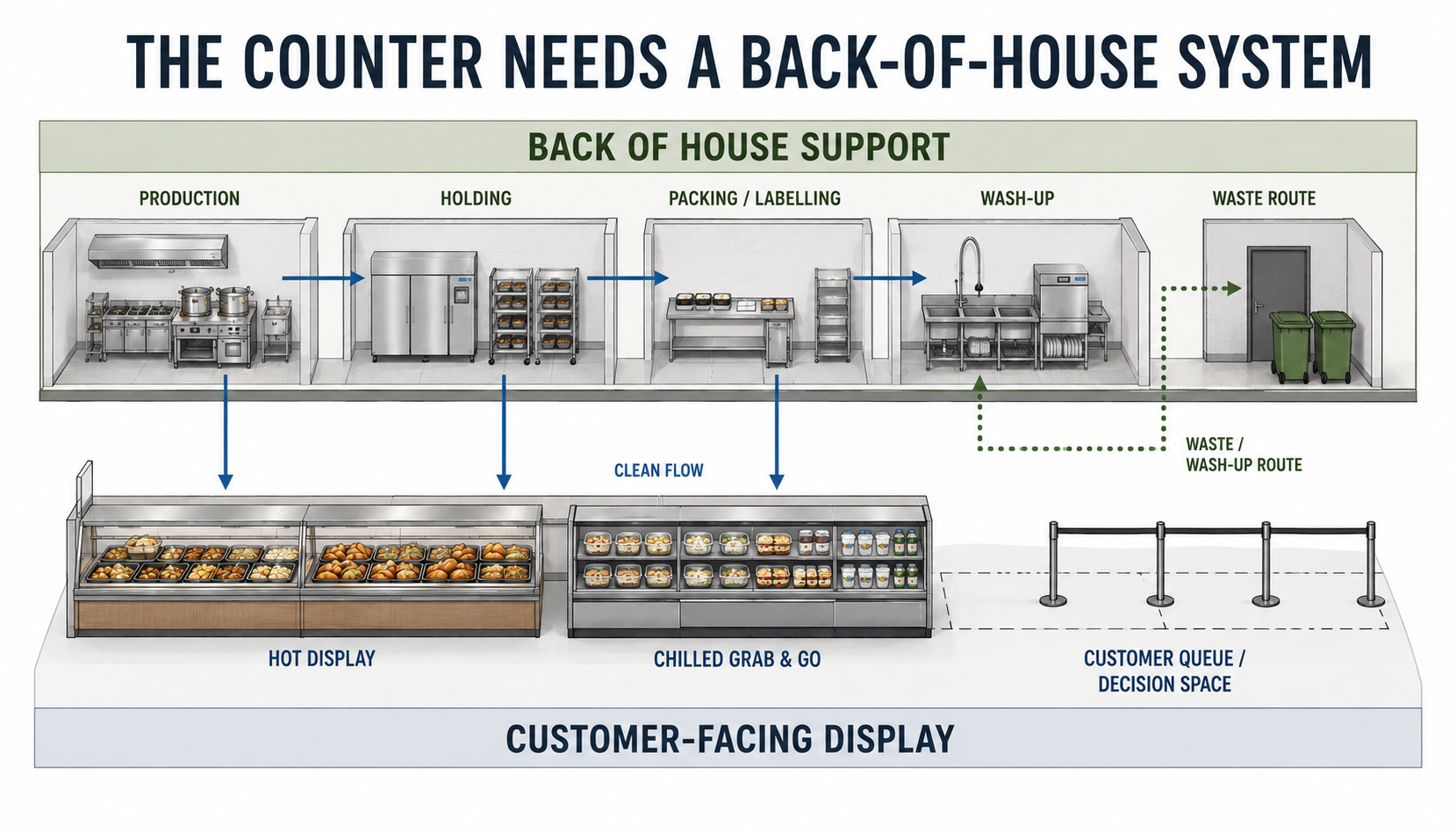
A longer counter will not improve performance if the back-of-house cannot support it. It may create more shrink, more labour pressure and a harder department to manage.
Signage, lighting and services coordination are not late details
Signage direction and customer communication in Prepared Foods is operational.
It must help the customer answer basic questions quickly:
What is available now?
Is it hot, chilled, frozen or ambient?
Is it ready to eat or heat at home?
What does it cost?
What portion am I buying?
Do I serve myself or ask staff?
Where do I order?
Where do I collect?
Where do I pay?
If signage is weak, customers hesitate, queues slow down and staff spend time answering the same questions.
Lighting is also not decoration. A practical supermarket lighting strategy should support both the selling face of the department and the production work behind it.
Prepared Foods lighting must support both food appeal and staff task work. The customer side must make food look fresh, clean and appetising. The production side must support safe preparation, packing, cleaning and inspection.
A simple ceiling grid rarely solves both.
Services must also be coordinated early.
Ovens, fryers, chilled cabinets, hot displays, label printers, digital menus, sinks, drains, extraction, gas, power, water, grease traps and refrigeration routes all affect the layout.
Writing “by specialist” on a drawing does not remove the need to coordinate space, routes and access.
If services are only checked after the counter is frozen, the project can inherit avoidable clashes, delays and rework. This is where working drawings and fit-out documentation need to carry the coordination logic forward, not just show attractive counters.
Checklist: questions to ask before approving a Prepared Foods layout
Before approving a supermarket Prepared Foods layout, the owner should be able to answer these questions:
What role must this department play in the store: support, meal-solution or destination?
Who is the main customer, and what are the top shopping missions?
What are the core products that must be available every day?
Which products are hot, chilled, frozen or ambient?
Which products are serviced, assisted, self-service, grab-and-go or order-and-collect?
Has the lunch queue been drawn, not imagined?
Can grab-and-go customers bypass the hot-food queue?
Can staff replenish hot and chilled displays without crossing customer queues?
Is there enough packing, labelling and packaging storage?
Is there enough hot holding and chilled staging?
Are dirty return, wash-up, waste and cleaning routes shown?
Are signage, lighting, drainage, extraction, power, data and maintenance access coordinated?
Can the department operate during lunch, dinner, weekend and closing pressure?
Does the capex follow evidence and operating capacity?
If these questions are not answered, the drawing is not ready to be frozen. For earlier project preparation, also read what information is needed before starting a supermarket layout.
Prepared Foods should be designed to trade, not just to open
A Prepared Foods department must look good on opening day.
But that is not enough.
It must work during lunch pressure. It must replenish properly before dinner. It must support chilled grab-and-go without creating waste. It must allow staff to pack, label, clean, wash, store, serve and maintain the department without fighting the layout every day.
The best Prepared Foods departments are not the most decorative.
They are the departments where the customer understands the offer, the staff can run the operation under pressure, the product looks fresh, the range matches demand, and the design protects the store from avoidable labour, shrink, hygiene, maintenance and capex problems.
Prepared Foods can be one of the strongest commercial departments in a supermarket.
But only if it is planned as a department that must perform.
Not only as a counter that must look good.
FAQ: supermarket Prepared Foods design
What is supermarket Prepared Foods design?
Supermarket Prepared Foods design is the planning of the customer-facing food offer, kitchen production area, hot and chilled display, service model, packing, storage, replenishment, cleaning and back-of-house support required to sell ready-to-eat or ready-to-heat food inside a supermarket.
What should be planned before a hot food counter is designed?
Before the hot food counter is designed, the owner should confirm the customer mission, product range, display method, service model, production rhythm, holding requirements, packing and labelling needs, back-of-house support, signage, lighting, services and maintenance access.
Why do supermarket Prepared Foods departments fail?
Many Prepared Foods departments fail because the counter is designed before the operation is understood. Common causes include wrong range, weak queue planning, insufficient hot holding, poor chilled display, no packing space, inadequate storage, weak signage, bad lighting, poor replenishment routes and back-of-house areas that cannot support the front offer.
Is chilled grab-and-go part of Prepared Foods design?
Yes. Chilled grab-and-go is often an important part of Prepared Foods design. It supports sandwiches, wraps, salads, chilled ready meals, desserts, fruit pots and heat-and-eat meals. It must be planned with packing, labelling, chilled staging, display visibility, rotation access and replenishment routes.
How does Prepared Foods design affect supermarket basket size?
Prepared Foods can increase basket size when it is planned around meal missions. Hot mains, sides, salads, bakery rolls, drinks, desserts, sauces and chilled ready meals should be positioned and communicated so customers can build a complete meal instead of buying only one item.
When should a supermarket owner review the Prepared Foods layout?
The Prepared Foods layout should be reviewed before layout freeze, equipment selection, services coordination, pricing, working drawings or fit-out. Once counters, drainage, extraction, refrigeration and services are fixed, the cost of correction increases.
Suggested closing CTA
Planning a new supermarket, upgrading a Prepared Foods department, or reviewing a layout before approval?
Grove Retail Design helps food retailers think through supermarket prepared foods design, supermarket layout, department planning, customer flow, back-of-house support, working drawings and practical project coordination before costly decisions are locked in.
Contact Grove Retail Design to review your supermarket layout or Prepared Foods department planning.
