How Supermarkets Can Turn the Spice Section Into a Meal-Planning Department
Most spice sections are underused
Most supermarket spice sections are treated as stock modules.
They are ranged, replenished and faced, but they are rarely used as proper commercial departments.
The result is a dead wall of packets, jars and sachets. The shopper may find what they came for, but the department does very little to help them decide what to cook next.
That is a missed opportunity.
Spices are physically small, but they influence much larger parts of the basket. A shopper who buys curry powder may also buy chicken, rice, potatoes, onions, tomatoes, coriander, garlic and ginger. A shopper who buys Italian herbs may also buy pasta, tomato products, mince, cheese and fresh basil.
The spice item may be small. The meal basket it triggers can be much larger.
That is why the spice section should not be seen only as a dry grocery aisle. In the right supermarket, it can become a meal-planning department.
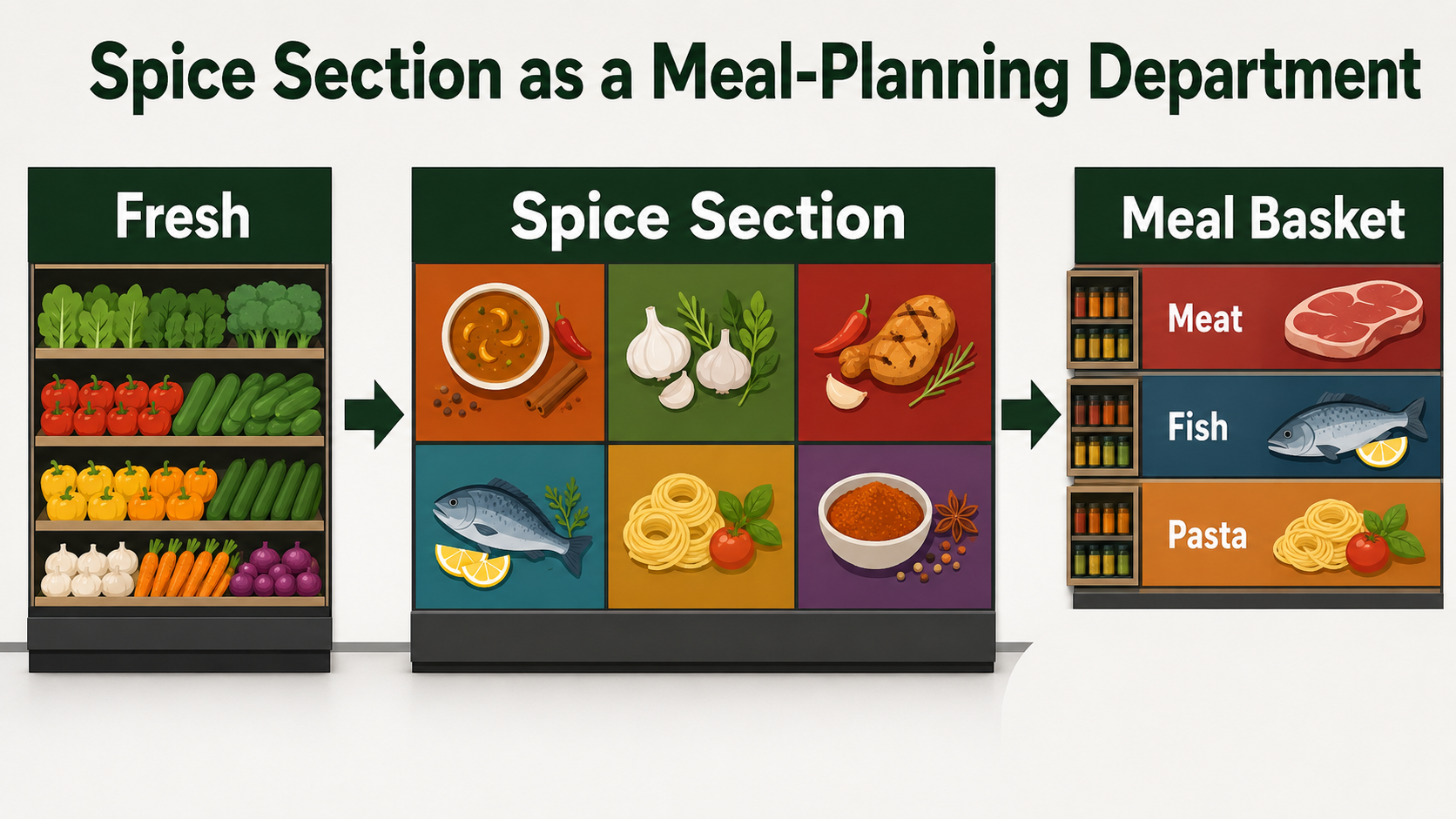
The real role of the spice department
A standard spice aisle says:
Here are the products.
A stronger spice department says:
Here is what you can cook tonight.
That is the commercial shift.
The objective is not to decorate the spice section or create unnecessary theatre. The objective is to help the shopper make a faster cooking decision.
Many shoppers know the main item they are buying. They may have chicken, mince, potatoes, fish, rice, pasta or vegetables in mind. What they often need is flavour direction.
They are asking simple questions:
What can I make with this?
What spice goes with this product?
What else do I need to complete the meal?
How do I make this meal less boring?
What can I cook quickly tonight?
A good spice department should answer those questions.
From spice aisle to flavour destination
The strongest approach is to move the spice section from a passive replenishment aisle into a more active flavour destination.
This does not mean every supermarket needs a large, expensive feature department. It means the category should be planned around shopper missions, not only supplier ranges.
A conventional spice aisle is usually organised around stock control and product grouping. That is still necessary. The basics must work. The range must be correct. The shelves must be neat. The products must be easy to replenish.
But a flavour destination goes further.
It uses clear category blocking, better shelf discipline, meal-led signage and selected cross-merchandising to connect spices to the food departments around them.
The department should still carry the core dry range, but it should also guide the shopper:
curry and masala for family meals
herbs and garlic for pasta
lemon pepper and dill for fish
rosemary and paprika for potatoes
peri-peri and chicken spice for poultry
cumin, coriander and turmeric for lentils, rice and pulses
premium spices for special recipes and gifting
This is where the spice section becomes commercially useful beyond its own shelf space.
Location matters
The best position for a stronger spice department is often close to the transition between fresh produce and the next major fresh department, such as butchery, bakery, deli, fish, hot foods or prepared meals.
That is where the shopper is already thinking about food, not only grocery replenishment.
Fresh produce often starts the meal. Spices help complete it.
This location gives the category more visibility and a stronger link to meal planning. A customer passing from vegetables toward chicken, meat, fish or prepared foods is already in a decision-making zone. That is the right moment to prompt flavour.
In a new store layout, this should be considered early. In an existing store, it may not always be possible to move the full spice range. That does not mean the opportunity is lost.
If the spice section must remain in dry grocery, the same thinking can still be applied through:
stronger category blocking
better shelf management
clear section headers
endcap features
recipe prompts
product-level “best for” signs
selected satellite spice stations near fresh departments
The key is not only where the products sit. The key is whether the department helps the shopper connect spices to meals.
What a better spice department can include
A growth-driven spice department should be built in layers.
Not every store needs every layer. A small neighbourhood store and a large premium supermarket should not carry the same level of complexity.
But the structure should be clear.
1. Core dry spice range
This remains the base of the department.
It includes sachets, refill packs, jars, shakers, grinders, everyday herbs, everyday spices, chicken spice, braai spice, steak and chops spice, fish spice, potato spice, vegetable spice, curry powder, masala, baking spices and salt and pepper variants.
This section must be practical, easy to replenish and easy to shop.
Small spice bottles and jars can become messy very quickly. They are narrow, light and difficult to keep straight. Shelf-ready trays, dividers, product stops and pusher systems should be considered as part of the fixture specification, not as an afterthought.
A messy spice bay weakens the department.
2. Curry and masala destination
In South African supermarkets, curry and masala should often be treated as a visible destination, not hidden inside a general alphabetical spice run.
This block can support curry, breyani, dhal, stew, rice dishes, pulses and family meals.
Depending on the catchment, it may include curry powders, masalas, breyani masala, tandoori masala, garam masala, turmeric, cumin, coriander, chilli, mustard seed, fenugreek and whole spices.
The signage does not need to be clever. It needs to be clear.
Examples:
Curry & Masala
Build your curry base
For Durban curry, breyani and family meals
This is a high-relevance cooking mission and should be easy to find.
3. Fresh herbs and chilled flavour products
Fresh herbs, crushed garlic, crushed ginger, crushed chilli, garlic and ginger blends, herb pastes and curry starter pastes can strengthen the spice department because they connect dry grocery to fresh cooking.
These products solve a real shopper problem.
They reduce preparation work.
The shopper wants flavour but may not want to peel garlic, grate ginger, chop chillies, waste half a bunch of herbs or clean another chopping board.
The promise is simple:
Fresh flavour, less preparation.
This section can sit in the nearest produce fridge or, in stronger stores, in a dedicated self-contained upright chiller within the spice destination.
The dedicated chiller is stronger where the store has enough sales volume and operational discipline. It makes dry spices, fresh herbs, crushed flavour products and meal starters read as one connected department.
But this is not a dry grocery section. It is chilled, date-sensitive and shrink-sensitive. Produce or chilled operations must own the rotation and standards.
4. Premium and exotic spices
Premium and exotic spices should be controlled carefully.
They can create authority, discovery, gifting value and premium perception, but they are not usually volume drivers.
Examples include saffron, vanilla pods, vanilla paste, cardamom, mace, star anise, sumac, Sichuan pepper, truffle salt, smoked salt and premium finishing salts.
These products should not be lost on a dusty bottom shelf among ordinary spice packs.
They need:
small controlled range
clear “best for” guidance
recipe support
better lighting
premium presentation
theft awareness where needed
strong supplier verification for high-risk items
The mistake is to range exotic spices because they are interesting. They should be ranged because they support a clear shopper mission, cuisine block, premium recipe, gifting use or local catchment.
5. Loose spice, refill and blend module
Loose spice can create strong value perception and market-style theatre, especially in stores with high curry usage or strong specialist cooking demand.
But it must be treated as a controlled food-handling system, not casual loose grocery.
Open scoop bins can look authentic, but they bring real risks: mess, cross-contamination, poor traceability, moisture issues, cleaning problems and unclear ownership.
A better model is usually controlled and staff-assisted.
For whole and coarse products, food-grade dispensers may work where the product flows properly. For fine powders, staff-assisted weighing or store-packed pouches are usually safer and easier to control.
Blend-to-order can be powerful, but only where trained staff can weigh, label and control the ingredients.
The correct message is:
Choose your blend. We mix it fresh.
Uncontrolled customer free-mixing should be avoided.
6. Gifting and live herbs
Spice gifting, grinder sets, herb pots and grow-your-own herb kits can work as a lifestyle and premium layer.
But this section must stay curated.
It should not become random homeware.
Good examples include:
braai spice gift sets
curry spice kits
grinder duos
herb pots
grow-your-own pizza herb kits
local flavour boxes
small spice accessories that support cooking, grinding, storing or gifting
Live herbs can also strengthen the freshness message. Basil, parsley, coriander, mint, rosemary and thyme are practical foundation lines. Specialist plants such as chilli plants, curry leaf, lemongrass or bay leaf should be added only where the store can maintain them properly.
A dying herb display damages the store’s fresh-food credibility.
Satellite spice stations: useful, but dangerous if uncontrolled
Satellite spice stations can be one of the strongest ways to create “one more item” purchases.
The principle is simple:
Place a small, relevant spice selection next to the food that needs flavour.
But the discipline is important.
The main spice department carries the full range. A satellite station should carry only 3 to 8 high-volume meal triggers.
A satellite station should never become a second spice aisle.
Examples:
Butchery
Take the meat. Add the flavour.
Possible products: steak and chops spice, braai spice, BBQ spice, black pepper grinder, garlic and herb, rosemary.
Chicken
Chicken four ways: peri-peri, lemon & herb, curry, BBQ.
Possible products: chicken spice, peri-peri, lemon and herb, curry powder or masala.
Fish
Fish tonight: lemon, garlic, herbs.
Possible products: fish spice, lemon pepper, garlic and herb, dill, parsley.
Potatoes
Better potatoes, better basket.
Possible products: potato spice, rosemary, garlic and herb, paprika, black pepper.
Pasta
Tomato + garlic + oregano = dinner.
Possible products: Italian herbs, oregano, basil, garlic, chilli flakes.
The operational risk is clutter. If satellite stations are not controlled, they create double stock, expired stock, dusty sachets, out-of-stocks in the main aisle and confusion over ownership.
The idea is good. The execution must be strict.
Signage should name meals, not only categories
Signage in a spice department should not be treated as decoration.
Its job is to help the shopper choose.
The strongest signs are practical and meal-led.
Examples:
Chicken curry tonight
Pasta night starts here
Better potatoes, better basket
Fish tonight: lemon, garlic, herbs
One mince pack. Five dinner ideas
Braai weekend flavour station
Rice + lentils + curry spices = family meal
Fresh flavour, no chopping
These messages work because they connect the spice to an actual meal decision.
The department also needs signage discipline.
Too many colours, messages, QR codes, shelf talkers and campaign signs will create visual noise. If everything is shouting, nothing is clear.
The department should feel lively, but still calm and easy to shop.
A practical signage hierarchy should include:
Department sign
Zone sign
Eye-level meal prompt
Product-level “best for” guidance
Each level has a job. Do not make one sign do everything.
QR codes can help, but only when they are specific
QR codes should not link to a generic homepage.
They should link to something useful and specific:
a recipe
a shopping list
a spice pairing guide
a meal bundle page
a local supplier story
a product education page
a gift-use guide
The sign should give the quick answer. The QR code should give the deeper help.
Used properly, this can support both in-store shopping and website content. Used badly, it becomes clutter.
Do not overbuild the concept
The danger with a spice department concept is trying to install every idea in every store.
That will not work.
The correct rollout approach is to separate core, optional and test-only elements.
Core elements
clear department identity
core dry spice range
visible curry and masala block where relevant
shelf management for small bottles and jars
meal-led signage
simple recipe or pairing prompts
clear operational ownership
basic performance measurement
Optional elements
dedicated chilled flavour chiller
live herb and edible plant display
premium and exotic spice block
local flavour collection
vegan cooking identifiers
culinary wellness or warm drinks block
spice gifting display
selected satellite spice stations
Test-only elements
large loose spice refill stations
blend-to-order counters
large physical meal kits
wide exotic spice ranges
large gifting displays
heavy QR code systems
Start with what is easy to shop, easy to operate and commercially measurable. Add complexity only when the store can manage it.
Measurement matters
A better spice department should be measured properly.
The question is not only whether spice sales increased. The bigger question is whether the concept helped shoppers add one more relevant item to the basket.
Useful measures include:
spice category sales
units sold
gross profit
sales per metre
rate of sale by key SKU
out-of-stock rate
shrink and markdowns
fresh herb and chilled paste waste
attachment to chicken, fish, meat, pasta, rice, pulses and produce
performance of satellite stations
performance of recipe-led campaigns
The measurement does not need to become complicated. It needs to be consistent enough to show whether the concept is working.
Ownership is the make-or-break point
This concept will fail if nobody owns it.
A flavour destination crosses departments. It touches grocery, produce, chilled, butchery, marketing, buying, operations and store design.
That makes ownership essential.
Someone must control:
range discipline
shelf standards
signage condition
satellite station stock
chilled product rotation
supplier issues
campaign timing
QR code content
performance review
Without ownership, the department becomes messy, over-ranged, visually noisy and difficult to repeat.
Good retail ideas do not fail only because the idea is wrong. They often fail because the operating model was never agreed.
The commercial point
The spice section can sell more than spices.
It can help the shopper decide what to cook. It can connect fresh produce to meat, chicken, fish, pasta, rice and pulses. It can support premium cooking, local flavour, gifting and convenience. It can make the store feel more food-led.
But only if it is planned properly.
A stronger spice department is not a decorative exercise. It is a category-growth and basket-building opportunity.
The goal is simple:
Grow the spice category first, then use that growth to support wider store sales.
That is where supermarket design becomes more than flow and finishes.
It becomes commercial department planning.
Grove Retail Design helps food retailers plan supermarket layouts, departments and category areas that are commercially useful, practical to operate and ready for implementation.
If you are reviewing a supermarket layout or looking at underperforming departments, Grove Retail Design can help assess how the space, category logic, fixtures, signage and operational model work together.
Need help applying this to a live supermarket or QSR project?
See Services or Contact Grove Retail Design.
