What Retailers Should Prepare Before Store Layouts and Working Drawings Start
A drawing package is only as good as the information behind it.
When a retailer asks for a store layout or working drawings, the design process should not become the place where the whole brief is discovered for the first time. Drawings are there to test, coordinate and document decisions. They cannot do that properly if the basic project information is missing.
This applies to both greenfield supermarket projects and revamps, but the information required is not exactly the same.
A greenfield project needs clear operating intent before the building and services are locked in.
A revamp needs accurate information about what already exists, what must stay, what can change and how the store will keep trading during the work.
Both project types need preparation before detailed drawing work starts.
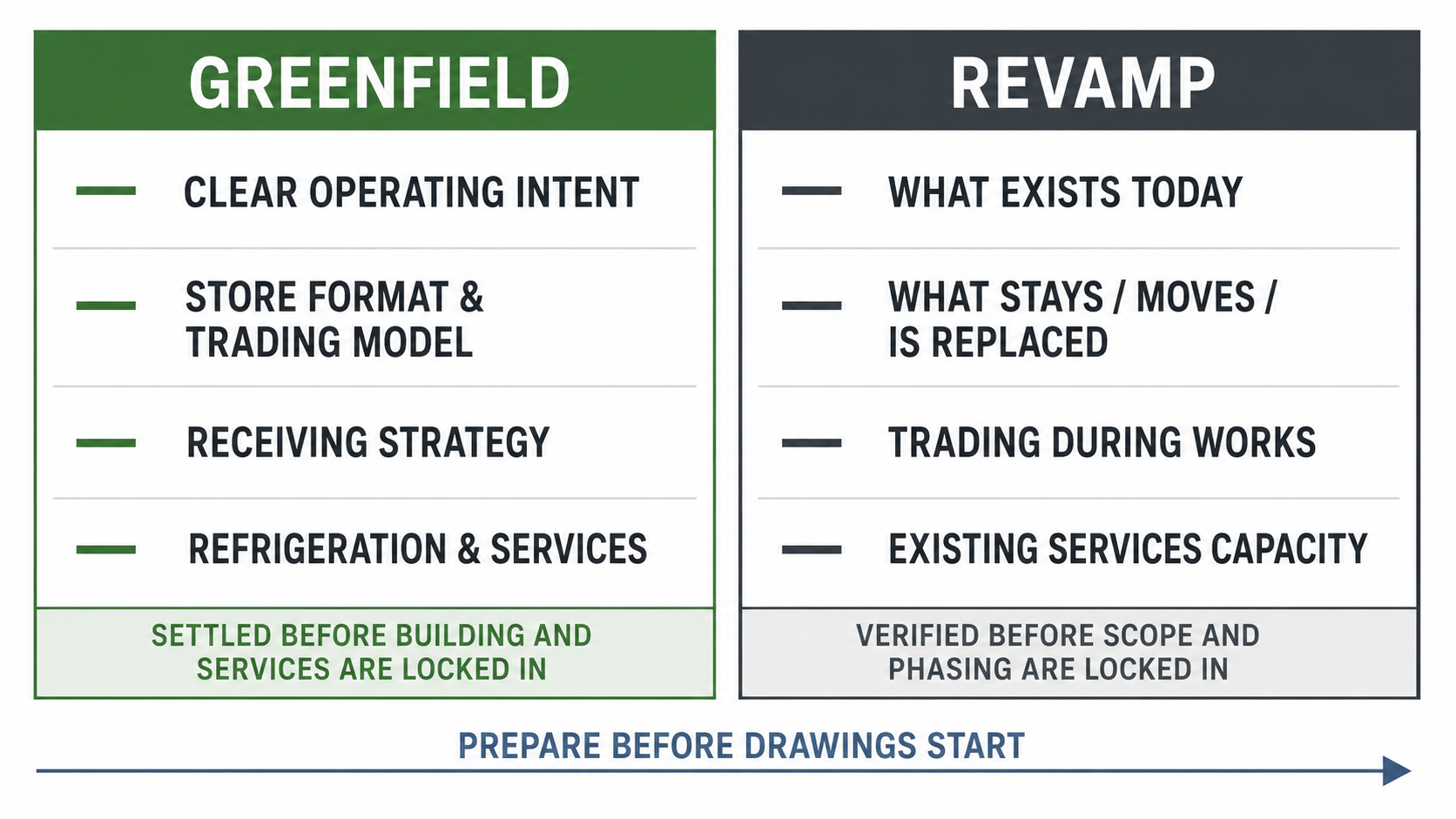
Greenfield and revamp projects need different information before drawing work starts.
1. Why project information must come first
The early brief affects almost every later decision.
It affects the size of the sales floor, the back-of-house allowance, the receiving flow, the fresh departments, the refrigeration strategy, the electrical load, the drainage layout, the generator requirement, the ceiling coordination, the shopfitting package and the programme.
If those items are unclear, the drawings become unstable.
That usually leads to:
repeated layout changes
supplier clashes
late cost changes
incorrect service positions
unnecessary redesign
procurement delays
site work being changed after it has already started
The better the input information, the cleaner the drawing process becomes.
Working drawings should not be used to discover the brief. They should be used to coordinate confirmed decisions.
2. What to prepare for a greenfield supermarket project
A greenfield project gives the retailer more freedom, but it also carries a major risk.
Because the building is still being shaped, early assumptions can become fixed into the structure. If the operating model is not clear, the building can be designed around the wrong logic.
Before store layout or working drawing work starts, the retailer should prepare the following information.
3. Store format and trading model
The first question is what type of store is being planned.
The design team needs to understand whether the store is a full supermarket, a compact supermarket, a fresh-led store, a convenience store, a hybrid food market, or a supermarket with strong production departments.
The retailer should confirm:
approximate store size
intended customer profile
trading position in the market
level of fresh-food focus
whether the store is price-led, premium, convenience-led or production-led
expected department mix
service departments versus self-service departments
This decision affects the whole layout.
A store with a strong bakery, butchery and hot-food offer needs a very different back-of-house and services strategy from a store that is mainly dry grocery and packaged chilled products.
4. Sales floor and back-of-house balance
A common problem in early supermarket planning is trying to maximise the sales floor without allowing enough space for the operation that supports it.
The retailer should confirm the expected balance between:
sales floor
receiving
dry storage
cold rooms
freezer rooms
bakery
butchery
kitchen or deli
staff facilities
offices
waste handling
plant and service areas
The sales floor generates turnover, but the back-of-house makes the store function.
If back-of-house areas are squeezed too far, the problem normally reappears later as poor workflow, storage pressure, staff movement problems, hygiene issues and operational frustration.
5. Receiving and delivery strategy
Receiving must be resolved early in a greenfield project because it affects the building, yard and back-of-house layout.
The retailer should confirm:
delivery vehicle size
delivery frequency
main receiving position
whether fresh produce needs separate receiving
whether butchery needs direct receiving
whether bakery or kitchen suppliers need special access
waste removal route
staff access route
GRV and checking process
Receiving is not just a door on the back of the building.
It is where goods, suppliers, staff, waste and control processes meet. If it is poorly planned, it affects the whole store.
6. Fresh department operating model
Fresh departments must be planned around the way the retailer intends to trade.
The design team needs to know whether departments are self-service, served, or a combination of both.
For example:
Will butchery sell mainly packaged meat, service-counter meat, or both?
Will bakery be self-service, served, or partly served?
Will hot food operate as a full kitchen, light food preparation, or simple reheating?
Will fruit and veg require chilled display, ambient display, prep space or separate receiving?
Will there be a seating area linked to bakery, coffee or hot food?
These are operational decisions, not just design preferences.
They affect department size, equipment, drainage, power, extraction, refrigeration, staff movement and customer flow.
7. Refrigeration and cold storage requirements
Refrigeration should be discussed before the layout is frozen.
The retailer should confirm:
product range
expected volumes
display method
self-service versus served display
cold-room requirements
freezer-room requirements
chilled produce requirement
dairy display requirement
frozen food display requirement
meat display strategy
grab-and-go requirement
drinks display requirement
Refrigeration is one of the areas where late decisions become expensive.
Cabinet positions affect drainage, electrical supply, pipe routes, ceilings, lighting, signage, bulkheads and maintenance access.
In a greenfield project, the refrigeration strategy should help shape the services and building planning, not be added after the layout is already fixed.
8. Services and infrastructure strategy
The services strategy should be discussed early, even if the final engineering design is still to follow.
The retailer and professional team should confirm the design basis for:
electrical supply
backup power
generator requirement
refrigeration plant positions
water supply
water treatment if needed
drainage
grease traps
gas if required
HVAC and humidity control
extraction for kitchen and bakery
fire and life-safety systems
IT and security infrastructure
The design team does not replace the engineers or specialist suppliers, but the retail layout must allow space and routes for the systems that make the store work.
If services are not considered early, the project often pays for it later through rework, visible service routes, poor access or compromised department planning.
9. Supplier involvement
Certain suppliers should be involved early enough to confirm realistic requirements before procurement.
This usually includes:
refrigeration supplier
shelving supplier
shopfitting supplier
bakery equipment supplier
kitchen equipment supplier
butchery equipment supplier
lighting supplier
HVAC contractor or mechanical engineer
security and CCTV supplier
signage supplier
Early supplier input does not mean the design should be handed over to suppliers.
It means the layout must be tested against real equipment sizes, service requirements, lead times, installation needs and maintenance access.
A supplier-standard solution is often better than inventing a custom solution where it is not needed.
Related service: If your project information is ready but the layout still needs to be resolved, Grove Retail Design can help with retail design and layout development before working drawings or fit-out documentation begin.
10. Programme and procurement timing
A greenfield project must also be planned around long-lead items.
The retailer should identify which items need early decisions and early orders.
Typical long-lead or programme-sensitive items include:
refrigeration
generators
cold rooms
bakery equipment
kitchen equipment
butchery equipment
shelving
shopfitting
lighting
imported finishes or specialist fixtures
If these decisions wait until the working drawings are complete, the programme may already be under pressure.
The correct sequence is usually:
Confirm the operating model.
Develop and approve the general layout.
Engage key suppliers.
Confirm service and equipment requirements.
Finalise coordinated drawings.
Start procurement and site preparation in the correct sequence.
11. What to prepare for a supermarket revamp or conversion
A revamp is different from a greenfield project.
The retailer is not starting with a clean site. The project team must work around existing conditions, existing services, existing structure, existing finishes and often an operating store.
The key question is not only what the new store should become.
The key question is what can realistically be changed without causing unnecessary cost, downtime or disruption.
12. Existing drawings and site information
The first requirement for a revamp is accurate existing information.
The retailer should prepare:
existing floor plan
as-built drawings if available
lease plan if available
site measurements
photographs
ceiling information where relevant
electrical board positions
drainage points
refrigeration positions
air-conditioning plant and duct positions
structural constraints
shopfront and entrance conditions
landlord or centre restrictions
If proper drawings are not available, the project may need a measured survey before meaningful design work starts.
Designing from incomplete existing information is one of the fastest ways to create errors on site.
13. What must stay, what can move and what must be replaced
In a revamp, the reuse strategy must be clear.
The retailer should confirm:
which equipment must be reused
which equipment will be replaced
which departments stay in their current position
which departments can move
which walls can be demolished
which services can be altered
which finishes must remain
which areas require full replacement
which parts of the store must remain operational during the works
This is a major difference between a revamp and a greenfield project.
In a revamp, the best layout is not always the perfect layout on paper. It is often the best balance between improvement, cost, disruption and programme.
14. Trading during construction
If the store must trade during the revamp, this must be part of the brief from the start.
The design team needs to know:
whether the store will close fully
whether the work will happen in phases
which departments must keep trading
whether night work is required
how customers will move safely
how staff will work during construction
how dust, noise and access will be controlled
how temporary refrigeration or temporary counters will be handled
how deliveries will continue
A phased revamp is not just a design exercise.
It is a construction and operations exercise. The layout must be planned together with the phasing strategy.
15. Existing services capacity
Existing services can either support the revamp or limit it.
Before the design is developed too far, the project team should understand:
existing electrical capacity
spare capacity on distribution boards
refrigeration plant condition
drainage capacity and positions
grease-trap availability
water supply
HVAC performance
extraction routes
fire-system constraints
IT and security infrastructure
Changing a layout without checking services can create a design that looks good but is expensive or impractical to build.
This is especially important for fresh departments, refrigeration, bakery, kitchen, butchery and food preparation.
16. Front-end decisions
The front end should be resolved early enough to avoid wasting prime trading space.
The retailer should confirm:
checkout quantity
express till requirement
self-checkout if applicable
customer entry and exit flow
trolley storage
parcel counter if required
security point
high-value display
queueing strategy
grab-and-go or impulse refrigeration
This does not need to dominate the project, but it must be decided early.
The front entrance is valuable space. If trolley storage, parcel control, security and checkout planning are added late, they usually take space away from something else.
17. Signage and brand direction
Signage should not wait until the end of the project.
The retailer should prepare:
final store name
logo
brand colours
existing brand guidelines if available
department names
signage style references
examples of stores they like
preferred level of graphics
whether the store needs simple department signage or a stronger branded environment
Signage affects walls, bulkheads, lighting, service counters and customer navigation.
It should be coordinated with the design, not added as decoration after the main decisions have been made.
18. What the design team should receive before working drawings start
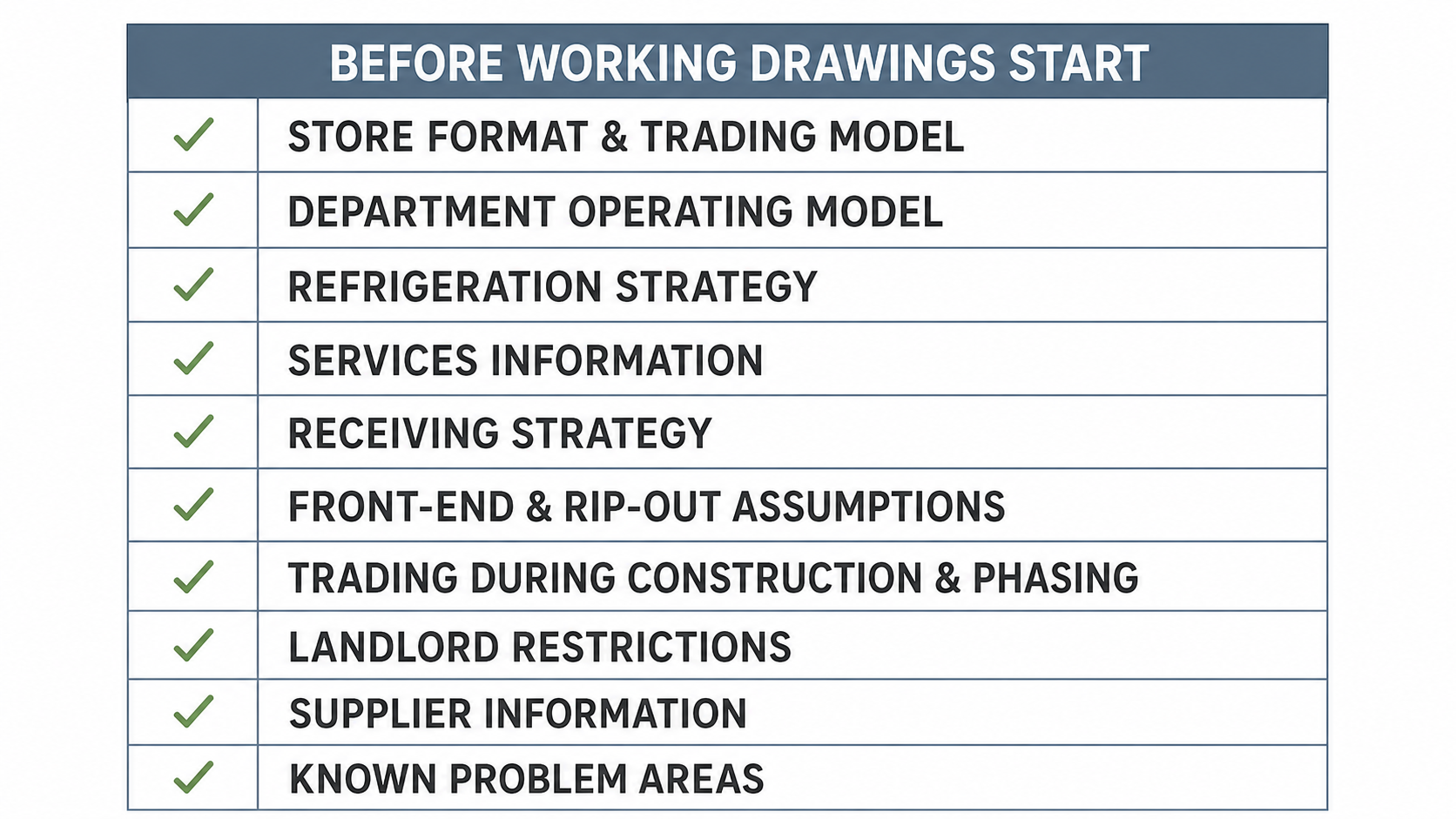
The brief the design team needs before working drawings begin.
Before working drawings begin, the retailer should ideally provide a proper project pack.
For a greenfield project, this should include:
store format and trading brief
site plan
building shell information
target sales area and back-of-house expectation
department list
fresh department operating model
refrigeration and cold-storage assumptions
receiving and delivery strategy
service and infrastructure assumptions
supplier contacts where available
programme expectations
responsibility split between landlord, retailer and professional team
For a revamp, this should include:
existing layout
site measurements
photographs
existing services information
equipment reuse list
strip-out assumptions
trading-during-construction requirements
phasing requirements
landlord restrictions
supplier information
known problem areas in the current store
The information does not need to be perfect, but it must be clear enough to start the design process on the right basis.
19. The real purpose of working drawings
Working drawings are not just a more detailed version of a layout.
They are the coordination tool that helps turn the approved design into something that can be priced, checked, built and installed.
A proper working drawing package should help coordinate:
walls
doors
floors
ceilings
electrical points
drainage points
refrigeration interfaces
equipment positions
shelving and shopfitting
signage zones
lighting
supplier requirements
installation responsibilities
For that to work, the project decisions must be developed before the drawings are expected to carry them.
If the brief is unresolved, the drawings will simply expose the gaps.
20. Final checklist for retailers
Before asking for store layouts or working drawings, prepare the following:
What type of store is being planned?
What departments must be included?
Which departments are self-service and which are served?
What fresh-food production is required?
What refrigeration and cold storage is needed?
How will receiving work?
What are the main services and infrastructure requirements?
What must suppliers confirm early?
What is the expected programme?
Is this a greenfield project, revamp or phased conversion?
What existing information is available?
What must remain, move, or be replaced?
Will the store trade during the works?
What front-end decisions must be resolved?
What signage and brand information is available?
The purpose is not to make the project complicated.
The purpose is to prevent avoidable uncertainty from becoming avoidable cost.
Good project information leads to better layouts, cleaner working drawings, stronger supplier coordination and fewer late surprises on site.
Ready to turn project information into a layout or drawing brief?
If you already have a site plan, landlord information, department list or project brief, Grove Retail Design can help identify whether your next step should be layout development, working drawings or a project-readiness review.
FAQs
What should a retailer prepare before supermarket layouts or working drawings start?
Clear project information before detailed drawing work begins. Working drawings coordinate confirmed decisions; they should not be used to discover the brief. The retailer should settle the store format, trading model, back-of-house balance, receiving, fresh departments, refrigeration and services, so the drawings can test and document those decisions rather than change them repeatedly.
Why does project information have to come first?
The early brief affects the sales floor size, back-of-house allowance, receiving flow, refrigeration strategy, electrical load, drainage, ceiling coordination and programme. If those items are unclear, the drawings become unstable, which leads to repeated layout changes, supplier clashes, late cost changes and unnecessary redesign. Better input information makes the drawing process cleaner.
How is preparing for a greenfield project different from a revamp?
A greenfield project needs clear operating intent before the building and services are locked in. A revamp needs accurate information about what already exists, what must stay, what can change, and how the store will keep trading during the work. Both need preparation before detailed drawing work starts.
What information does a greenfield supermarket project need first?
The store format and trading model, the sales floor and back-of-house balance, the receiving and delivery strategy, the fresh department operating model, refrigeration and cold storage requirements, the services and infrastructure strategy, supplier involvement, and the programme and procurement timing. These are operational decisions that shape department size, equipment, drainage, power and flow.
What extra information does a supermarket revamp need?
Accurate existing drawings or a measured survey, a clear reuse strategy for what stays, moves or is replaced, a trading-during-construction and phasing plan, existing services capacity, and front-end and signage decisions. Designing from incomplete existing information is one of the fastest ways to create errors on site.
What is the real purpose of working drawings?
Working drawings are the coordination tool that turns the approved design into something that can be priced, checked, built and installed. They coordinate walls, doors, floors, ceilings, electrical and drainage points, refrigeration interfaces, equipment, shopfitting, signage, lighting and supplier requirements. For that to work, the project decisions must be developed before the drawings carry them.
