Wellness Areas Need Trust, Not Just Shelves
A wellness area can look full, stocked and visually busy — but still fail as a department.
The problem is usually not only the range. The problem is that the shopper cannot quickly understand what the department is for, where it starts, how the products are grouped, or why the range belongs together.
In many supermarkets, wellness is still treated as a small vitamin shelf, a few “better-for-you” grocery lines, or a supplier-led collection of products added wherever space is available.
That is not enough.
A strong wellness department needs trust. It needs clear category logic. It needs to connect to how customers already shop for health, family, food, recovery, daily routine and better everyday choices.
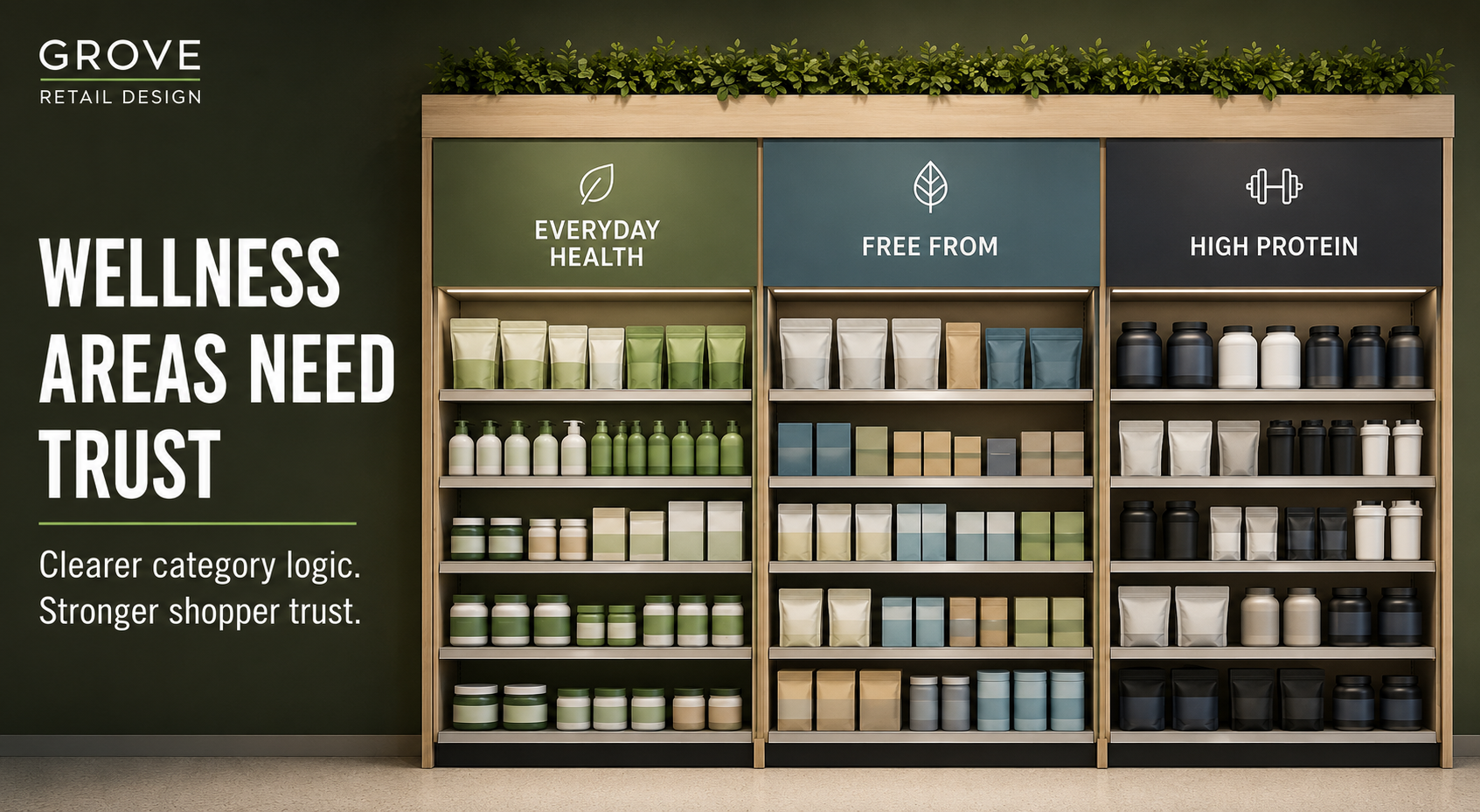
Wellness is now part of normal supermarket shopping
Wellness is no longer only a specialist health-store category.
In supermarkets, wellness can appear across breakfast, snacks, dairy, chilled drinks, free-from products, plant-based ranges, vitamins, supplements, personal care and checkout impulse products.
The issue is that these products are often scattered across the store.
A shopper may find gluten-free products in grocery, protein bars near tills, kombucha in chilled drinks, vitamins near pharmacy or personal care, and better breakfast products in cereal. Each location may make sense on its own, but the total wellness offer can still feel disconnected.
That is where the opportunity sits.
The supermarket does not need to become a health shop. But it does need to make better everyday choices easier to find, easier to understand and easier to trust.
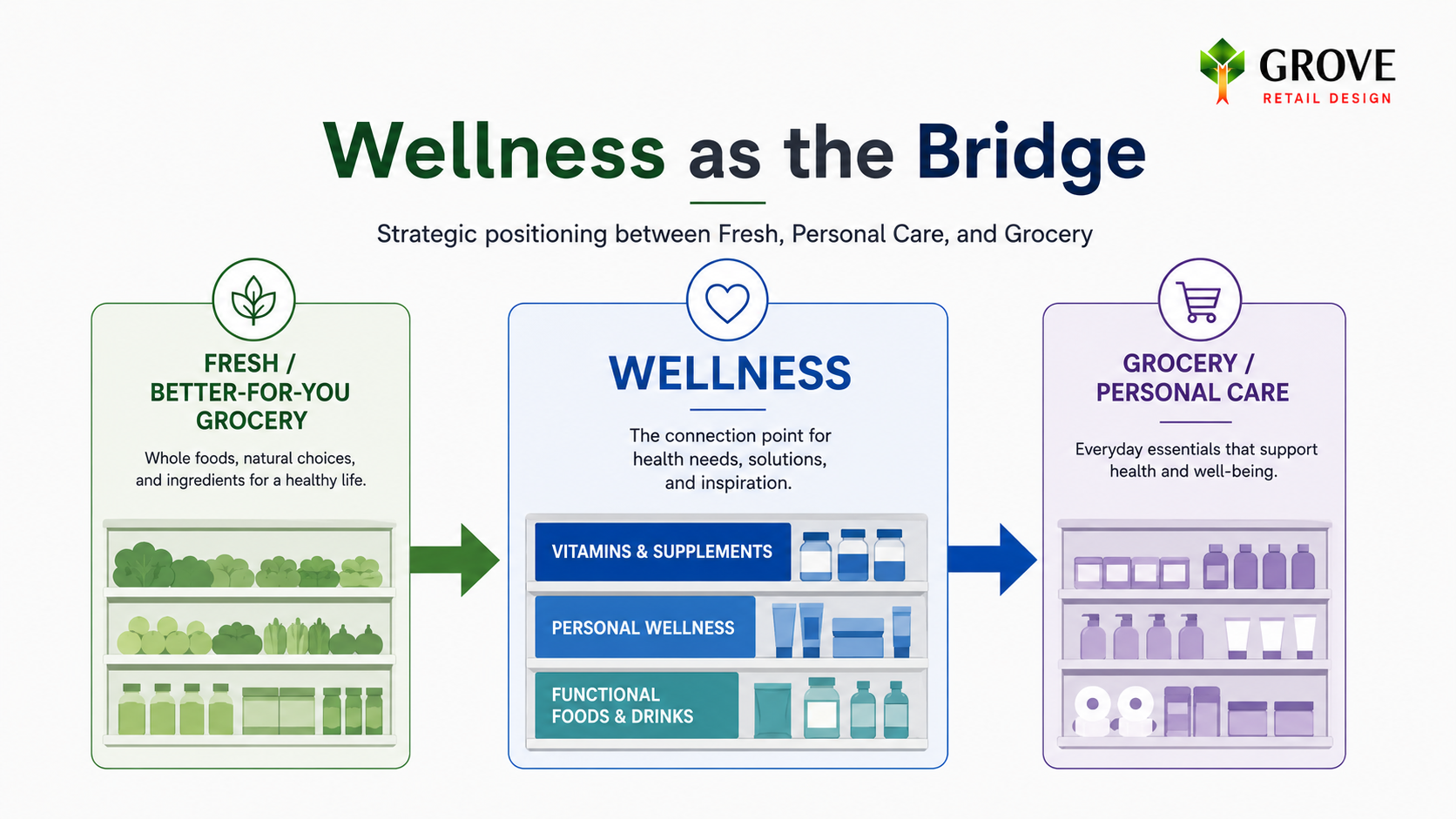
Wellness works best when it connects existing supermarket missions instead of standing alone as a disconnected shelf.
The common mistake: treating wellness as leftover shelving
The most common mistake is to treat wellness as a product collection instead of a shopper mission.
The result is usually a mixed shelf of vitamins, protein products, free-from items, natural products, supplements, health snacks and personal care. The department may be stocked, but the customer is left to decode the offer.
That creates several problems:
Products feel expensive without context.
Supplier brands compete for attention.
Small packs become visually messy.
Claims and shelf talkers create clutter.
The customer cannot see the main zones.
Slow-moving products start to damage the department’s credibility.
Wellness products carry a higher trust requirement than ordinary grocery products. If the area looks confused, untidy or over-claimed, the shopper becomes cautious.
For this type of department, clarity is not decoration. Clarity is part of trust.
Wellness should be planned as a trust zone
A better approach is to treat the wellness area as a trust zone.
This does not mean making the department look clinical or over-designed. It means the department must be easy to read and credible enough for customers to feel comfortable shopping it.
A good wellness area should answer four questions quickly:
What is this department for?
Where do I start?
Which products belong together?
Can I trust the way this range is presented?
That requires discipline.
The department needs clear blocking, simple signage, controlled product claims, tidy shelves, accurate prices and a logical flow from familiar everyday choices into more specialist products.
Start with everyday health, then move into specialist depth
In most mainstream supermarkets, wellness should not start with the most specialist range.
The strongest entry point is usually food-led wellness: better everyday eating, better breakfast, high-fibre products, nuts, seeds, free-from basics, better snacks, hydration, dairy/chilled links and functional food and drink.
From there, the department can move into deeper categories such as:
High Protein
Free From
Gut Health
Sugar Conscious
Plant Based
Vitamins and Supplements
Sports Nutrition
Natural Personal Care
This sequence matters.
If the shopper is immediately faced with technical supplements, expensive niche products and too many claims, the department can feel intimidating. If the department starts with familiar supermarket missions, it becomes easier to enter.
The rule is simple:
Start with what the shopper understands.
Then guide them toward the specialist range.
Category blocking must follow shopper missions
Wellness should not be blocked only by supplier, pack type or available shelf space.
It should be organised around shopper missions.
A customer looking for a better breakfast is not thinking the same way as a customer looking for protein recovery, gluten-free baking, digestive comfort or everyday supplements.
If these missions are mixed together, the shopper has to work too hard.
A better structure may include:
Better Breakfast
High Protein
Free From
Gut Health
Sugar Conscious
Plant Based
Everyday Supplements
Natural Personal Care
Healthy Snacking
Hydration and Functional Drinks
The exact structure will depend on the store format, customer profile, available space and range depth. A small store may only need a disciplined core. A flagship or premium store may justify a larger destination wellness area.
The principle remains the same: organise the department around how customers shop, not around how suppliers sell.
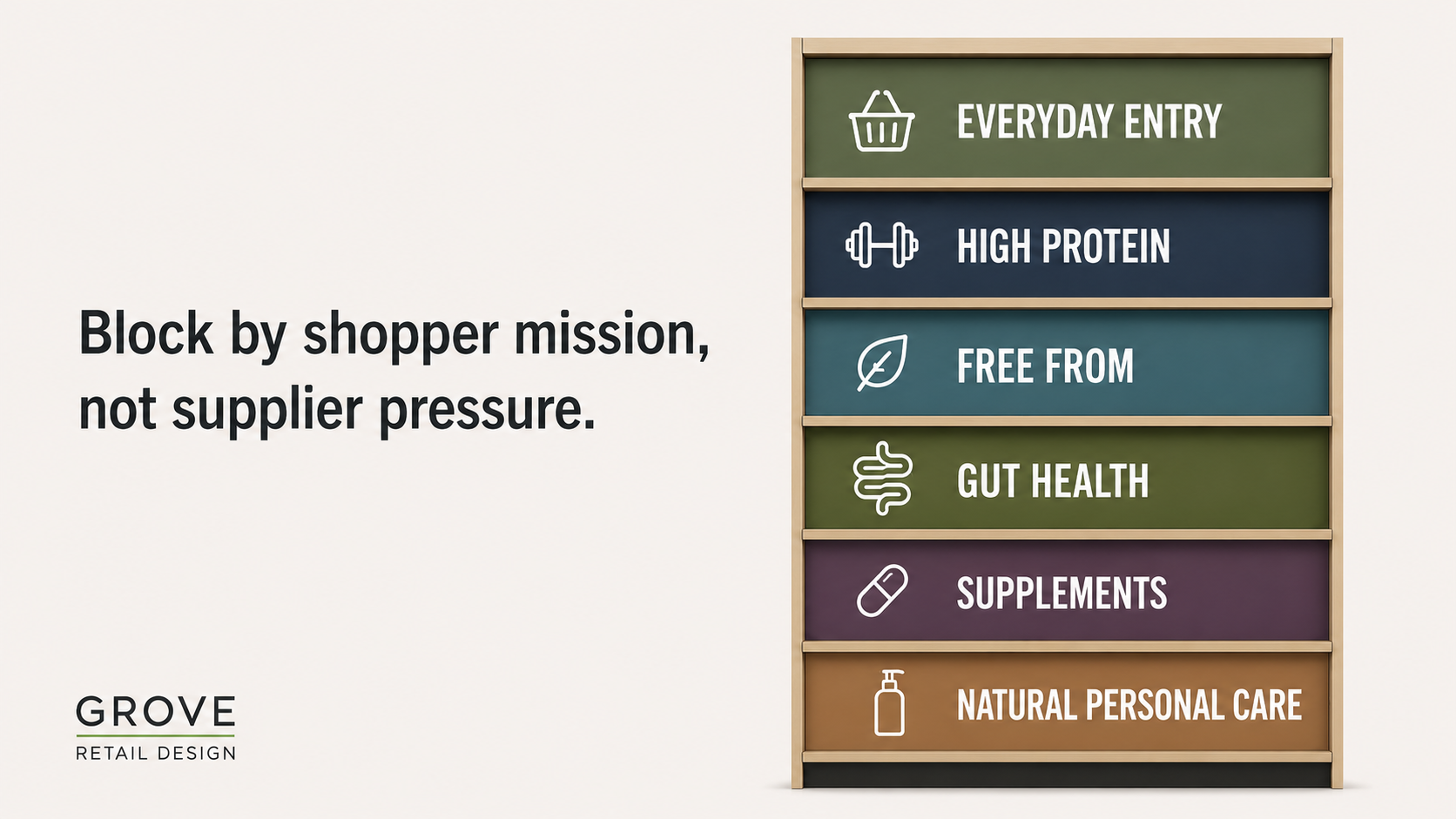
Block the department by shopper mission, not supplier pressure.
Wellness should connect to the rest of the store
Wellness should not sit completely alone.
A supermarket has an advantage that specialist stores do not have: wellness can connect to the customer’s normal shopping trip.
Good adjacencies may include:
Fresh produce
Better-for-you grocery
Breakfast
Dairy and chilled drinks
Healthy snacks
Personal care
Baby care
Sports nutrition
Checkout impulse
Meal solutions
This is where wellness can become a store-wide system rather than a single aisle.
For example:
Fresh produce can connect to better eating.
Dairy and chilled drinks can support gut health and protein.
Breakfast can connect to fibre, oats, seeds and sugar-conscious choices.
Checkout can carry a tight impulse range of protein bars, hydration or better snacks.
Personal care can support the wider wellness mission where the store format allows it.
The important point is control.
Not every category needs a wellness satellite. Not every supplier display deserves a secondary location. Satellite points must be edited, useful and replenishable.
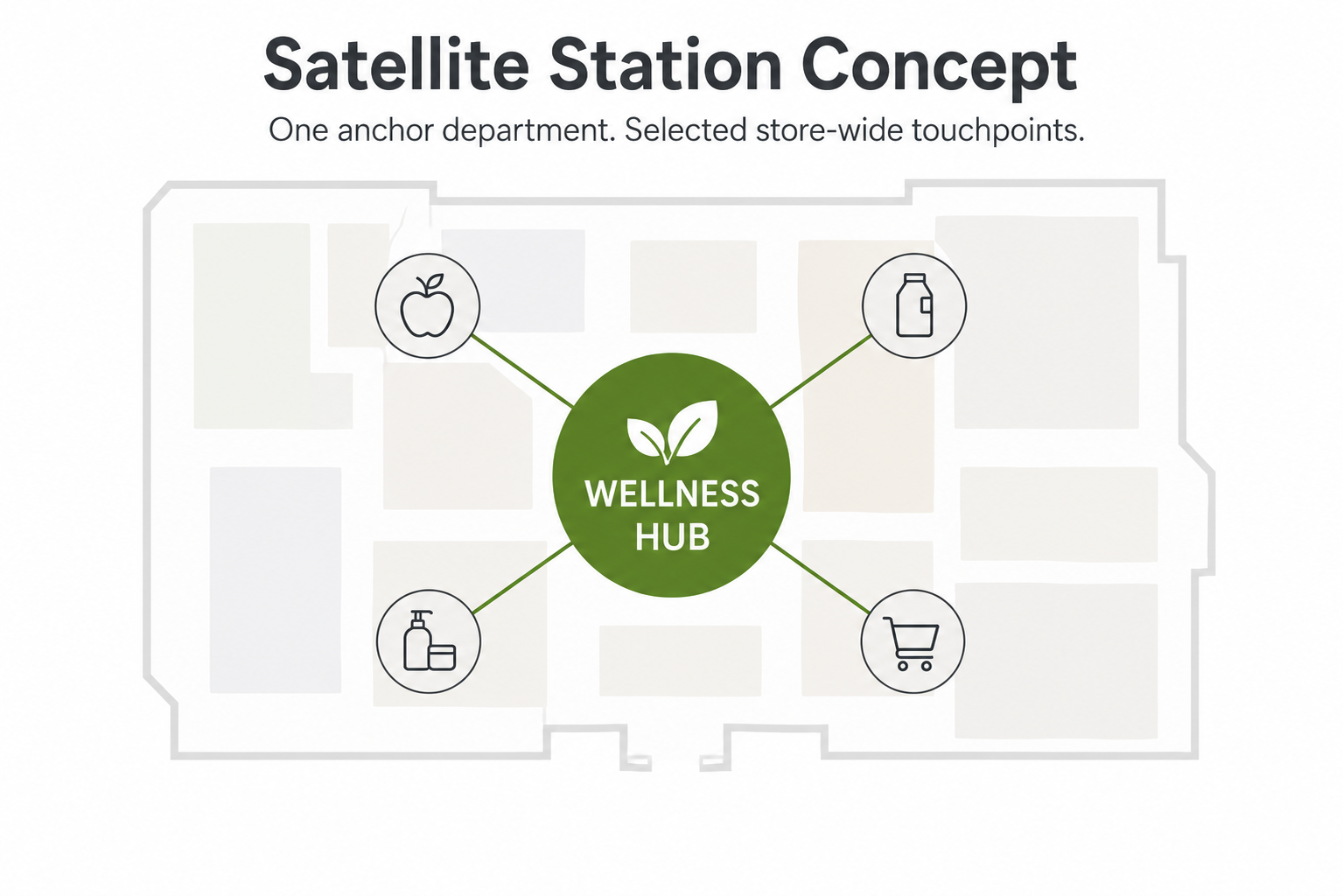
One anchor department. Selected store-wide touchpoints.
Signage should reduce confusion, not add noise
Wellness signage has one main job: reduce shopper confusion.
It should help the customer identify the department, find the correct zone and make a final product choice.
That means the signage hierarchy should be simple:
Department sign
Zone headers
Shelf-edge callouts
Cross-merchandising messages
Product-level information where needed
The language must also be controlled.
A supermarket should help customers navigate choices. It should not act like a clinic.
Safe, practical wording may include:
Better choices for everyday shopping
High in fibre
No added sugar
Gluten free
Lactose free
Source of protein
Build a better breakfast
Smarter snacks for busy days
Avoid unsupported medical or exaggerated claims.
The more sensitive the category, the more disciplined the communication must be.
Premium wellness needs deliberate positioning
Wellness often carries premium products.
That can support margin and destination value, but only if the shopper understands the offer before being pulled back into standard value alternatives.
This does not mean hiding value products. It means controlling the sequence.
If premium wellness sits behind a wall of value duplicates, the shopper may never properly understand the better choice. If the premium range is seen first, the department can explain the proposition before normal grocery comparison takes over.
This is especially important in categories such as:
Free From
Sugar Conscious
High Protein
Gut Health
Supplements
Natural Personal Care
Functional Drinks
The commercial question is not only “Do we stock it?”
The better question is:
Where does the shopper first see the better choice?
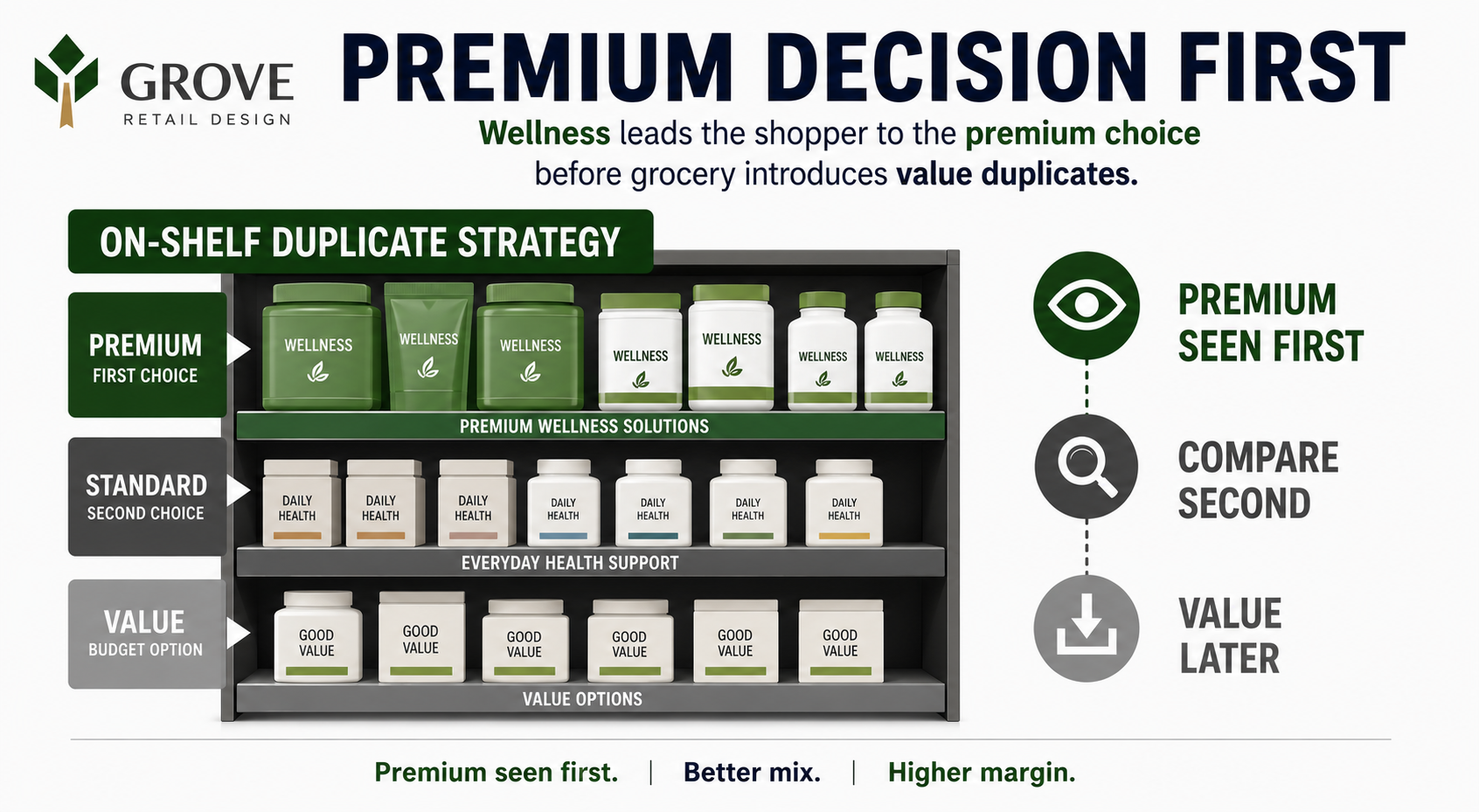
Premium wellness products need to be seen before standard grocery value duplicates pull the shopper back into price comparison.
Operational discipline matters
Wellness can fail quickly if it is not maintained.
Small packs, supplements, bars, sachets and specialist products can become messy. Expiry dates matter. Pricing must be clear. Supplier material must be controlled. Chilled wellness products must justify their space through range, rotation and refrigeration control.
A wellness area should be reviewed against practical questions:
Can the store replenish it properly?
Can staff keep it tidy?
Are prices visible?
Are product claims controlled?
Are slow movers being removed?
Are satellite stations being maintained?
Is the range still clear to the customer?
If the store cannot replenish it, rotate it, price it correctly or explain it safely, the range should be reduced or kept out of the core wellness offer.
A smaller, clearer wellness area is usually better than a larger confused one.
What good wellness development looks like
A good supermarket wellness area should pass three tests.
First, it must be clear to the shopper.
The customer should understand where the department starts, what the main zones are, and why the products belong together.
Second, it must be practical for the store team.
The range must be manageable, replenishable and easy to maintain.
Third, it must earn its space commercially.
It should support destination value, basket-building, premium range visibility and better use of existing floor area.
When those three tests are met, wellness becomes more than a shelf. It becomes a useful department.
How Grove Retail Design can help
Grove Retail Design helps supermarket owners, operators and development teams turn department ideas into practical retail concepts.
For wellness areas, this can include:
Department positioning
Layout and adjacency planning
Category flow
Zone logic
Signage hierarchy
Fixture principles
Satellite station planning
Implementation coordination
The goal is not to make the store look more complicated.
The goal is to make the department clearer, more practical and more commercially useful.
Wellness should be treated as a strategic supermarket department, not a small add-on.
Done properly, it can help customers build a better basket without leaving the supermarket.
Planning a wellness department or reviewing an underperforming supermarket category?
Grove Retail Design helps supermarket owners and development teams plan clear, practical and commercially focused retail departments.
Need help applying this to a live supermarket or QSR project?
See Services or Contact Grove Retail Design.
