Your Beverage Aisle Is Still Sized for the Drinks People Bought Five Years Ago
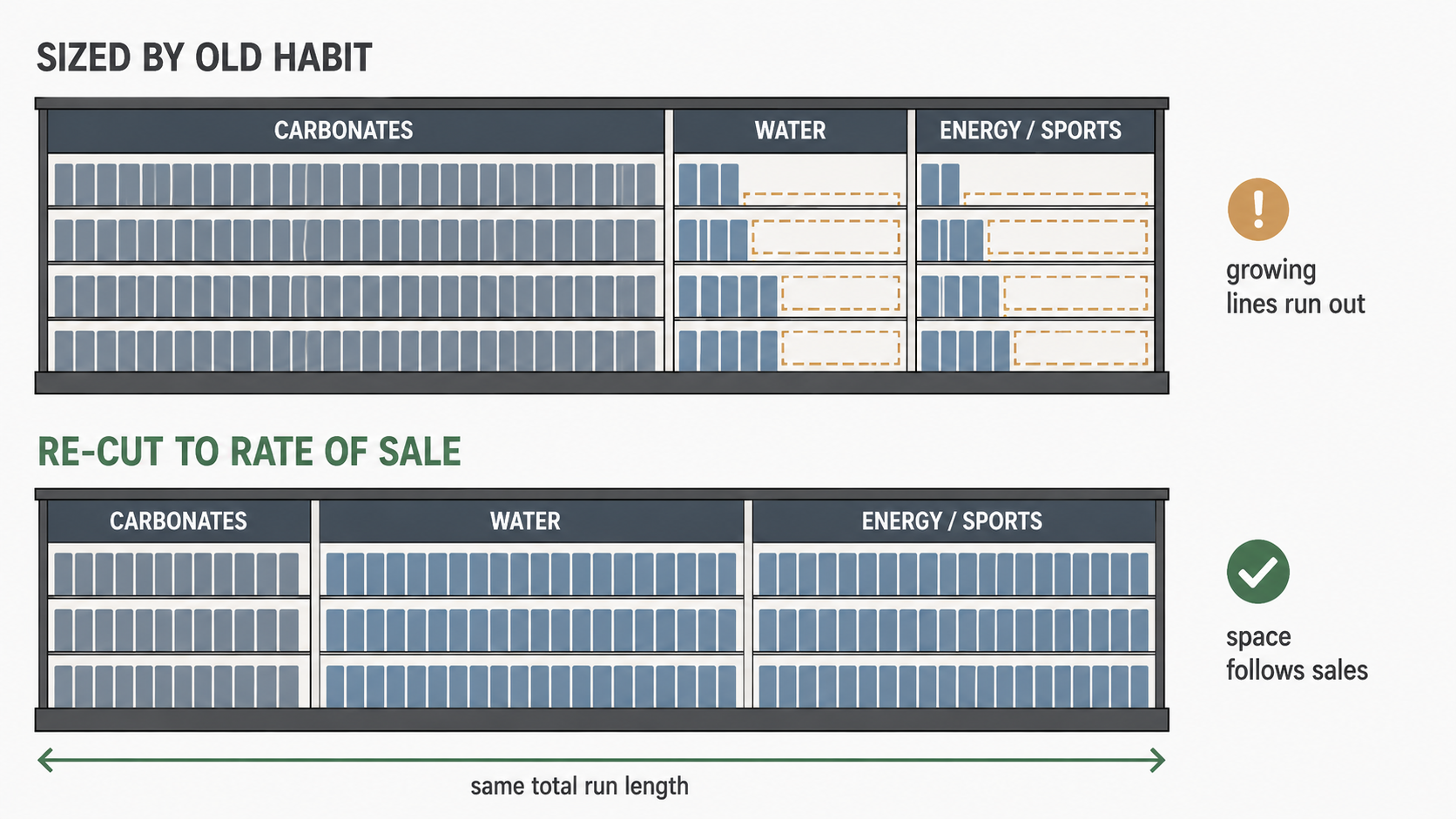
Same run, two splits: sized by old habit (top), water and energy run dry; re-cut to rate of sale (bottom), the space follows what sells.
Walk most supermarket beverage aisles and the split looks settled. A long, confident run of fizzy drinks. Water tucked into a bay or two. Energy and sports squeezed onto a couple of shelves, usually picked over and half empty. It looks like someone planned it carefully. Mostly, someone planned it carefully — a few years ago — and nobody has re-cut it since.
That is the problem. Beverages have shifted faster than almost any category in the store, and the shelf has not kept up. The metres were carved out when full-sugar carbonates ruled the aisle. Then the ground moved. South Africa’s sugar tax — the Health Promotion Levy, in force since April 2018 — pushed sugary carbonate volumes down sharply, with urban sales of taxed drinks dropping by roughly a third in the years after. At the same time water kept climbing, and energy drinks went from a side category to one of the fastest-growing parts of the whole store — a market on track to roughly double, from about R24 billion in 2024 toward R43 billion by 2030.
The buying changed. The bay did not. So the shelf you have is sized for the drinks people bought five years ago, not the ones they reach for now.
How the split gets stuck
Beverage space rarely drifts because anyone decided it should. It drifts because three forces quietly hold it in place.
The first is the old planogram. A split that was right once becomes “the way the aisle is,” and it gets copied from store to store and refit to refit without anyone asking if it is still true.
The second is supplier pressure. The biggest beverage supplier has every reason to defend its metres, and space deals are often negotiated on relationships and history rather than on what is actually selling through. That is fine for the supplier. It is not the same as what is right for the store’s turnover.
The third — and this is the one that belongs to the store planner, not the buyer — is the fixtures. Even when someone does spot the drift and wants to move metres from fizzy drinks to water and energy, they often cannot, because the aisle was built rigid. The shelving will not adjust, the bay widths do not suit the new pack sizes, the cold wall is sized and plumbed for a fixed split. So the planogram stays wrong because the layout will not let it be right.
What the drift quietly costs
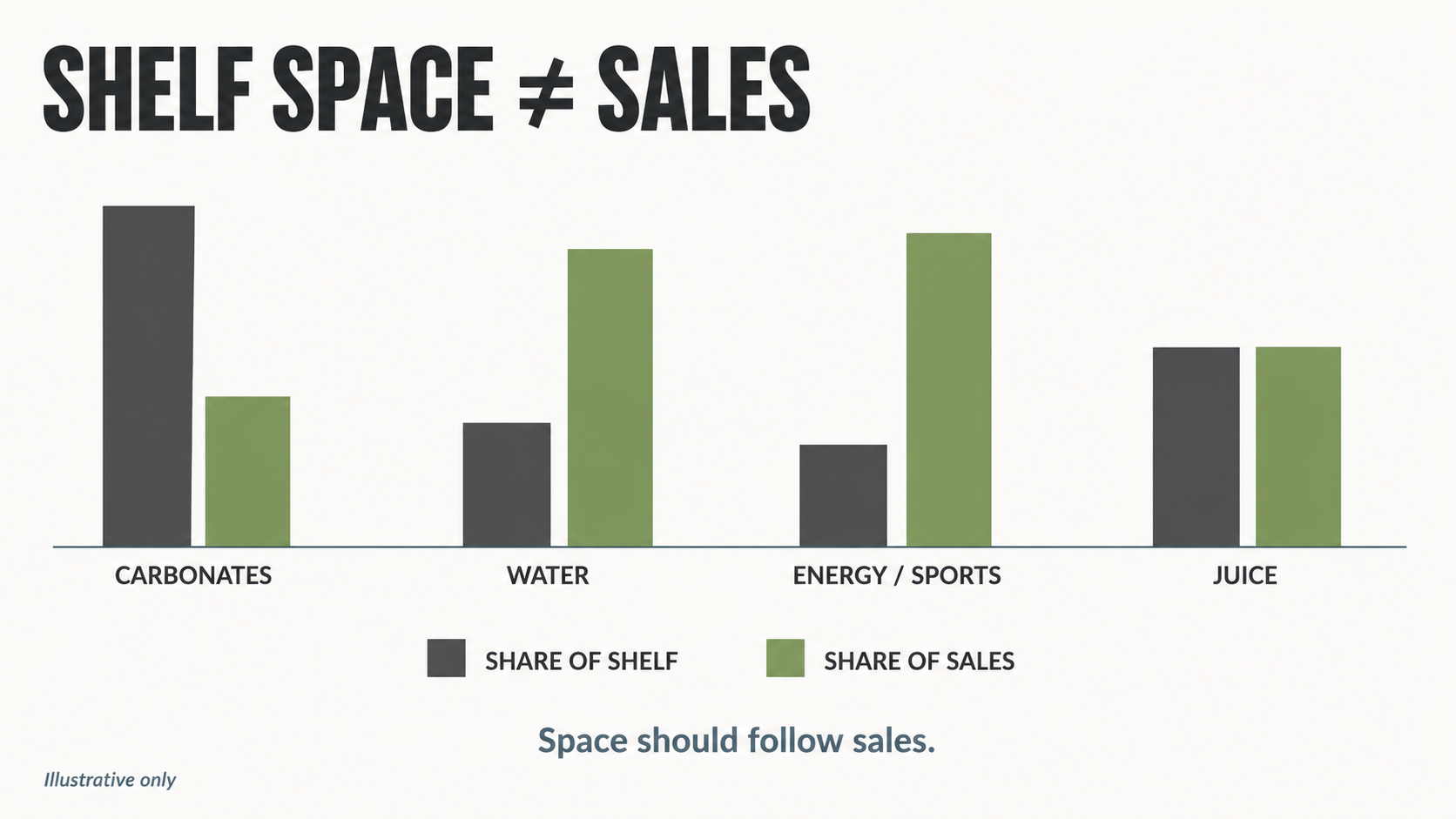
Share of shelf rarely matches share of sales — carbonates often hold more metres than they earn, water and energy earn more than they hold.
A beverage split that no longer matches demand loses money at both ends, and neither loss is obvious from the shop floor.
At the growing end, the fast lines run out. Water and energy on too few facings empty before the next replenishment, so the shelf sits with gaps through the busiest trading hours. An out-of-stock on a growing line is the most expensive miss in retail: the customer came to buy, was willing to pay, and left without it — and often bought it up the road instead. It never shows in a markdown report because it never reached the till.
At the shrinking end, the slow lines sit over-spaced. Full-sugar carbonates holding metres they have stopped earning means stock standing longer, dates running down, and space generating less turnover per metre every season. The aisle looks full and well-stocked. It is just full of the wrong ratio.
Put simply: the shelf is over-serving the lines in decline and under-serving the lines in growth — the exact opposite of what beverage turnover needs.
The principle: space follows sales
The fix is not complicated, and it is well understood in category management — it is just rarely applied to a beverage aisle after opening day. Space should track rate of sale. A sub-category earning, say, a fifth of beverage turnover should hold roughly a fifth of the metres — not the share it held five years ago, and not the share its supplier would like.
In practice that means a planner and buyer should be able to look at each part of the bay — water, carbonates, juice, sports and energy, mixers, value lines — and check share of space against share of sales and rate of sale. Where a growing line is out of stock by mid-morning, it needs more facings or more depth. Where a declining line is always full and never short, it is over-spaced. And it is not a once-off: the category keeps moving — zero-sugar and functional lines are still climbing, budget energy brands are surging in township and informal trade — so the split needs a review on a cycle, not a one-time fix.
The part the planner owns: build it to be re-cut
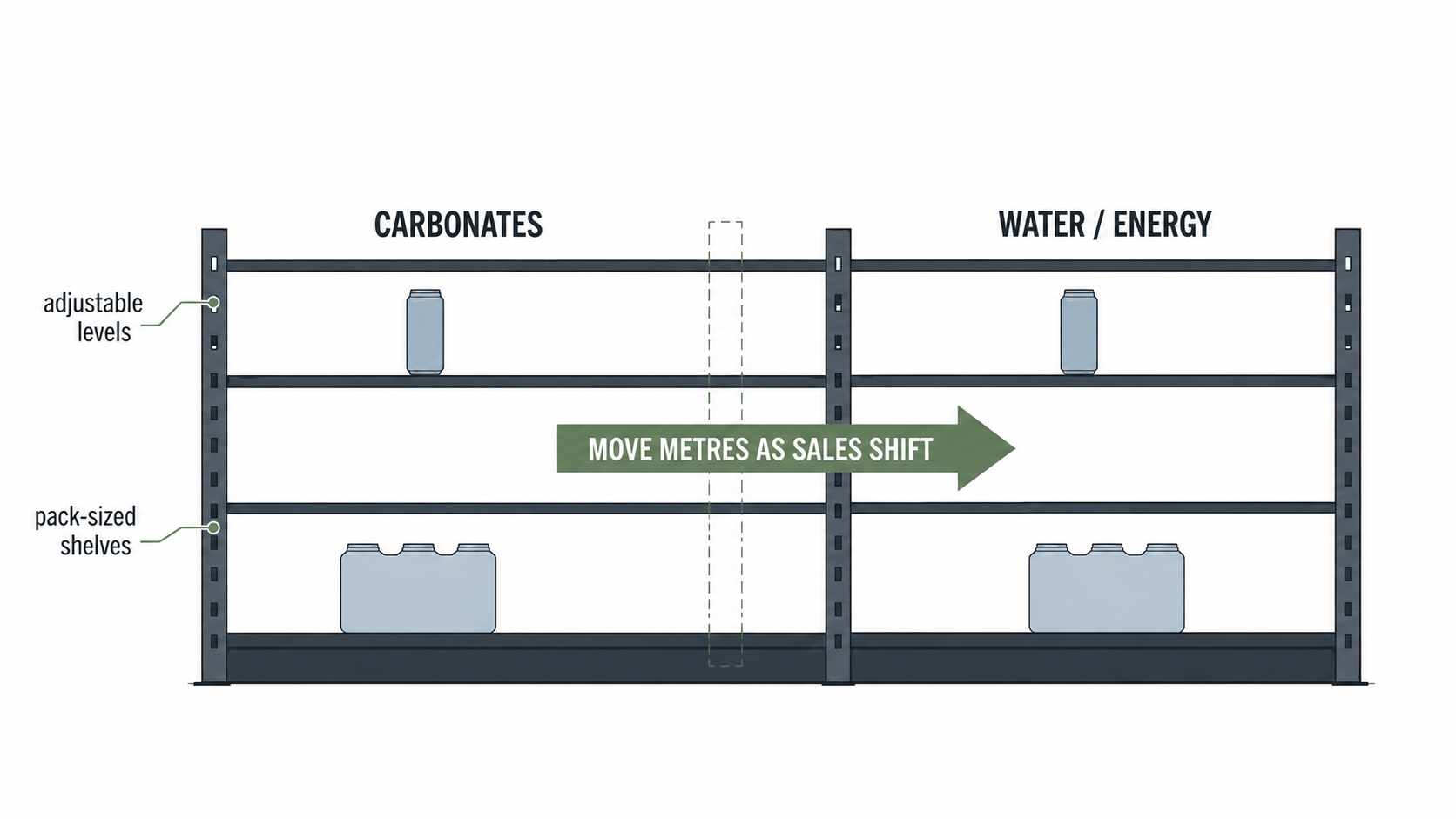
Build the run to be re-cut: adjustable shelving lets you move metres from carbonates to water and energy as sales shift — a planogram change, not a refit.
Here is where layout design earns its place. A buyer can re-write a planogram in an afternoon. They can only execute it if the store planner built the beverage run to take change.
That means a few deliberate decisions when the aisle is drawn:
Flexible, modular shelving on the ambient run — adjustable levels and movable uprights, so metres can shift from carbonates to water or energy without new fixtures
Bay widths and shelf heights that suit the real pack range — heavy multipacks and large water bottles low and strong; small energy and functional cans on shelves set for their size, not left rattling around on spacing built for two-litre bottles.
A cold single-serve wall sized and serviced with headroom — energy, water and functional drinks are increasingly bought chilled, so the cold fronts and the plant behind them should be planned for where the category is going, not pegged to today’s split
Built-in promotional space — a dump bin or pallet-drop position for the seasonal and value surges, so promotions do not steal facings from the permanent range or block the aisle.
Get this right and re-cutting the aisle to match sales is a planogram change. Get it wrong and it is a refit — which is why so many stores leave the drift in place and quietly carry the lost sales instead.
What to check on your own beverage aisle
Two quick tests, one for the buyer’s side and one for the planner’s.
First, the sales test: pull the rate of sale for each part of the beverage bay and compare it to the metres it holds. If water or energy is short by mid-morning while a row of fizzy drinks is always full, the split is out of date and costing you the growing lines.
Second, the layout test: ask whether you could move two metres from carbonates to energy next month if the numbers said so. If the shelving adjusts, the bay widths suit the packs, and the cold wall has headroom — easy. If it would mean new fixtures or a re-plumb, the aisle was built to hold one split forever, and the category will keep outrunning it.
Beverages are too big and too fast-moving a category to set once and leave. Allocate the space to what sells, review it as the market shifts, and — most of all — build the run so the shelf can keep up with the customer. That is the difference between a beverage aisle that earns its metres and one that is slowly being left behind.
Related reading
Getting the fixtures right in the first place — How to Choose the Right Shelving System for a Supermarket. -
Plan the cold fronts from the product, not the cabinet — Good Refrigeration Planning Starts With the Product, Not the Cabinet.
Planning or refitting a store?
A quick layout review can check that your beverage run is sized to what actually sells — and built to be re-cut as the category shifts, without a refit. Book a layout review with Grove Retail Design, or get in touch.
