Good Refrigeration Planning Starts With the Product, Not the Cabinet
In many retail projects, refrigeration is still treated too late and too narrowly.
It gets approached as an equipment exercise, a supplier exercise, or a technical coordination exercise. Those things matter. But they are not where good refrigeration planning starts.
Good refrigeration planning starts with the product.
Before anyone decides on cabinet types, plant positions, or pipe routes, the first questions should be clear. What product is going into each refrigerated zone? Is it self-service or staff-served? What volume needs to be carried at peak trading? What temperature does that category require? How should the product be seen, reached, replenished, and sold?
If those questions are not resolved first, the project may still end up with refrigeration, but it will not necessarily end up with the right refrigeration.
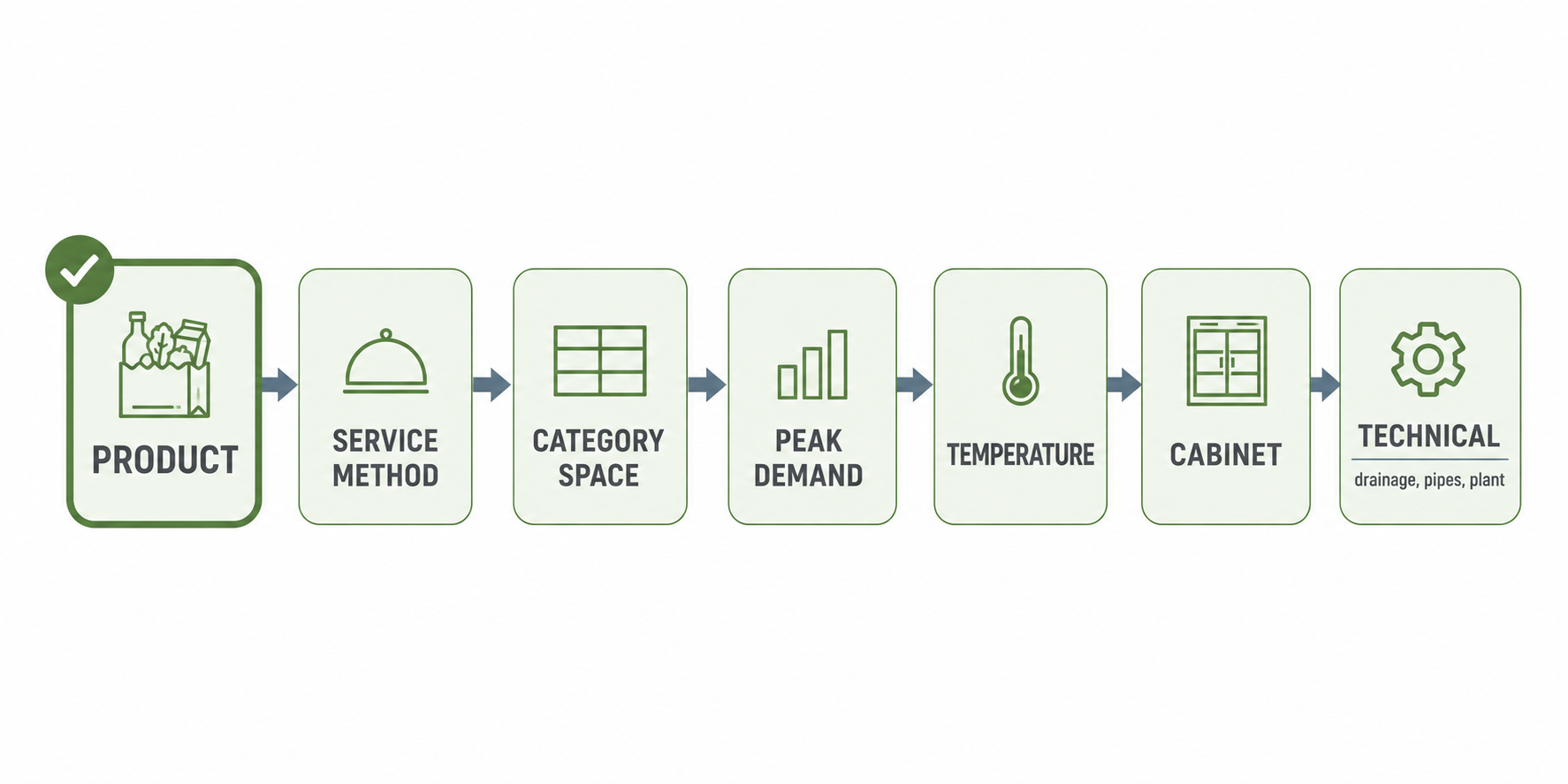
Plan in this order: the product decides the cabinet, not the other way round.
Start with the merchandising logic
This is where refrigeration planning often goes wrong.
Retailers sometimes choose the cabinet first and work backwards from there. That is the wrong sequence. The cabinet should follow the merchandising need, not define it.
A common mistake is pre-packed product ending up behind curved glass service refrigeration. The product is already packed and ready for self-service, but the customer cannot reach it. Staff now have to serve something that should simply have been picked up and bought. In that case, either the wrong cabinet was selected, or the product was merchandised in the wrong place within the cabinet.
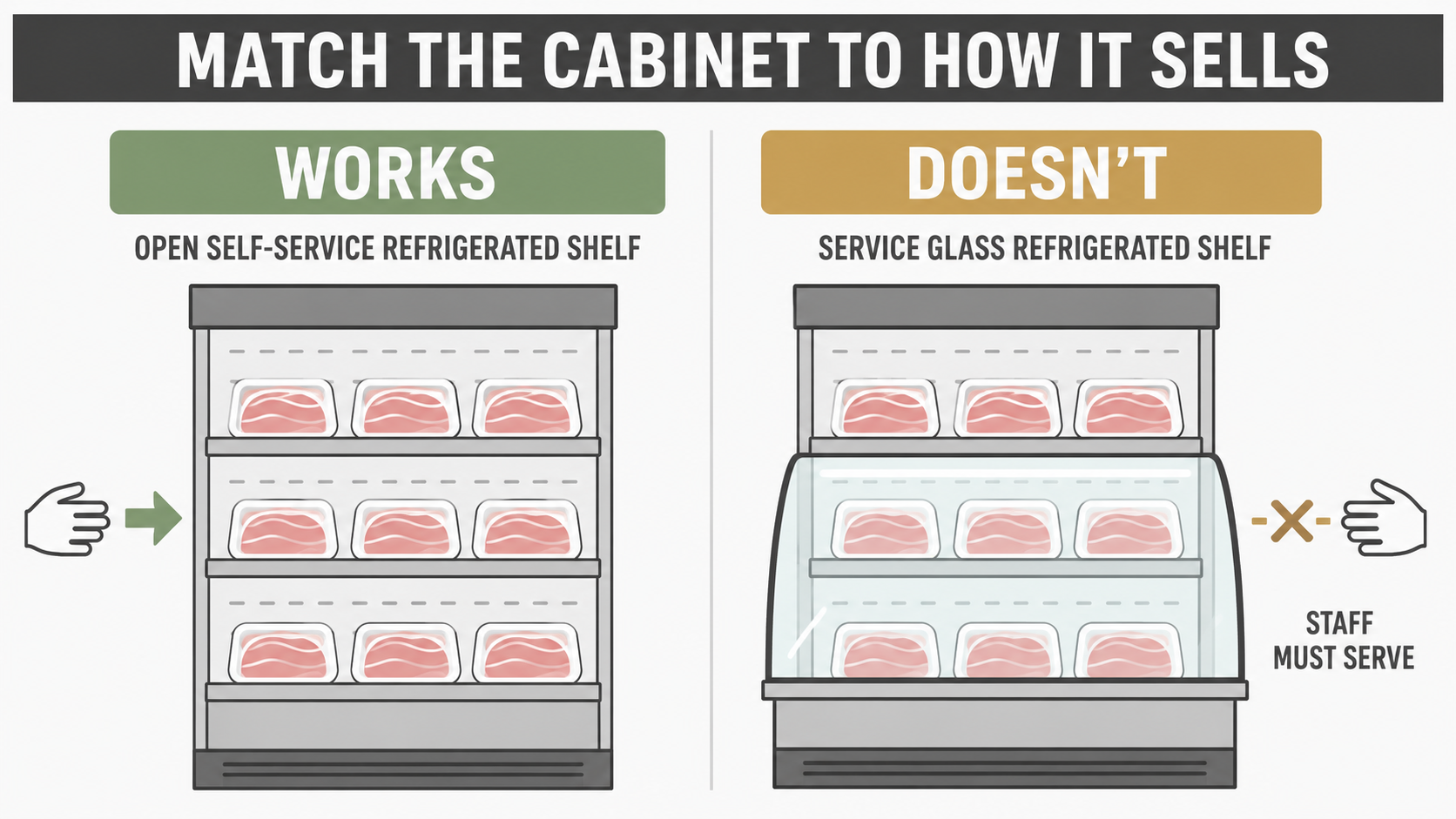
The cabinet has to match how the product is sold, or the customer can't reach it.
The same problem appears with large pack items. If the customer cannot comfortably see or reach the product, the refrigeration and merchandising logic are not working together.
This is the real issue. We do not sell cabinets. We sell merchandise. The cabinet should support the product, not become the focus of the department.
Every refrigerated category needs to be planned properly
Refrigerated categories should be managed with the same discipline as shelf categories.
That means each category needs proper thought around product mix, space allocation, pack size, visibility, access, replenishment, and temperature requirement. It is not enough to say a store needs so many metres of dairy, so many doors of frozen, or so much space for cold drinks just because another store used that format.
Experienced retailers make this mistake as well. They assume that because one store has six feet of this category or twelve feet of that category, the next store should follow the same pattern. But every store trades in its own environment. The customer mix may be different. Basket composition may be different. Sales peaks may be different. Range strategy may be different. Existing stores may even be wrong.
Each store should be studied on its own merits.
Refrigeration should not be sized just to fill a wall or complete a drawing. It should be sized to hold and sell the right product mix properly.
Peak trading matters more than average trading
One of the most overlooked issues in refrigeration planning is that stores do not trade at one constant level.
What happens on a Monday morning at nine o’clock is not the same as what happens on a Friday afternoon at five o’clock. Peak periods place very different demands on refrigeration capacity, product holding, and visual presentation.
That means refrigeration planning has to account for busy periods, not just quiet periods.
At the same time, quiet trading periods also need a strategy. If refrigeration is sized only for the peak, there must still be a sensible plan for how it looks and trades when demand is lower. That may mean using low-waste, low-cost product to maintain a full and credible presentation during quieter periods. Otherwise, the store ends up with under-filled refrigeration, weak visual impact, and a department that looks poorly planned even if the capacity is technically correct.
This is where retail understanding matters. Refrigeration is not just about holding product cold. It is about holding and presenting product in a way that supports trading throughout the week.
Temperature planning cannot be guessed
Every refrigerated category has its own requirements.
Those requirements are not interchangeable. Putting meat into a fruit and veg refrigeration environment, for example, is an obvious failure. The category, the product condition, the humidity, and the temperature requirement are different. The result will be poor product performance, poor shelf life, and poor quality.
This sounds basic, but the discipline is often weaker than it should be. Once refrigeration decisions start being made loosely, the entire department becomes vulnerable to compromise. Categories drift into the wrong spaces. Cabinets get used for products they were not planned for. The result is inefficiency at best and serious product problems at worst.
A refrigeration plan should therefore be based on a clear temperature strategy by category, not just a list of cabinets.
The technical planning still matters, but it must follow the retail logic
Once the product mix, service method, category allocation, and peak demand are understood, the technical side can be resolved properly.
This is where coordination becomes critical.
Drainage
Drainage must be planned early and properly. Poor drainage decisions are expensive to fix later and often compromise the finished floor. Floor drains in the wrong place can become useless, especially when they end up too close to freezers or in positions where freezing or poor falls make them ineffective.
The principle should be simple. Know what needs drainage, know where that drainage should go, and minimise unnecessary slab cutting wherever possible.
Pipe routes
Pipe routes always need deliberate thought.
Underground routing is often neater and less intrusive visually, but overhead routing offers flexibility. Neither approach is automatically right. The answer depends on the building, the layout, the ceiling space, future access, and how well the routes can be concealed.
If overhead routing is used, it should not be an afterthought. There must be space to hide it properly and coordinate it with the rest of the services. If underground routing is used, it must be planned early enough to avoid unnecessary disruption and compromise.
Plant room location
Plant space is another area where projects often go wrong.
Too often, once the store has been planned, whatever space is left over becomes the plant area. That is poor planning. Refrigeration plant should not be pushed into a leftover corner and then expected to perform efficiently for years.
Plant location affects service life, maintenance access, pipe run efficiency, airflow, and operating cost. If the plant is too far away, poorly ventilated, or difficult to access, the project pays for that decision for the rest of the store’s life.
In practice, it is often better to plan the back of house with the plant requirements already in mind, rather than trying to fit the plant into what remains after everything else has been drawn.
Airflow and integration
Refrigeration and air conditioning cannot be planned in isolation.
They work together in the same environment and must be balanced properly. If that integration is poor, the store ends up fighting itself. Refrigeration performance suffers, comfort suffers, and energy efficiency suffers.
This is why coordination with a proficient team matters. The design team, refrigeration specialist, and mechanical services team must all be aligned early enough for the system to work as one.
Do not let the cabinet overpower the merchandise
Another issue that deserves more attention is the visual side of refrigeration.
Retailers sometimes become overly focused on the cabinet itself, including details like cabinet colour. But the cabinet is not the hero. The merchandise is.
The best refrigeration usually allows the product to stand out while the cabinet fades into the background. If the cabinet draws too much attention to itself, it can easily weaken the merchandising outcome instead of improving it.
That does not mean cabinet choice is unimportant. It means the cabinet must serve the product, not compete with it.
What should be fixed before layout sign-off
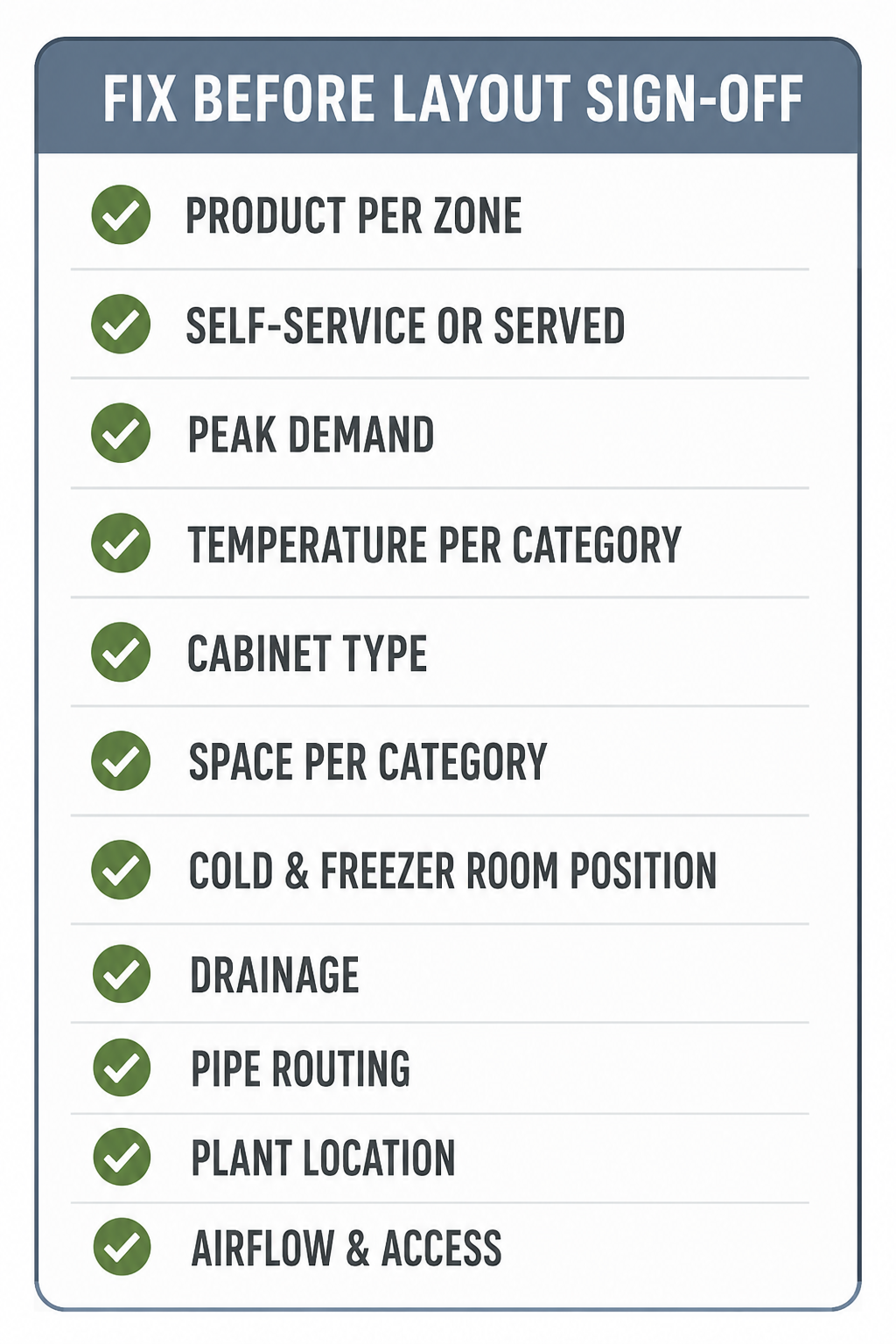
Resolve these before the layout is fixed, not after.
Before a layout is signed off, the major refrigeration principles should already be resolved.
That includes:
what product will go into each refrigerated zone
whether each category is self-service or staff-served
what the peak trading requirement is
what strategy will support quieter trading periods
what temperature range each category requires
what cabinet type best matches each product and service method
how much space each category genuinely needs
where cold rooms and freezer rooms should sit in the operational flow
what drainage requirements exist
what pipe routing approach will be used
where the plant will be located
whether airflow and maintenance access have been properly considered
whether refrigeration and air conditioning have been coordinated as one system
If these points are still open, the layout is not really ready to be fixed.
Conclusion
Good refrigeration planning does not start with the cabinet schedule, the plant room, or the supplier quote.
It starts with the product.
If the product mix, category strategy, service method, sales pattern, and temperature requirements are properly understood first, the technical design can follow in a logical way. If that sequence is reversed, the project usually ends up with compromised merchandising, wasted space, unnecessary labour, or expensive correction later.
Refrigeration should help the store trade better, not just look equipped.
That is why the right refrigeration decisions need to be fixed before layout sign-off, starting with what the store is actually trying to sell.
Need help applying this to a live supermarket or QSR project?
See Services or Contact Grove Retail Design.
FAQs
Where should refrigeration planning start in a store project?
With the product, not the cabinet. Before deciding cabinet types, plant positions or pipe routes, resolve what product goes into each refrigerated zone, whether it is self-service or staff-served, the peak volume it must carry, and the temperature each category requires. The cabinet should follow the merchandising need, not define it.
What should be fixed before layout sign-off?
The major refrigeration principles: what product goes in each zone, whether it is self-service or staff-served, the peak trading requirement, the temperature per category, the cabinet type per product, the space each category needs, cold and freezer room positions, drainage, pipe routing, and plant location. If these are open, the layout is not ready.
Why size supermarket refrigeration for peak trading rather than average?
Stores do not trade at one constant level. A Monday morning is not the same as a Friday afternoon, and peak periods place very different demands on capacity, product holding and presentation. Size for the busy periods, then plan how the department looks and trades when demand is lower so it never appears under-filled.
Can refrigeration temperature be standardised across categories?
No. Every refrigerated category has its own temperature, humidity and product requirements, and they are not interchangeable. Putting meat into a fruit and veg environment, for example, gives poor shelf life and poor quality. A refrigeration plan should be based on a clear temperature strategy by category, not just a list of cabinets.
Why does refrigeration plant room location matter?
Plant should not be pushed into whatever space is left once the store is planned. Its location affects service life, maintenance access, pipe run efficiency, airflow and operating cost. It is usually better to plan the back of house with the plant requirements already in mind rather than fitting the plant into leftover space.
Should the cabinet or the merchandise lead the design?
The merchandise. We do not sell cabinets, we sell merchandise, so the cabinet should support the product rather than become the focus of the department. The best refrigeration lets the product stand out while the cabinet fades into the background. If the cabinet draws too much attention to itself, it weakens the merchandising outcome.
