Where to Put Flowers in a Supermarket (Placement & Impulse)
Flowers nearly always go just inside the front doors. It is high-traffic, and they add a bit of colour and life to the entrance — both real. But look closely and the entrance spot is usually a habit, not a planning decision. Flowers are an impulse department, and the entrance is the one place in the store where the shopper is least in a buying frame of mind: they have just walked in, they are thinking about the weekly shop, and they will not pass the flowers again on the way out. The place a shopper is paused, holding a basket and ready to add one more thing, is the checkout queue. Where flowers go is a trade decision — and for an impulse perishable, the checkout and the gifting aisle often beat the door.
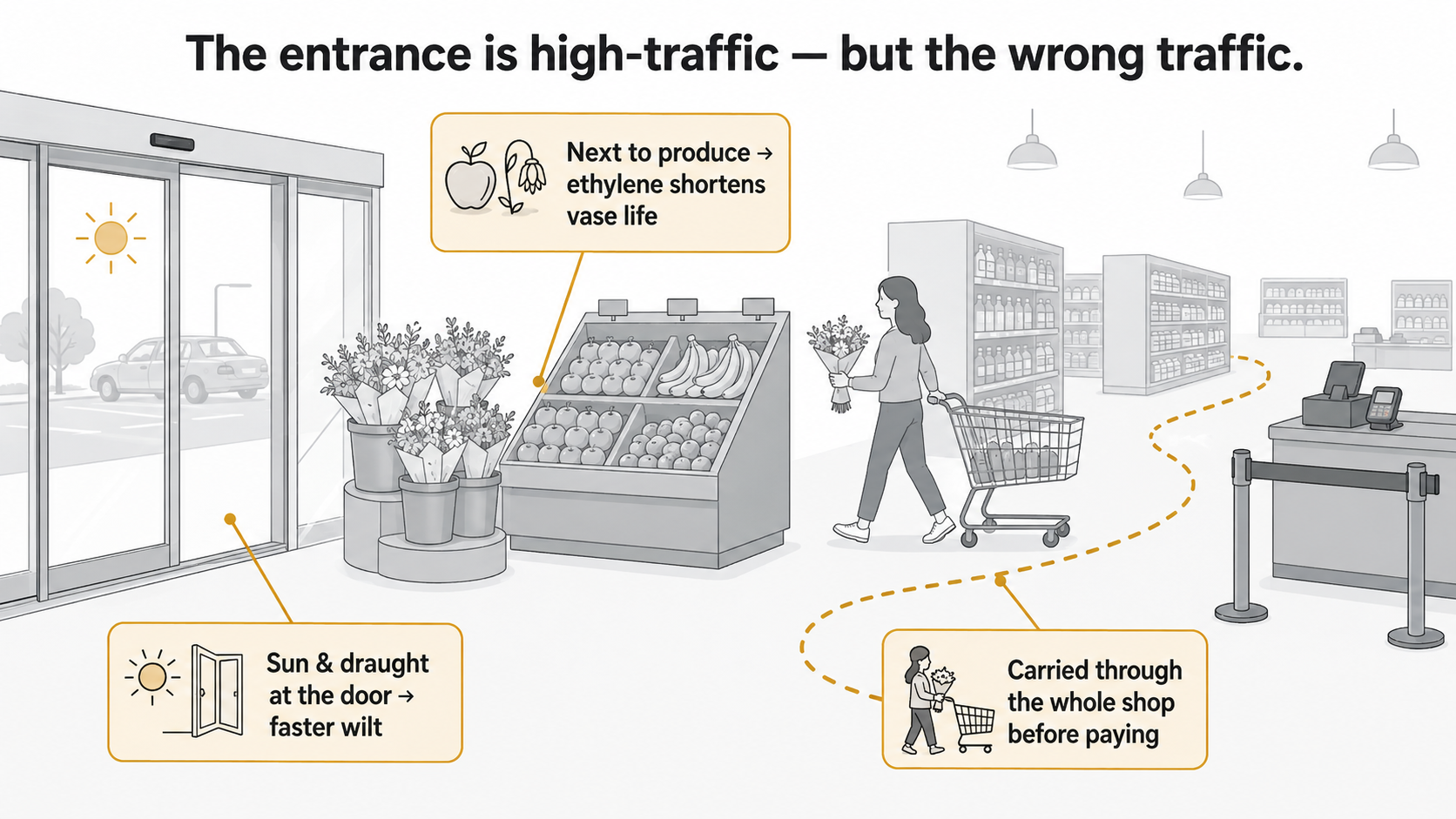
The default entrance spot brings three problems flowers handle badly — produce ethylene, sun and draught, and a fragile bunch carried through the whole shop before it is paid for.
Flowers are a perishable, not a bucket of colour
Before the placement, the thing most layouts miss: flowers are the most demanding perishable in the store dressed up as decoration. They are received, re-cut and conditioned in water, held cool, watered every day and culled the moment they turn. Their dominant cost is not the stock — it is the vase-life cull, the bunches that die on display before anyone buys them. Everything about where they go and how they are served either slows that cull or speeds it up. Treat flowers as a bucket of colour to brighten the door and the cull runs high, the display looks tired, and a high-margin department quietly loses money. Treat them as a perishable that happens to sell on impulse, and they earn.
The entrance is high-traffic — but it's the wrong traffic, and it brings three problems
The case for the entrance is footfall and ambiance. But produce usually already owns the entrance and does the ambiance job — a wall of colour and fresh smell is the first thing most stores want a shopper to see. Adding flowers there stacks two fresh departments on top of each other, and it brings three problems flowers handle badly.
First, the adjacency is the worst in the store. Flowers next to fruit and veg means flowers next to ethylene — the gas ripening produce gives off — and ethylene shortens vase life. It cuts both ways: the flowers age faster, and the extra ethylene can push the produce to ripen too fast as well. Two departments lose shrink to one lazy placement.
Second, the entrance is hard on a fragile perishable. Doors bring sun and draught — the two things that cut vase life fastest. A flower stand baking in the afternoon sun by an open sliding door is a stand of next-day culls.
Third, it asks too much of the shopper. Bought at the entrance, a wet, delicate, easily-crushed bunch has to be carried through the entire shop, in and out of a trolley, before it is paid for. Most shoppers will not start their trip that way — so even the shoppers who would buy, don't.
The checkout is where impulse actually sells
An impulse buy needs two things: traffic and intent. The entrance has the traffic but not the intent. The checkout has both. A shopper in the queue is paused, has a moment, is already in the act of paying, and is exactly where the store puts everything else it wants bought on impulse. A bunch of flowers there is a five-second decision — pick it up, it goes on the belt, it is paid for immediately and carried straight out, fresh, without a lap of the store. That is the natural home for the impulse grab. Where the store runs a communal queue, the entrance to that queue is the sweet spot — the shopper is slowing down and looking around with buying already in mind.
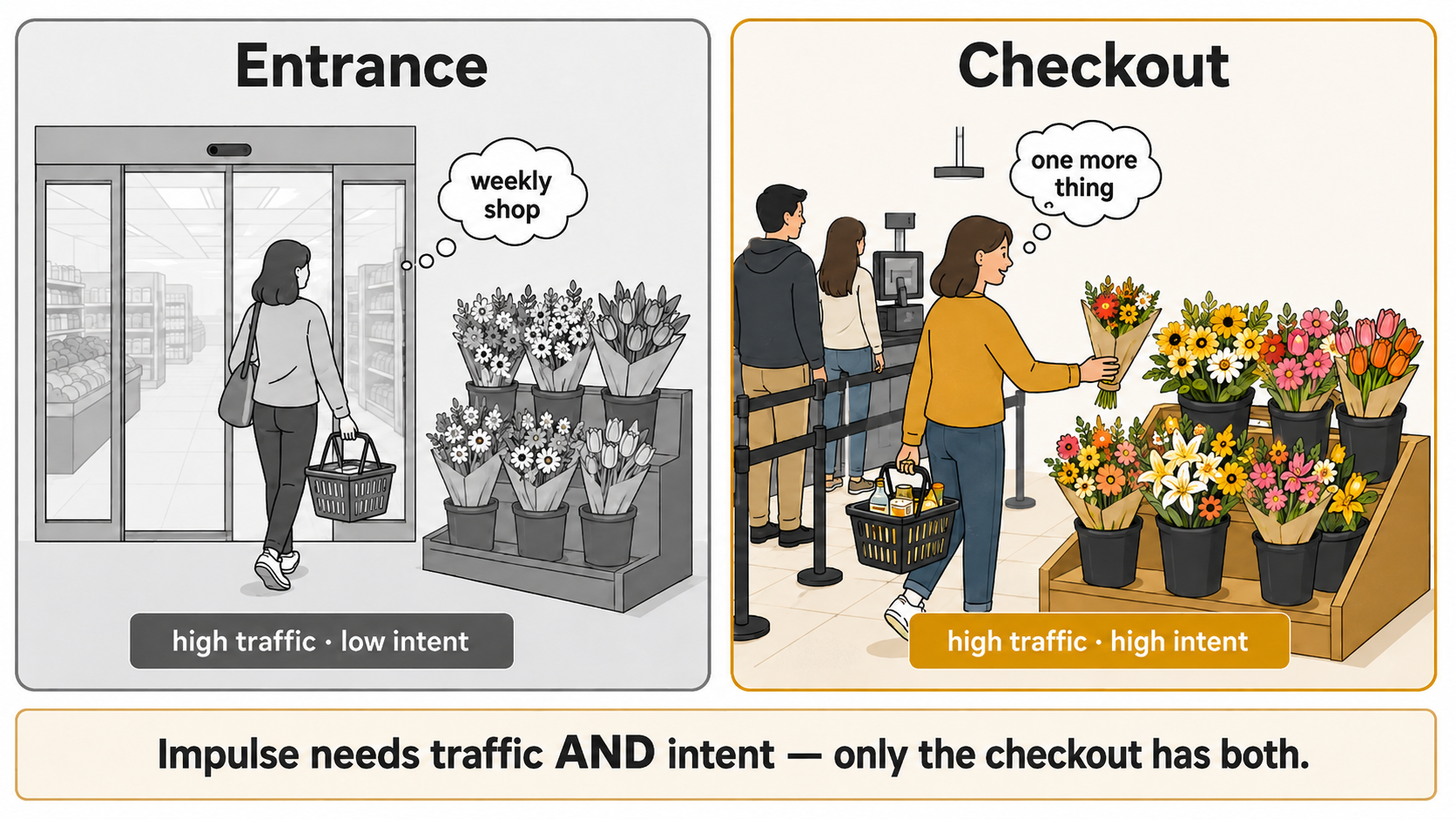
An impulse buy needs traffic and intent — the entrance has the traffic but not the intent, and the checkout has both, which is why the same bunch sells harder in the queue.
Gifting is the other home — where flowers finish an occasion
The second real home for flowers is the gifting aisle — the cards, the wrap, the occasion lines. Flowers rarely sell alone; they complete something. A card needs a bunch to go with it; a gift is finished by flowers; a bottle and a bunch is a ready-made "I'm coming round" present. Placed beside gifting, flowers stop being a single grab and start lifting the whole occasion basket — which is the same trade-up logic that runs through the whole fresh side of the store. The occasion peaks — Valentine's, Mother's Day, and the steady sympathy trade — are gifting missions first, and flowers sitting in the gifting aisle catch them.
Wherever they land — design out the produce clash
The one rule that holds no matter where flowers go: keep them physically separated from fresh produce. Do not share a run, a chiller or the same pocket of air with ripening fruit and veg. This is the single most common flower-placement mistake, and it is the most expensive, because it quietly raises shrink on both departments. If the only high-traffic spot on offer is near the produce, that is the reason to choose the checkout or gifting instead — the entrance placement usually forces the exact adjacency you most want to avoid.
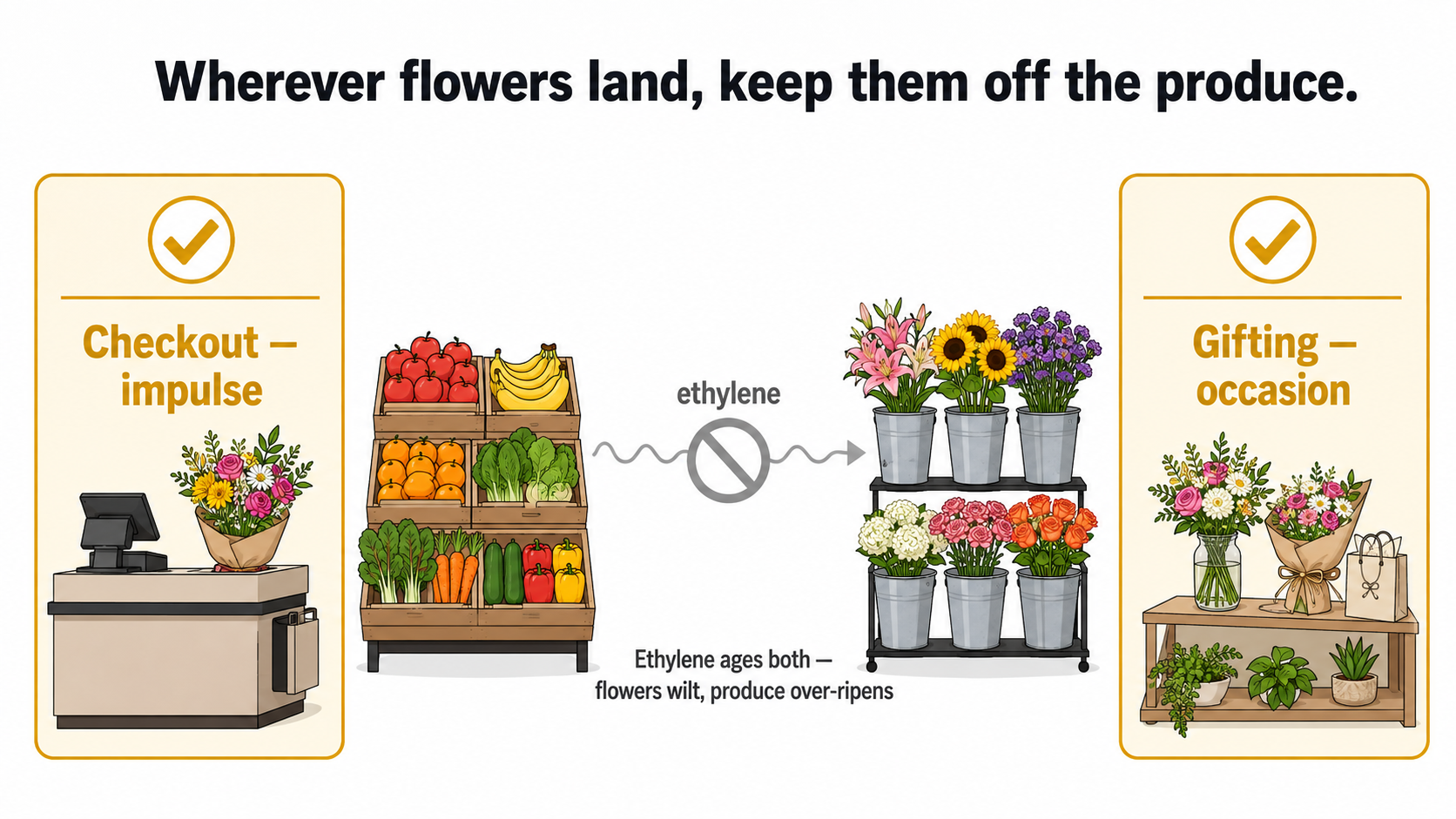
The one adjacency to design out everywhere — flowers next to produce, where ethylene ages both departments at once; the checkout and gifting are the better homes.
Give flowers their own route, water, and a cool light
Placement is half the job; handling is the other half, and it is where the cull is won or lost.
Give flowers their own clean route from receiving through a back-of-house conditioning area to the display, so stems are re-cut, conditioned and brought forward without being dragged across the store and crushed. Give the conditioning area and the display water and drainage — flowers live in water, and without it you get wet floors and dry buckets, the mess-and-wilt combination that kills a display. Hold them cool — a floral chiller at roughly 2–8 °C with humidity, separate from the food refrigeration, extends vase life more than anything else you can do. And light them cool and low-heat — a hot downlight over a flower display cooks the very stock it is meant to show off. None of this is exotic; all of it is decided on the plan, and all of it is cheaper drawn in from the start than retrofitted after the build.
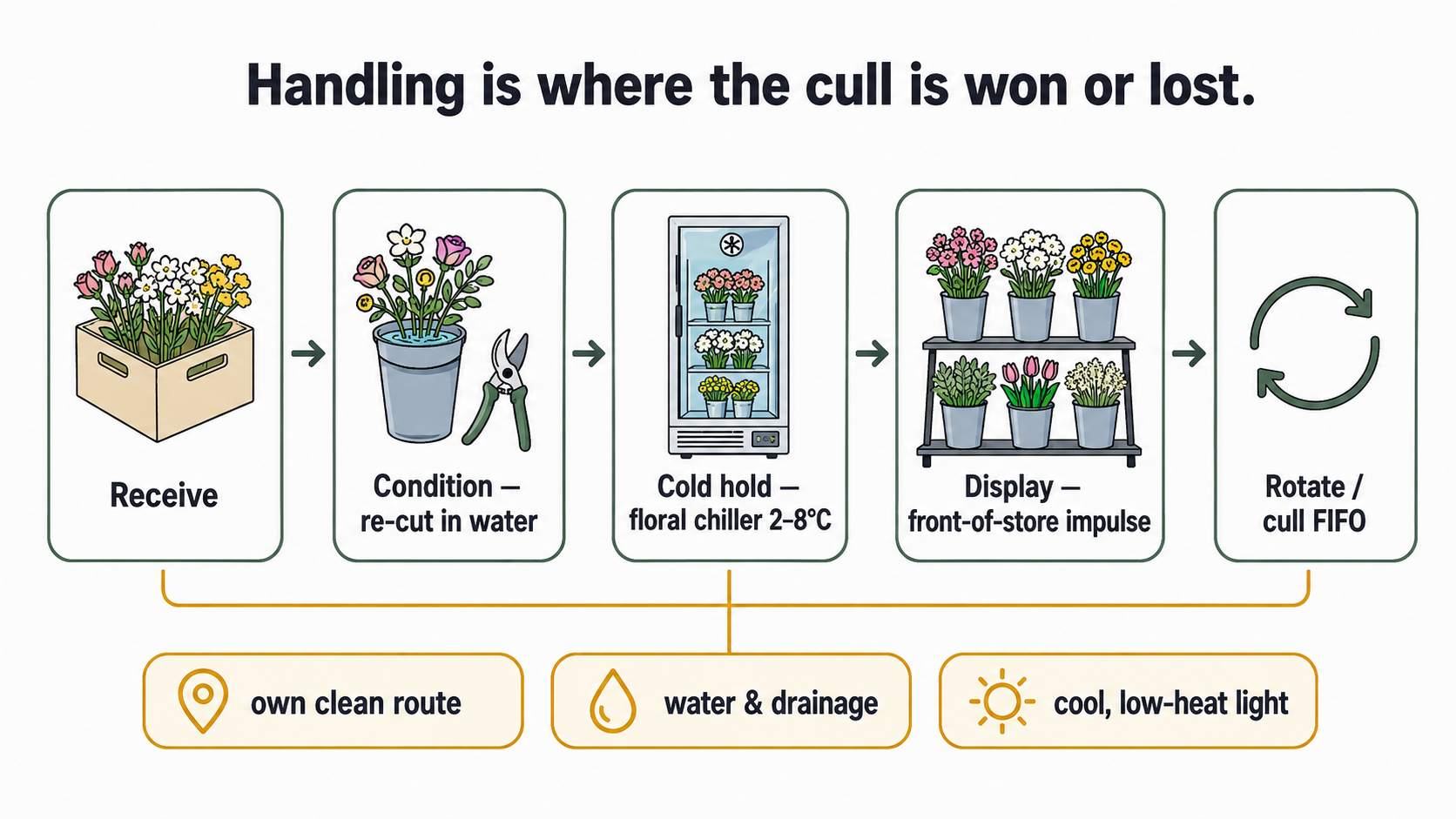
Handling is half the job — flowers need their own clean route from the back, water and drainage, cool holding at roughly 2–8 °C and a cool, low-heat light, all decided on the plan and cheapest drawn in from the start.
Plan for the peaks, and judge it on margin after shrink
Flowers have huge occasion peaks — Valentine's, Mother's Day, the sympathy trade — where a normal week's volume can several-fold in a day. Two failures sit here: missing the peak (empty buckets when the demand is there) and over-buying it (a wall of stock that culls out the week after). Both are planning decisions: a labour surge for the conditioning and serving, and a buy matched to the catchment rather than to optimism.
And judge the department the honest way — on margin after shrink, not gross margin on a bunch. Flowers are low-energy and, at the buy-in end, fairly low-labour, but their cull is real money. Slow that cull with the right placement, the right handling and a buy sized to demand, and the strong per-bunch margin actually reaches the bottom line. Let the stock die at a sunny entrance next to the produce, and the margin dies with it.
The takeaway
Take one thing to your next flowers drawing: place flowers for the impulse and the occasion — at the checkout and beside gifting — not out of habit at the entrance, and keep them physically away from produce wherever they land. The entrance is high-traffic but low-intent, hard on a fragile perishable, and it forces the produce clash that raises shrink on two departments at once. The checkout catches the shopper ready to buy; gifting catches the occasion. Get the placement right, give flowers their own route, water and a cool light, and a high-margin impulse department stops wilting at the door and starts earning.
Planning or replanning where flowers go? A layout review will tell you whether flowers are placed for the impulse or stranded at the entrance, whether they are sitting where produce ethylene is ageing them, and whether they have the route, water and cool light they need to last — before anything is drawn for approval. Start with a layout review or get in touch.
FAQ
1. Where should flowers go in a supermarket?
Place flowers for the impulse and the occasion, not out of habit at the entrance. Flowers are a high-impulse, high-margin perishable, and an impulse buy needs both traffic and intent. The entrance has the traffic but not the intent — the shopper has just walked in, is thinking about the weekly shop, and will not pass the flowers again on the way out. The checkout queue has both: the shopper is paused, holding a basket, already in the act of paying, and a bunch of flowers there is a five-second decision that goes straight on the belt and out of the store, fresh. The other strong home is beside gifting — the cards and occasion lines — where flowers complete a present and lift the whole basket, and where the Valentine's, Mother's Day and sympathy peaks are caught. Wherever flowers land, keep them physically away from fresh produce, and give them their own clean route from the back, water and drainage, and a cool, low-heat light so they last.
2. Why shouldn't flowers go at the supermarket entrance?
The entrance is high-traffic, but for flowers it is the wrong kind of traffic and it brings three problems. First, it usually sits flowers next to produce, and ripening fruit and veg give off ethylene, which shortens vase life — while the flowers can push the produce to over-ripen in return, so two departments lose shrink to one placement. Second, the entrance exposes a fragile perishable to sun and draught, the two conditions that cut vase life fastest. Third, it asks the shopper to carry a wet, delicate, easily-crushed bunch through the whole shop, in and out of a trolley, before it is paid for — so even shoppers who would buy, don't. On top of all that, the shopper at the entrance has just arrived and is not yet in a buying frame of mind, and produce usually already does the first-impression, ambiance job the entrance flowers are meant to do. The entrance is habit, not a planning decision.
3. Why is the checkout a good place for flowers?
Because an impulse buy needs traffic and intent, and the checkout has both. A shopper in the queue is paused, has a moment, is already paying, and is exactly where the store puts everything else it wants bought on impulse. A bunch of flowers there is a quick decision — it goes on the belt, is paid for immediately, and is carried straight out of the store fresh, without a lap of the aisles that crushes it. Where the store runs a communal queue, the entrance to that queue is the sweet spot, because the shopper is slowing down and looking around with buying already in mind. The checkout catches the shopper at the one moment they are most ready to add one more thing, which is what an impulse department needs.
4. Can flowers be displayed next to fruit and vegetables?
No — this is the single most common and most expensive flower-placement mistake. Ripening fruit and vegetables give off ethylene gas, which shortens the vase life of cut flowers, so flowers next to produce die faster and cull harder. It also runs the other way: the flowers can raise the ethylene around the produce and push it to ripen too fast, so both departments lose shrink to the one adjacency. Keep flowers physically separated from fresh produce — do not share a run, a chiller or the same pocket of air. If the only high-traffic spot on offer is beside the produce, that is a reason to choose the checkout or the gifting aisle instead, because the default entrance placement usually forces exactly the adjacency you most want to avoid.
5. What conditions do supermarket flowers need to stay fresh?
Flowers are the most demanding perishable in the store, and their dominant cost is the vase-life cull — the bunches that die before anyone buys them — so the conditions are what protect the margin. Give them their own clean route from receiving through a back-of-house conditioning area to the display, so stems are re-cut and conditioned and brought forward without being dragged across the store and crushed. Give the conditioning area and the display water and drainage, because flowers live in water and without it you get wet floors and dry buckets. Hold them cool — a floral chiller at roughly 2 to 8 degrees Celsius with humidity, separate from the food refrigeration — which extends vase life more than anything else. And light them with cool, low-heat lighting, because a hot downlight cooks the very stock it is meant to show off. All of it is decided on the plan, and all of it is cheaper drawn in from the start than retrofitted after the build.
6. How do you plan a supermarket flower department for the occasion peaks?
Flowers have huge occasion peaks — Valentine's Day, Mother's Day and the steady sympathy trade — where a normal week's volume can rise several-fold in a single day, and there are two ways to get it wrong. Missing the peak leaves empty buckets when the demand is there; over-buying it leaves a wall of stock that culls out the week after. Both are planning decisions rather than bad luck. Plan a labour surge for the extra conditioning and serving the peak needs, and match the buy to the catchment's real demand rather than to optimism. Placing flowers beside the gifting aisle helps here too, because the peaks are gifting missions first — the shopper buying a card, a present or sympathy flowers is already in the right part of the store.
7. How do you reduce shrink in a supermarket flower department?
Judge the department on margin after shrink, not gross margin on a bunch, and then design the cull out. The cull is driven by placement, handling and buying, all of which are decisions rather than luck. Place flowers away from produce ethylene and out of the sun and draught at the entrance, so they are not ageing before they sell. Give them their own route from the back so stems are not crushed crossing the store, water and drainage so buckets are never dry, a floral chiller to hold them cool, and a cool, low-heat light that does not cook them. Match the buy to demand, especially around the occasion peaks, so stock is not over-ordered into a cull. Flowers are low-energy and, at the buy-in end, fairly low-labour, so the cull is where the money is won or lost — slow it with the right placement and handling and the strong per-bunch margin actually reaches the bottom line.
