Grocery Store Design Layout and Planning Services
Grocery store projects usually start long before working drawings, quotations, or site work begin.
The quality of the final store depends heavily on the quality of the planning before drawings start. If early decisions are rushed, unclear, or based on incomplete information, the project usually pays for it later through redesign, delays, coordination problems, and unnecessary cost.
Grove Retail Design supports grocery store projects with practical layout development, planning input, working drawing coordination, and rollout support for food retail environments.
This support is most useful for independent grocers, supermarket owners, project managers, and developers who need a store to work commercially as well as physically.
Why planning matters in grocery store design
A grocery store is not just a box filled with shelving.
It is a working retail system made up of customer flow, department relationships, product handling, refrigeration needs, service points, back-of-house support, and fit-out coordination. Good planning helps bring those elements together early enough to make informed decisions before costs and constraints become harder to manage.
Strong early planning helps to:
use the available space more effectively
improve department adjacencies
reduce later layout changes
support a more efficient customer journey
align merchandising intent with physical layout
reduce design and fit-out rework
improve coordination before working drawings begin
For most grocery store projects, the earlier the right planning decisions are made, the easier the rest of the project becomes.
What inputs are needed before store layout planning starts
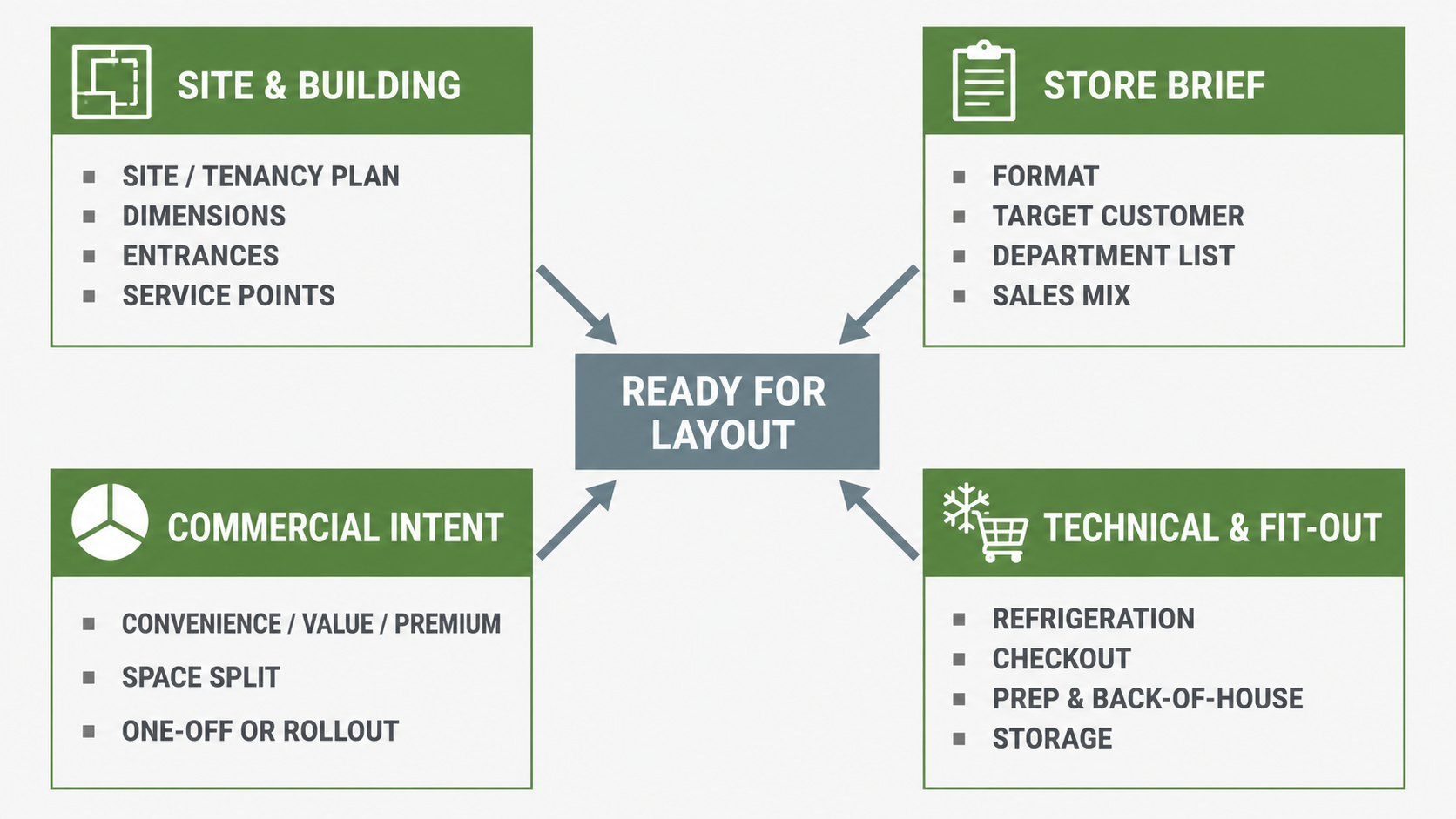
Four input groups sit behind every good layout — site, brief, commercial intent and technical direction.
A good layout does not begin with guesswork. It begins with the right project information.
Before layout planning starts, the following inputs are usually needed.
Site and building information
site plan or tenancy plan
existing drawings if available
key dimensions and structural constraints
entrance positions
service points and back-of-house limitations
landlord conditions where relevant
Store brief
intended store format
target customer
department list
approximate sales mix
service counters or fresh departments required
operational priorities
Commercial and operational intent
whether the store is convenience-led, value-led, or more premium
how much space should go to fresh, grocery, service, or promotional areas
whether the store is a once-off project or part of a rollout
expected traffic levels and basket behaviour
Technical and fit-out direction
refrigeration approach
equipment assumptions
checkout strategy
prep and back-of-house needs
storage requirements
likely service coordination requirements
The better these inputs are defined, the stronger the layout process becomes.
Layout development vs working drawings
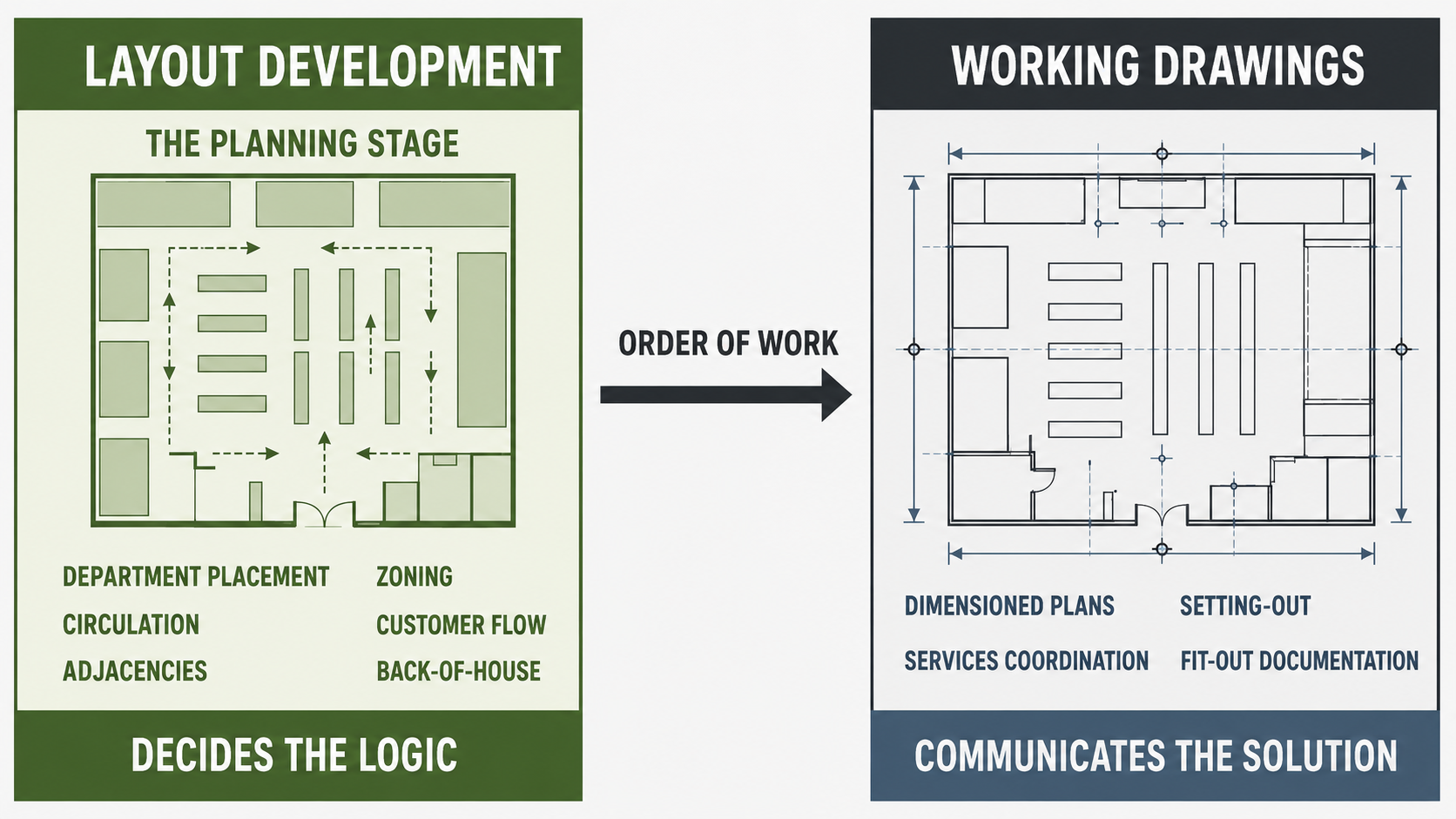
Layout development decides the logic; working drawings communicate it — get the first stage right and the second runs smoother.
These two stages are often confused, but they are not the same thing.
Layout development
Layout development is the planning stage.
This is where the store is organised at a practical level:
department placement
circulation
adjacencies
zoning
customer flow
major fixtures and counters
back-of-house relationships
broad operational logic
The goal at this stage is to decide what the store should be and how it should work.
Working drawings
Working drawings come later.
This is where the approved planning intent is translated into coordinated technical information for pricing, approvals, and construction or fit-out. Depending on the project, this may include dimensioned plans, setting-out information, reflected ceiling layouts, finishes, services coordination points, and other fit-out documentation.
The goal at this stage is to communicate clearly enough for the next project parties to act on the design.
In simple terms:
layout development decides the logic
working drawings communicate the solution
If layout decisions are weak, working drawings become slower, less stable, and more prone to revision.
Common mistakes in grocery store planning
Starting drawings before the brief is clear
This often leads to avoidable revisions. A project moves into documentation too early, before key decisions have been made.
Treating layout as a purely visual exercise
A store can look neat on paper and still work badly in reality if department flow, replenishment, prep needs, and customer movement have not been thought through properly.
Underestimating back-of-house requirements
Storage, receiving, prep, waste handling, staff areas, and service support are often squeezed too late in the process.
Weak coordination between concept and delivery
A concept may be approved in principle, but if technical realities are not considered early enough, the project can drift into costly compromises later.
Late changes after approval
Once a general layout is approved, uncontrolled changes tend to affect multiple downstream items, including drawings, equipment, services, programme, and cost.
Using incomplete project information
Missing site information, unclear operational requirements, or vague department intent usually creates uncertainty that shows up later as redesign.
These problems are common, but they are also preventable with better early planning discipline.
When to bring in specialist support
Specialist support is most useful before the project becomes locked into the wrong direction.
It is especially valuable when:
a new grocery store is being planned from a raw shell or new site
the operator needs help structuring the layout brief
the relationship between layout, concept, and drawings is unclear
there are multiple decision-makers involved
the project forms part of a wider rollout or repeatable format
the owner wants clearer project information before detailed drawing work starts
This kind of support does not need to make the process more complicated. Done properly, it helps reduce confusion and improve decision quality before the technical stages begin.
How Grove Retail Design supports grocery store planning
Grove Retail Design supports grocery store projects through practical planning input shaped by real retail development experience.
Depending on the project, this may include:
layout development
department zoning and planning logic
concept direction
working drawing support
fit-out documentation input
project information review before drawings begin
rollout support for repeat store formats
The focus is not on decorative design for its own sake. The focus is on making the store commercially sensible, operationally practical, and easier to deliver.
Grocery Store Design Layout and Planning Services
Need support on a live grocery store project?
If you need help with layout planning, working drawings, or early project input for a grocery store or supermarket, get in touch.
Frequently asked questions
What information is needed before a grocery store layout can start?
A layout starts with the right project information, not guesswork: site or tenancy plans, key dimensions and structural constraints, entrance and service points, and a store brief covering format, target customer, department list and sales mix. Commercial intent and refrigeration, checkout and back-of-house direction round it out.
What is the difference between layout development and working drawings?
They are two different stages. Layout development is the planning stage — department placement, circulation, adjacencies, zoning, customer flow and back-of-house relationships. Working drawings come later, translating the approved plan into coordinated technical information for pricing, approvals and construction. In short: layout development decides the logic, working drawings communicate the solution.
Why does planning matter so much in grocery store design?
A grocery store is a working retail system — customer flow, department relationships, refrigeration, service points and back-of-house support. Good early planning brings those together before costs and constraints harden. It helps use space more effectively, improve department adjacencies, reduce later layout changes and cut design and fit-out rework.
What are the most common mistakes in grocery store planning?
Starting drawings before the brief is clear, treating layout as a purely visual exercise, and underestimating back-of-house needs like storage, receiving and prep. Weak coordination between concept and delivery, late changes after approval, and using incomplete project information also cause avoidable redesign, delays and cost. All are preventable with better early planning.
When should I bring in specialist support for a store layout?
Before the project locks into the wrong direction. It is most valuable when a new store is planned from a raw shell, an existing store is being refurbished or resized, the layout brief needs structuring, several decision-makers are involved, or the store forms part of a wider rollout.
How does Grove Retail Design support grocery store projects?
Through practical planning input shaped by real retail development experience. Depending on the project, that can include layout development, department zoning, concept direction, working drawing support, fit-out documentation input, project information review before drawings begin, and rollout support for repeat formats. The focus is a store that is commercially sensible and easier to deliver.
