How to Plan a Supermarket Food-to-Go Department (Plan the Engine First)
Food-to-go works on a clear shopper mission, and the plan has to serve it. The department you want most shoppers to walk to is the hot food counter — the cooked, made-on-site offer that pulls people in and carries the margin. The grab-and-go at the front of the store is almost a duplication of that counter's top-moving lines, set up for two shoppers: the one who hasn't the time to walk to the department, and the one who passed it without buying and gets a second chance on the way out. Plan around that mission and both do their job. Treat the whole thing as a fridge and a coffee machine near the till and you get an offer that looks the part on opening day and stalls under a weekday lunch.
Because food-to-go is really two things at once. Behind the offer is a working kitchen — cooking, hot-holding, an extract canopy, grease in the drains and the labour bill a proper cook line brings. In front of it is a fast service zone, where a quick buyer wants to grab a coffee and a sandwich and be gone. The display is the easy part. The engine behind it, and the fast lane in front of it, are the department.
And it is worth getting right because of the one commercial fact that sets food-to-go apart: it gives a supermarket a second reason to visit. A shopper does a full shop once a week. They buy a breakfast, a lunch or a quick supper far more often — and those are trips a weekly-shop layout never captures. Food-to-go drives frequency, and frequency is footfall you do not otherwise have. But the extra visit only arrives if the offer is ready at the rush and quick to grab and pay for. Here is the order to plan it in.
Choose the production model first, because it is the labour and energy bill
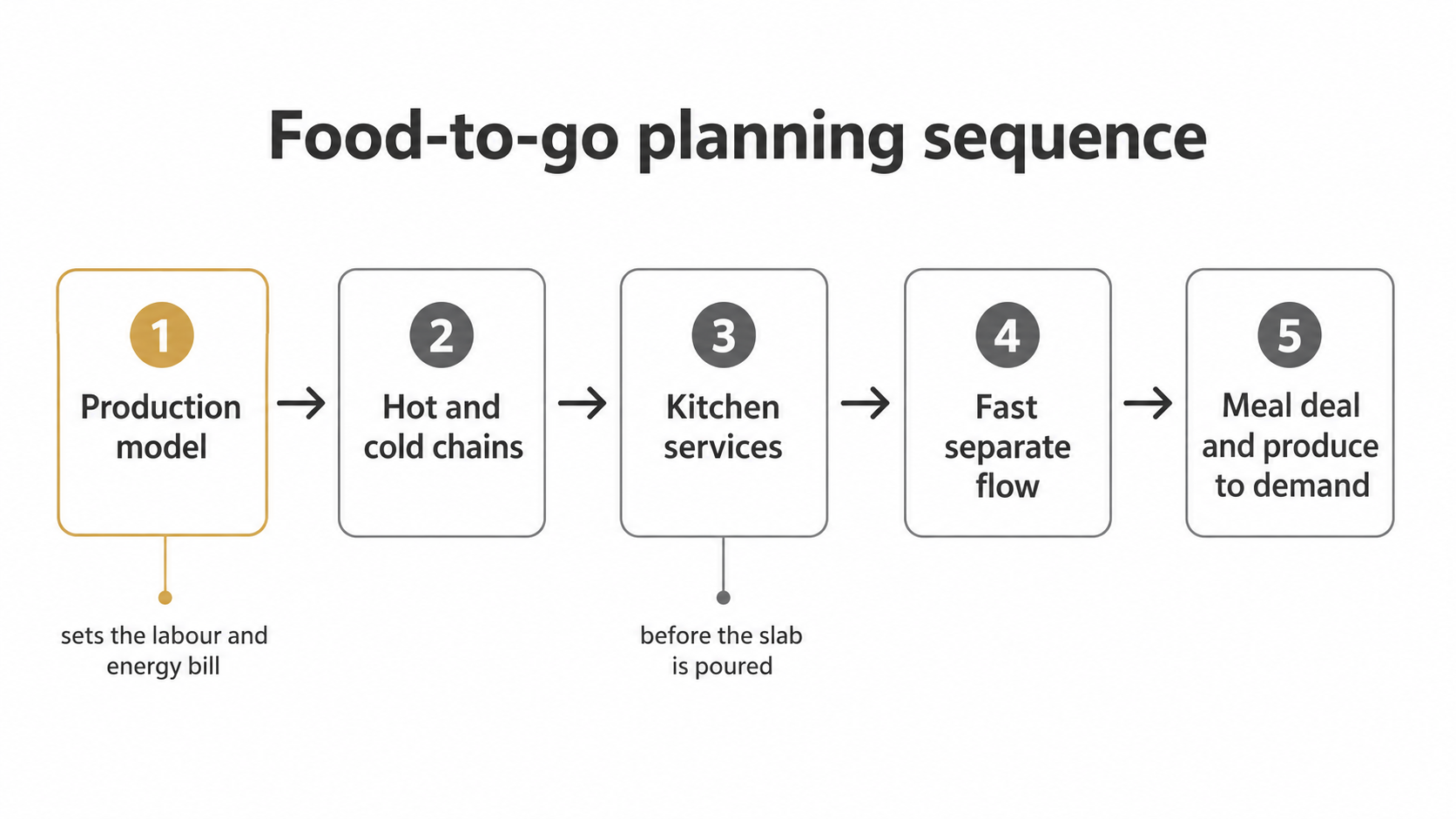
The department is planned production model first. Get the model and the two chains right and the services, the flow and the meal deal all follow — start with the shelf by the till and you will be retrofitting the kitchen behind it.
Before a single line is drawn, decide how this food-to-go is going to be produced. That one choice sets the kitchen size, the equipment, the services, the staffing and the energy load — everything downstream.
There are three broad production models, and they are a labour and energy decision as much as a food one:
Cook on site (a working kitchen) — food prepped and cooked in-store from raw. The strongest offer, the freshest smell and the best margin on a cooked line, and the highest labour and energy: it needs skilled kitchen staff, a full cook line, extract, hot-holding and blast chill, and the power or gas to run them.
Finish / regenerate — food arrives part-prepared and is finished, baked off or regenerated in-store. Moderate labour and skill, a lighter kitchen, but still hot-holding, extract for what is cooked, and the cold chain for what is chilled.
Bought-in — ready-made lines brought in chilled and simply displayed. The lowest labour and the simplest to run, but none of the cooked-on-site theatre or aroma, a narrower margin, and a reliance on a supplier for the whole offer.
The real decision is how far up that scale to build, and it is a commercial and operational call, not a technical one. A working kitchen is labour-heavy and energy-heavy — it is one of the highest heat and energy loads in the whole store. In a market where skilled kitchen labour is scarce or expensive, or where power is unreliable, a finish/regenerate model with a strong chilled range can carry most of the convenience offer for far less wage and energy cost than a full cook line running all day. The model has to be chosen and written down before anyone sizes the kitchen, the counter or the holding — because changing it after the layout is issued does not move a shelf, it re-scales the kitchen, the extract and the services, and cascades a revision through every drawing in the set. And in a load-shedding market, plan the hot-hold and the cold chain around the power you can actually count on.
Design both chains — hot and cold — and keep the heat off the cold
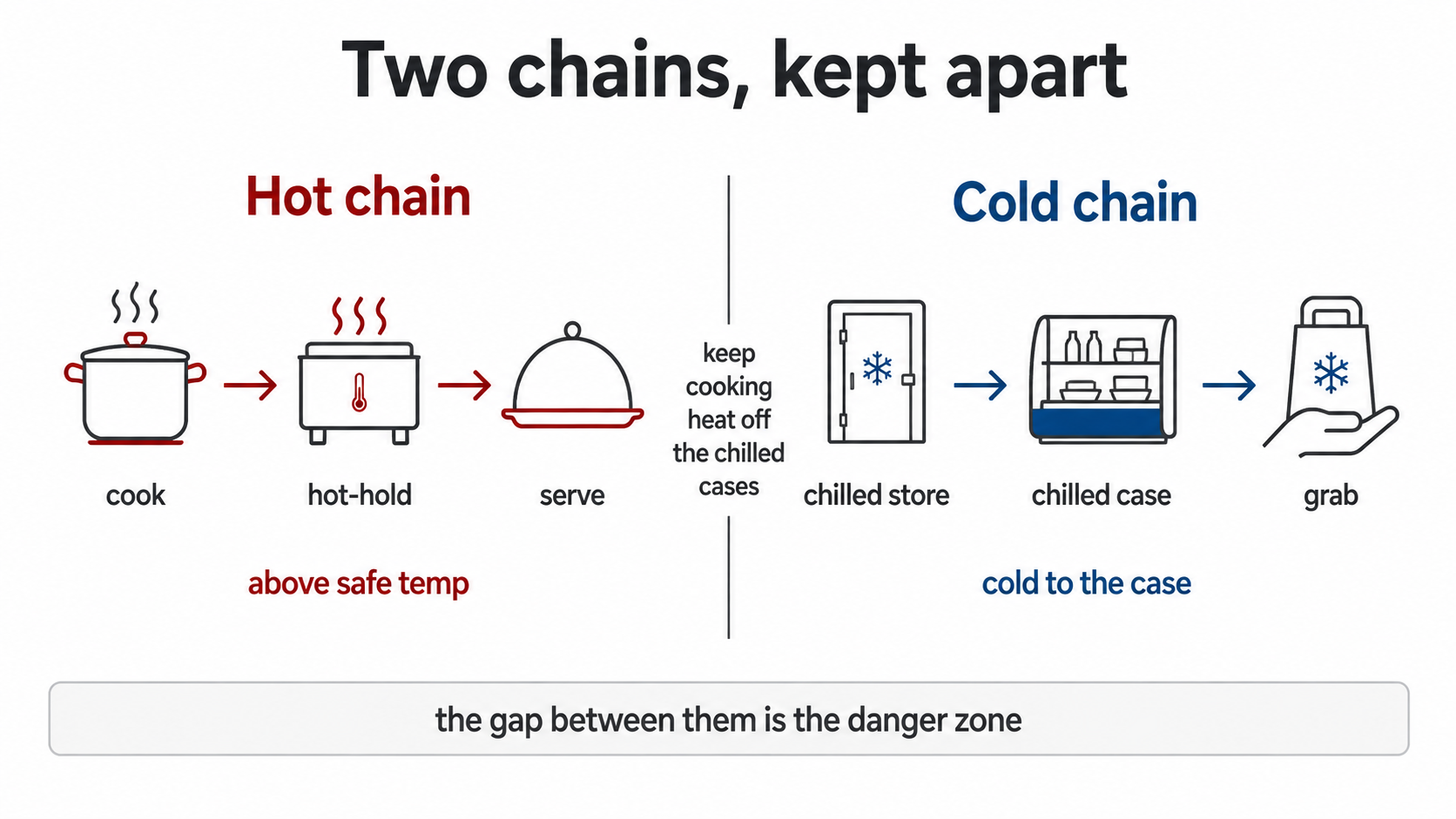
Food-to-go runs two temperature chains at once, and both have to hold. Draw them apart and keep the cook line's heat off the chilled meal-deal case — put the two together and the fridge fights the heat all day, right where the food is on show.
Food-to-go runs on two chains at once, and both have to hold. This is a food-safety-critical department: cooked food has to be kept above the safe temperature (the hot chain), chilled meal deals and drinks have to be kept cold to the case (the cold chain), and the gap between the two — the danger zone — is where food-to-go goes wrong.
The hot chain covers cooking, hot-holding and, where food is cooked ahead and chilled, rapid blast chilling — hot-hold time and temperature are controlled, not left to chance. The cold chain covers the chilled meal deals, salads, sandwiches and drinks, held cold from delivery to display with no warm gap. Design both, and then keep them apart: cooking heat must not load the chilled cases. Put a hot cook line or a rotisserie next to a chilled meal-deal fridge and the fridge fights the heat all day — it works harder, costs more to run, and the cold chain wobbles at exactly the point the food is on show. Separate the hot and the cold on the plan, and give each what it needs.
Raw and ready-to-eat stay ruthlessly apart too — through the store, the prep and the display — with prep following a one-way flow from raw in to ready-to-eat out. None of this is an operations detail to sort out later: how many hot-hold units, how much chilled metreage, where the cook line sits relative to the cold cases, and how prep flows are all layout decisions, made while the department is still on paper.
Fix the kitchen services before the slab — extract, grease, power, water
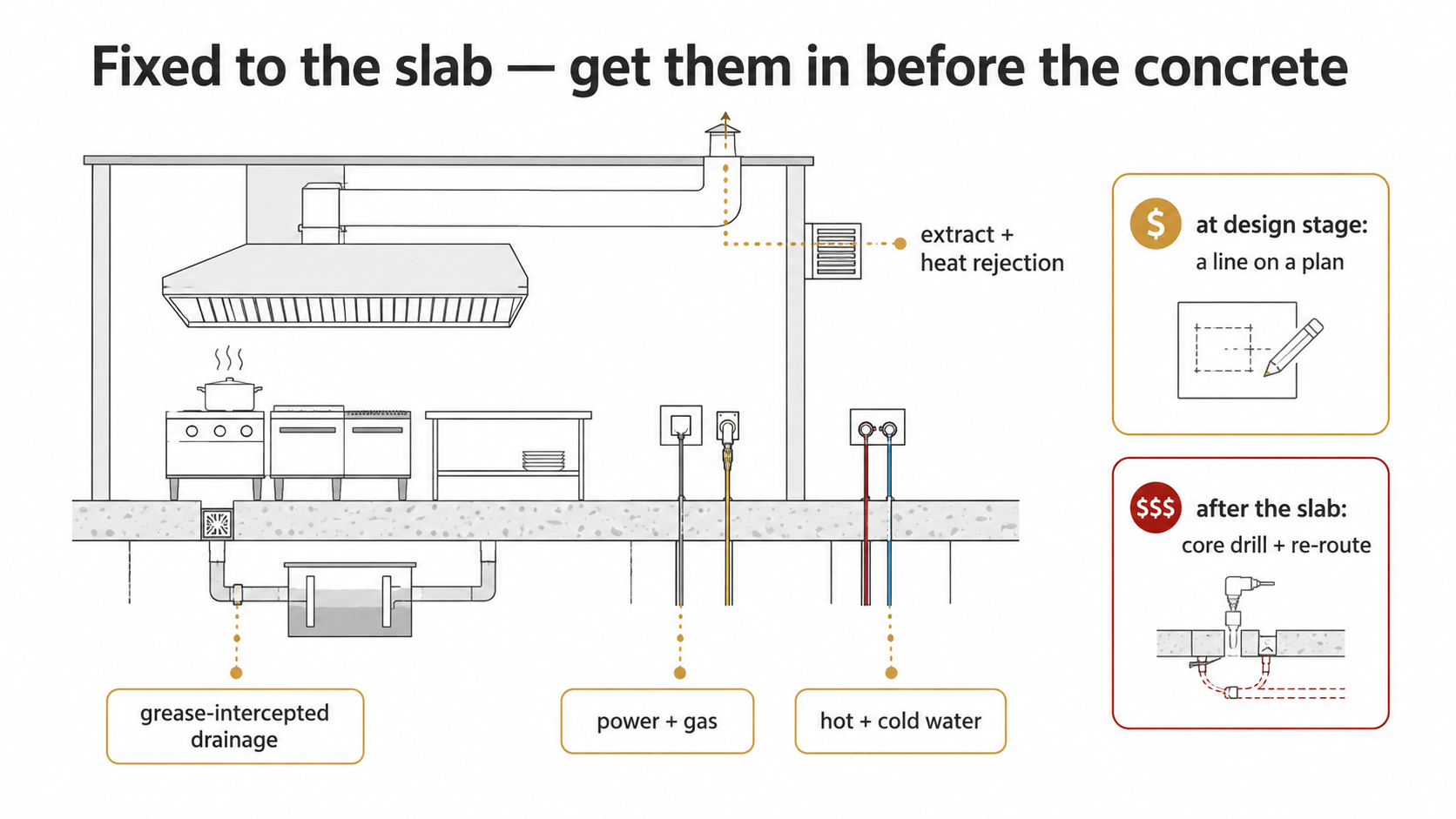
The four things that cost a fortune to add late. On the drawing they are lines on a plan; after the concrete is poured they are a core drill, a new canopy penetration and a re-routed drain — the most expensive way to build a kitchen.
Here is the part of food-to-go that a shelf-by-the-till never has to think about, and the part that costs the most to get wrong. A cook line needs an extract canopy and a heat-rejection route to take the cooking heat and grease out of the building. It needs grease-intercepted drainage, so kitchen waste never goes to an ordinary floor drain. It needs the power and, for some lines, the gas to run the equipment, and hot and cold water at the prep points.
Every one of those is fixed to the slab or the building fabric. Drawn at design stage they are lines on a plan and a coordination note to the engineer. Discovered after the concrete is poured, they are a core drill, a new canopy penetration and a re-routed drain — the single most expensive way to build a kitchen. Confirm the extract, the grease drainage, the power/gas and the water against the shared GRD refrigeration, extract and drainage standards, and against what the lease actually permits, before the slab. This department cannot be value-engineered into an ordinary retail bay after the fact.
Give the quick trip a fast, separate flow — and put the zone where the trip is
Food-to-go earns its extra visit on speed. A shopper who came in for a coffee and a sandwich will not queue behind a full trolley at the only till — do that to them twice and they stop coming, and the second reason to visit is gone.
So the zone needs a fast, separate flow: a grab-and-go layout that lets a quick buyer take a coffee, a hot item or a chilled meal deal and pay without being caught behind the weekly shop. That usually means grouping coffee, hot food and chilled meal deals as one legible grab-and-go zone, positioned where the quick trip actually happens — near the entrance or the front-end — with a quick route to pay, whether that is a dedicated point or a fast lane. Placed deep in the store behind the aisles, food-to-go loses the impulse and the speed that are its whole point.
If the offer includes seating — a café, a few tables, a coffee stop — treat the seating as an operating zone, not furniture. It needs its own order-pay-collect-sit-clear flow, room to queue without blocking the food counters, a clear cleaning and tray-return route, and daily cleaning labour to match. Seating is a floor-area investment: it earns its keep in the dwell and the basket it adds against the trade the space would otherwise have done, net of the cleaning it costs. Draw how it works in trading, at the peak and at close — not just where the tables go. Seating near food-to-go has its own checks: payment, tray return and cleaning during peak.
Merchandise the meal deal — the margin is in the basket, not the item
A food-to-go that sells a single sandwich has left most of its money on the shelf. The department's commercial engine is the meal deal: main plus side plus drink, with the snack, the treat and the bread within reach. One item becomes three when the layout puts them together.
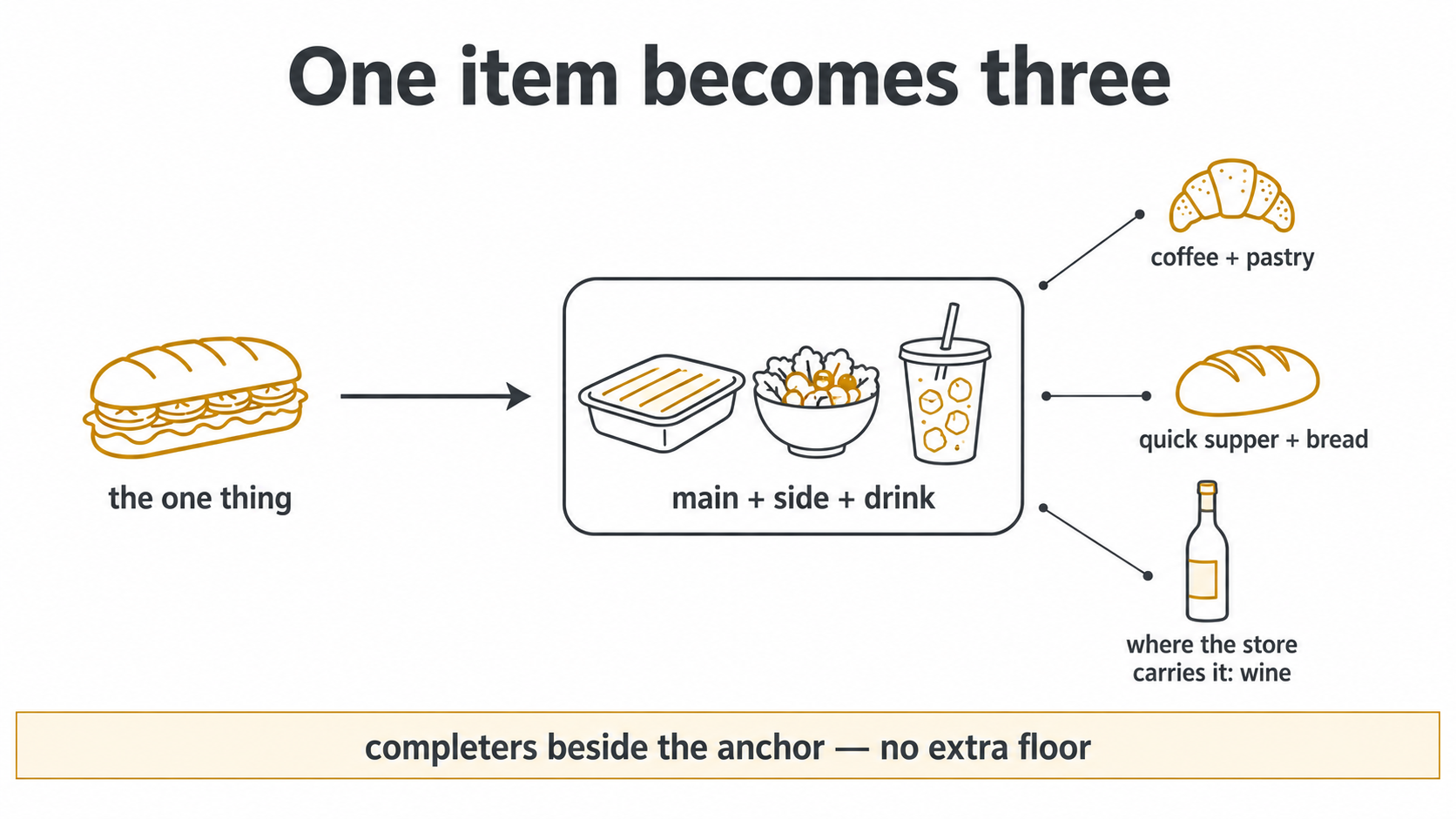
The margin is in the basket, not the item. Place the side, the drink and the completers beside the anchor and one sandwich becomes a meal deal — the cheapest sales lever in the department, because it costs no extra floor.
Group the offer so the basket builds itself — the hot main next to the cold drink, the sandwich next to the crisps and the fruit, the coffee next to the pastry, the quick supper next to the bread and, where the store carries it, the wine. This is the cheapest sales lever in the department: it costs no extra floor, only the decision to place the completers beside the anchor rather than aisles away. And it is where food-to-go stops being a low-margin convenience corner and starts earning a proper basket — because the shopper who came for the one thing leaves with the meal.
Produce to demand, because shelf-life is the enemy
Food-to-go product has a short shelf-life, and cooked lines have the shortest of all. The department is judged on margin after shrink, labour and energy — not on the gross margin of a single roll — and the biggest lever on shrink is producing and cooking to demand through the day rather than filling the case in one go at open.
That means cooking through the day to match the trading pattern — the shelves full for the lunch rush, not baked out at 8am and tired by noon — running cooked and made-on-site lines on strict date and time control with a markdown routine, and sizing the holding and the display to the actual turnover rather than to how much they can hold. A food-to-go that produces to demand looks fresh at the rush and bins less at close — the two go together, and both protect the margin the extra visit is meant to earn.
I visited a store in Dublin once where, at 10am, the whole food display changed from breakfast to lunch — in a matter of minutes the entire display was remerchandised, breakfast cleared and the lunch offer set. It impressed me, and it is the right attitude: the display follows the mission through the day rather than sitting static from open to close. It takes a well-trained, motivated team to pull off — but that is exactly what turns a food-to-go from a tired shelf by noon into a department that looks fresh at every rush. Design the holding, the display and the back-of-house flow so a changeover like that is quick to do, and you have built the department the team needs to trade it well.
The takeaway
Take one thing to your next food-to-go drawing: choose the production model — and with it the extract, the grease drainage and the power — before the slab and the services drawing are frozen. The merchandising, the signage and the grab-and-go display can all be revised at a cost. The production model sizes the whole department and sets the labour and energy bill for the life of the store, and the extract canopy and grease drainage under a cook line cannot be re-routed cheaply once the concrete is down.
[CTA block]
Planning or replanning a food-to-go department? A layout review will tell you whether the production model, the two chains, the kitchen services and the fast-lane flow hold up under a weekday lunch — and whether the meal deal is actually built — before anything is poured. Start with a layout review — or get in touch.
FAQ
1. How do you plan a supermarket food-to-go department?
Plan it from the engine forwards, not from the shelf by the till. Choose the production model first — cook on site, finish/regenerate, or bought-in — because that decision sets the kitchen size, the equipment, the services, the staffing and the energy load for the whole department, and it is as much a labour and energy decision as a food one. Then design the two chains that keep the food safe: the hot chain for cooked and hot-held lines, and the cold chain for chilled meal deals and drinks, and keep cooking heat off the chilled cases. Fix the kitchen services before the slab — the extract canopy, grease-intercepted drainage, power and water are the parts that cost a fortune to add later. Then give the quick trip a fast, separate flow near the entrance or the front-end, merchandise the meal deal, and produce to demand. Taking these decisions in the wrong order is what produces a food-to-go that looks the part on opening day and stalls under a weekday lunch.
2. Should supermarket food-to-go be cooked on site or bought in?
It depends on the labour and energy the store can fund, which is why the production model is the first decision, not an afterthought. Cooking on site from raw gives the strongest offer, the freshest aroma and the best margin on a cooked line, but it carries the highest labour and energy — it needs skilled kitchen staff, a full cook line, extract, hot-holding and blast chill, and the power or gas to run them, making it one of the highest heat and energy loads in the store. A finish or regenerate model, where food arrives part-prepared and is finished in-store, is moderate labour and a lighter kitchen. Bought-in, where ready-made lines are brought in chilled and displayed, is the lowest labour and the simplest to run but the narrowest margin. In a market where skilled kitchen labour is scarce or expensive, or where power is unreliable, a finish/regenerate model with a strong chilled range can carry most of the convenience offer for far less wage and energy cost, so the model must be confirmed in writing before the kitchen, counter and holding are sized.
3. Where should food-to-go go in a supermarket layout?
Near the entrance or the front-end, where the quick trip actually happens, with a fast separate flow and a quick route to pay. Food-to-go earns its value on speed: a shopper who came in for a coffee and a sandwich will not queue behind a full trolley, so the grab-and-go offer — coffee, hot food and chilled meal deals grouped as one legible zone — needs its own fast lane, whether that is a dedicated pay point or a quick route through the front-end. Placed deep in the store behind the aisles, food-to-go loses the impulse and the speed that are its whole point. The working kitchen and its extract, heat and grease sit behind the display, away from the customer flow but close enough to keep the offer stocked through the rush.
4. Why does food-to-go need an extract canopy and grease drainage?
Because a cook line is a working kitchen, and cooking produces heat, steam and grease that an ordinary retail bay is not built to handle. The extract canopy and heat-rejection route take the cooking heat and grease out of the building, and grease-intercepted drainage keeps kitchen waste out of an ordinary floor drain. Every one of these is fixed to the slab or the building fabric: drawn at design stage they are lines on a plan and a coordination note to the engineer, but discovered after the concrete is poured they are a core drill, a new canopy penetration and a re-routed drain — the single most expensive way to build a kitchen. Confirm the extract, the grease drainage, the power or gas and the water against the shared standards and against what the lease permits before the slab, because this department cannot be value-engineered into a plain retail bay after the fact.
5. How does food-to-go drive footfall and extra visits?
By giving the supermarket a second reason to visit, on the days a full shop would never happen. A shopper does a weekly shop once, but they buy a breakfast, a lunch or a quick supper far more often, and those are trips a weekly-shop layout never captures. Food-to-go drives frequency — the same shopper comes back more often for a coffee, a lunch or a hot supper — and that frequency is footfall the store does not otherwise have. But the extra visit only arrives if the offer is ready at the rush, easy to grab, and quick to pay for, which is why the production model, the holding and the fast separate flow all have to be planned rather than left to a shelf near the till.
6. How do you build a bigger basket at food-to-go?
By merchandising the meal deal instead of a single item. Food-to-go's commercial engine is main plus side plus drink, with the snack, the treat and the bread within reach, so one item becomes three when the layout puts them together. Group the offer so the basket builds itself — the hot main next to the cold drink, the sandwich next to the crisps and the fruit, the coffee next to the pastry, the quick supper next to the bread and, where the store carries it, the wine. This is the cheapest sales lever in the department because it costs no extra floor, only the decision to place the completers beside the anchor rather than aisles away, and it is where food-to-go stops being a low-margin convenience corner and starts earning a proper basket.
7. How do you reduce waste at a food-to-go counter?
By producing and cooking to demand through the day. Food-to-go has a short shelf-life and cooked lines have the shortest of all, so the department is judged on margin after shrink, labour and energy rather than on the gross margin of a single roll. Cook through the day to match the trading pattern — the shelves full for the lunch rush, not baked out at 8am and tired by noon — run cooked and made-on-site lines on strict date and time control with a markdown routine, and size the holding and display to the actual turnover rather than to how much they can hold. A food-to-go that produces to demand looks fresh at the rush and bins less at close — the two go together, and both protect the margin the extra visit is meant to earn.
