How to Design a Supermarket Deli Department (Start With the Service Model)
Most supermarket delis are designed as a chilled case. Someone gives the department a run of refrigerated cabinet and a serve-over case on the shop floor, treats the space behind it as ordinary storage, and picks "served counter" off a nice reference photo. That order is backwards, and it is why so many delis look the part on opening day and jam under a Saturday lunch.
A deli is not a case. It is a ready-to-eat service and theatre department — a served counter with skilled hands behind it, a cold chain that has to stay unbroken from the back to the front, a slicer that must never cross an allergen or a halaal line, cheese strong enough to taint the products around it, and a queue that will block the aisle if nobody planned it space. The case is the easy part. The service is the department.
The reason it is worth getting right is that a served counter is one of the few departments a shopper will actually choose a store for. A staffed counter reads as fresh and trusted in a way a self-service fridge never can, and it trades shoppers up from value cold meats to premium cheese and charcuterie. But all of that depends on the model behind it and the cold chain feeding it. Here is the order to design it in.
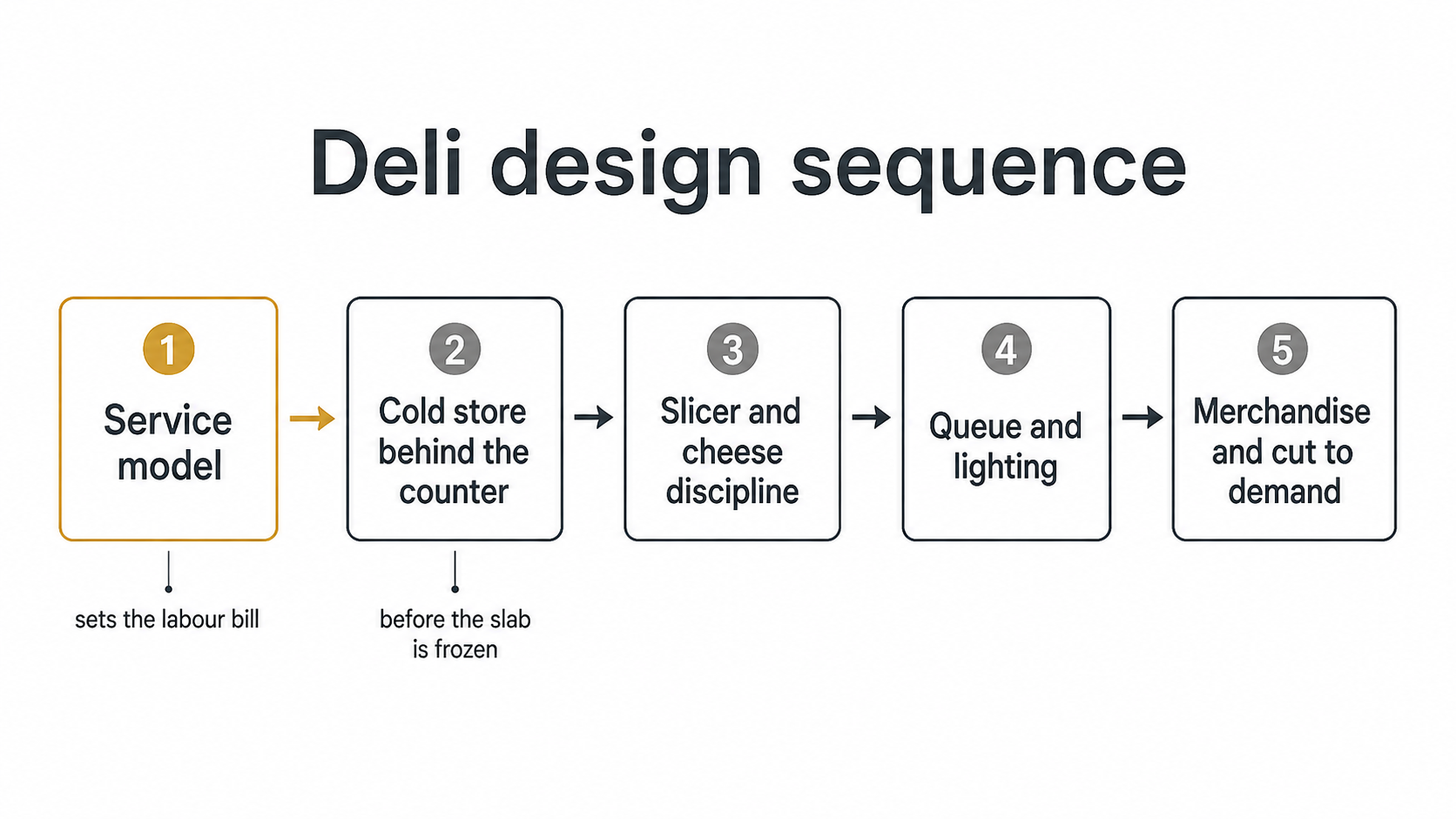
The department is designed service model first. Get the model and the cold chain right and the counter, the discipline and the merchandising all follow — start with the case and you will be revising everything behind it.
Choose the service model first, because it is really the labour bill
Before a single line is drawn, decide how this deli is going to serve. That one choice sets the counter length, the equipment, the services, the staffing and the labour cost — everything downstream.
There are three models, and they are a labour decision as much as a service one:
Full served counter — staff slice, portion, advise and pack to order across a serve-over case. The strongest theatre and trust, the widest trade-up, and the highest labour: it needs skilled people on the counter at every trading hour it is open.
Self-service grab-and-go — pre-packed cheese, cold meats and deli lines a shopper takes off a chilled fixture themselves. The lowest labour and the simplest to run, but none of the served-counter theatre or advice, and a narrower trade-up.
Hybrid — a served counter for the premium, advice-led and theatre lines, with a grab-and-go fixture alongside for the everyday and lunch-on-the-run lines. Most stores land here, because it puts the labour where it earns its keep and takes it off the lines that sell themselves.
The real decision is how far up that scale to build, and it is a commercial call, not a technical one. In a market where skilled deli labour is scarce or expensive, a leaner served counter with a strong grab-and-go alongside can carry most of the trust and trade-up for far less wage cost than a full counter staffed all day. It has to be made and written down before anyone sizes the counter, the slicer bank or the chilled metres. Change the model after the layout is issued and you are not moving a shelf — you are re-scaling the counter, the back and the services, and cascading a revision through every drawing in the set.
Put the cold store directly behind the counter, so the cold route is short
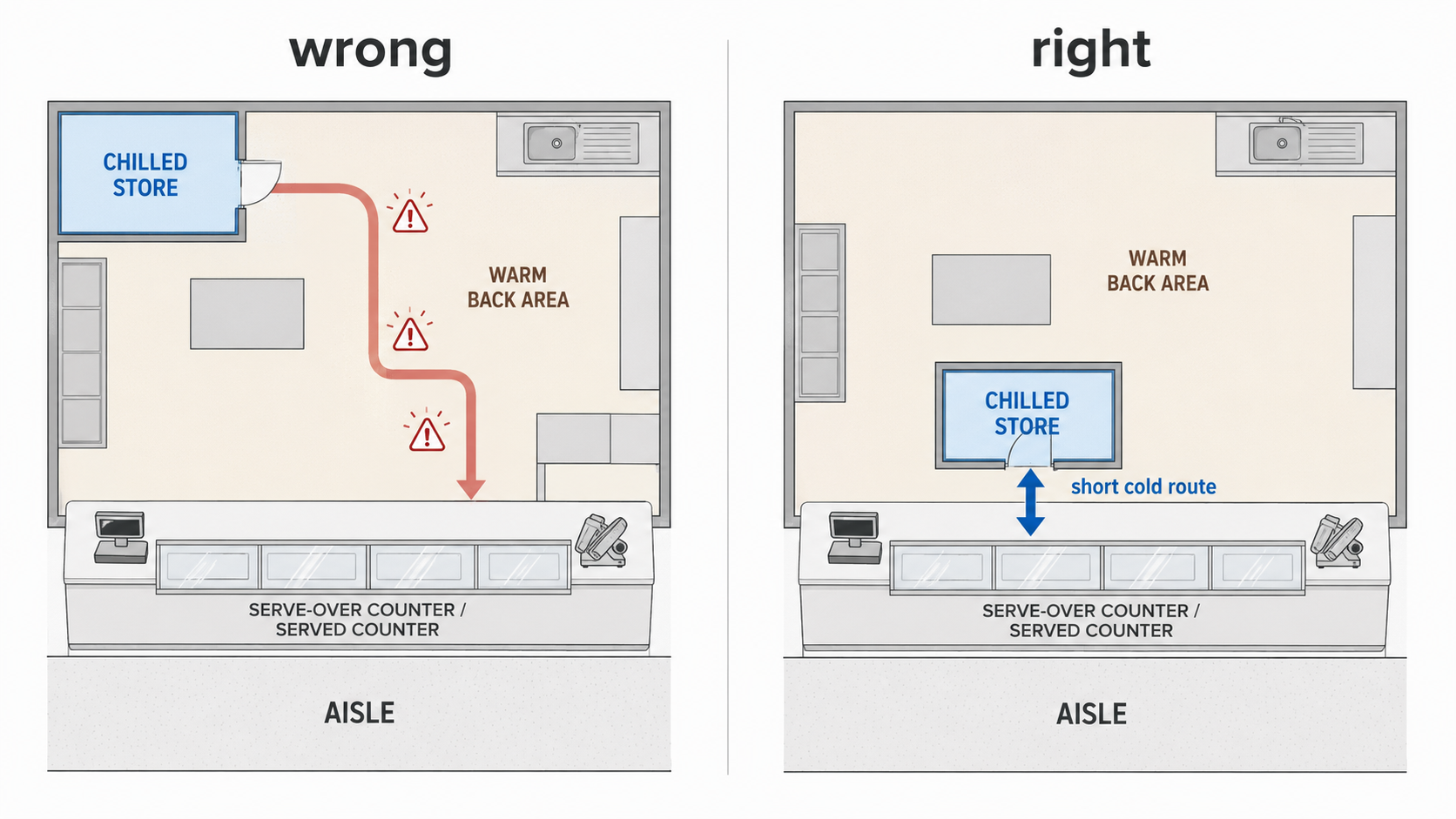
The cold chain is only as strong as its weakest walk. Put the chilled store directly behind the served counter and the route stays short and cold end to end — put it across a warm back area and the product warms up before it reaches the case.
The deli runs on a cold chain, and the cold chain is only as strong as its weakest walk. Every deli line — cheese, cold meats, charcuterie, olives, prepared salads — is handled ready-to-eat and has to be held cold from delivery to display, with no warm gap in between.
The design rule that protects it is simple: put the cold store directly behind the served counter, and keep the refrigerated route between them short. If restocking the case means carrying product across a warm back area or a stretch of shop floor, it warms up on every metre, and the cold chain the whole department depends on breaks on the walk. Plan the chilled store, the prep point and the served case close together, so the route from store to counter is short and cold from end to end.
The refrigeration, the condenser capacity, the heat-rejection route and the counter drainage are the parts fixed to the slab — confirm them against the shared refrigeration and drainage standards before the concrete is poured, not after. And in a load-shedding market, the served counter and its chilled cases need a backup plan drawn in, or the cold chain fails every time the power does. [link L3]
Discipline the slicer: allergen and halaal separation is physical, not a note
Here is the first thing a chilled case never has to think about and a served deli always does. A slicer that runs cheese, then cold meats, then a halaal line, then something with a nut or dairy allergen, without separation, is a cross-contamination incident waiting to happen — and no procedure written after the fact fixes a shared blade.
The control is physical and it belongs in the design: enough slicer and prep capacity to keep allergen and halaal lines separated, clear labelling, and a cleaning regime the layout actually allows room for. All deli lines are handled as ready-to-eat, with no raw cross-contact. This is not a hygiene detail to be sorted out in operations — it is a design decision about how many slicers, how much prep length, and how the counter is zoned, and it has to be made while the counter is still on paper.
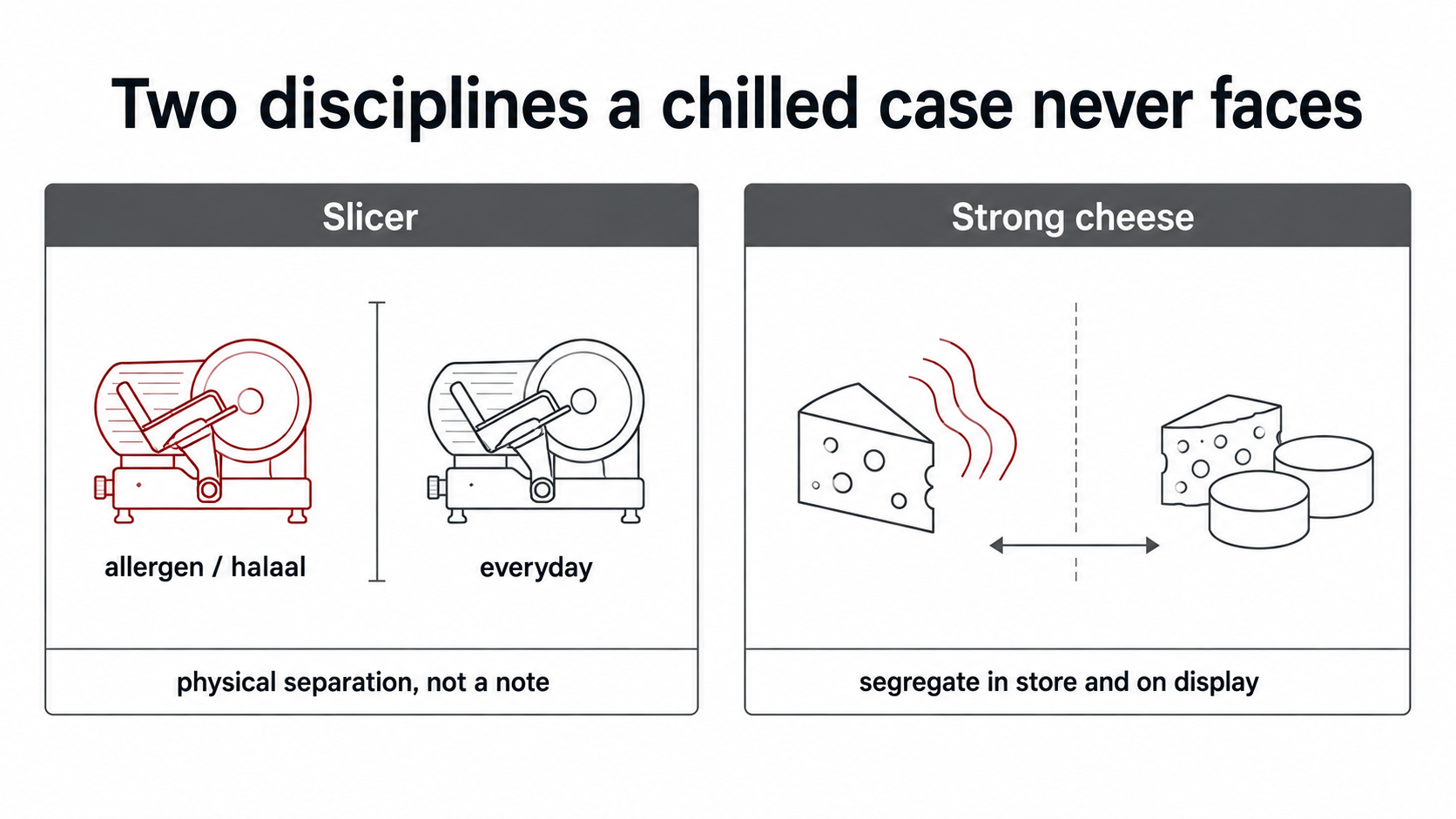
A self-service fridge never has to think about either of these. A served deli always does — the slicer needs physical allergen and halaal separation, and strong cheese needs segregating from the lines it would taint. Both are layout decisions, not procedures.
Segregate the strong-odour cheese, in the store and on the display
The second thing a case walks past and a deli cannot. A deli carries cheese strong enough to taint everything near it — in the chilled store and on the display. Sit a pungent blue or washed-rind cheese next to odour-sensitive lines and you have quietly damaged both: the neighbour picks up a smell it should not have, and the shopper notices.
Segregate strong-odour cheese from odour-sensitive lines in the cold store and in the display, so the department can carry the premium range that earns the margin without tainting the lines around it. Again, this is a layout decision — where the strong cheese is stored and where it sits in the case — not something to discover after opening.
Give the served counter a queue, and length it to throughput
A served counter without waiting space is a served counter that blocks the aisle behind it every time it gets busy. The queue is not an afterthought — it is part of the counter, and it has to be drawn.
Set the counter length to the throughput the store expects at peak, and draw the waiting space in front of it so a Saturday-lunch queue does not spill across the main route and choke the departments either side. A deli that looks great at 10am and has one person on it with a six-deep queue at Saturday lunch has turned its strongest asset into its worst bottleneck. Counter length, staffing and queue space are one decision, made together.
Light the cheese and charcuterie to sell
Deli product sells on how fresh and appetising it looks, and the light decides how it reads. Cheese, cold meats and charcuterie need lighting that renders colour honestly — a tired, flat light makes a premium range look ordinary and undercuts the trade-up the counter exists for. Some lines are also light- and heat-sensitive, so the lighting has to show them well without cooking them in the case.
The detailed specification belongs to the shared GRD Lighting Standard, and the deli application should be designed to it rather than left to whoever supplies the case. Put the requirement on the drawing so the electrical engineer specifies against it, the same way you would for any fresh department.
Merchandise the two baskets a deli owns
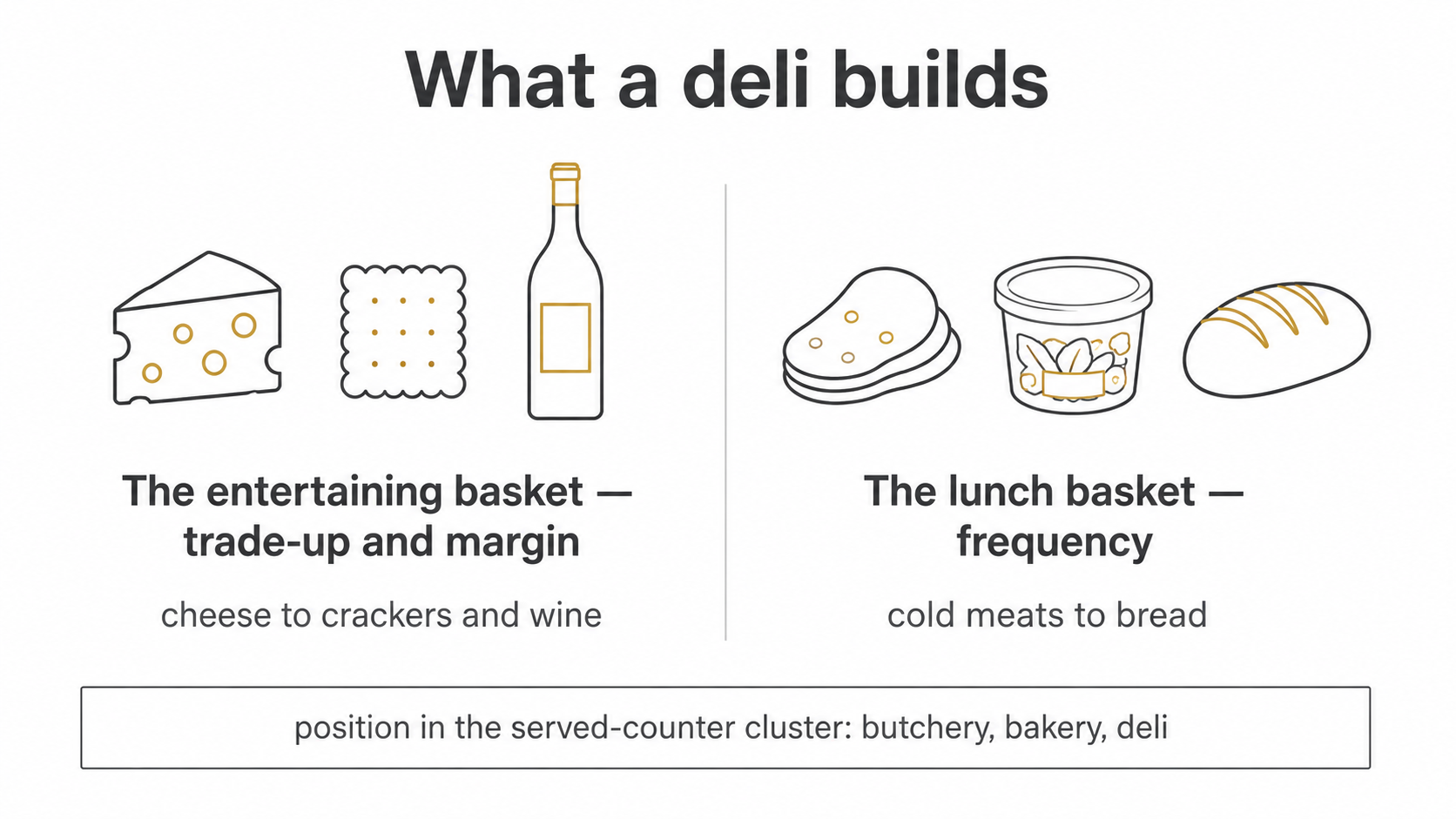
A deli owns two baskets. The entertaining basket earns the trade-up and the margin; the lunch basket brings the everyday frequency — and cross-merchandising each, cheese to wine and cold meats to bread, turns one purchase into a basket at no extra floor.
A deli does not sell one thing, it sells occasions — and it owns two baskets most departments would envy. Merchandise both or you are leaving money on the shelf:
The entertaining basket — cheese, charcuterie, olives and antipasti. This is the trade-up and the margin, and it completes an occasion. Placed within reach of crackers, and near the wine, one wedge of cheese becomes a cheeseboard and a bottle.
The lunch basket — cold meats, deli salads and the grab-and-go lines. This is the frequency and the everyday trip. Placed near the bread, one pack of ham becomes a sandwich.
The deli belongs on the fresh perimeter, in the served-counter cluster with the butchery and bakery, positioned for the entertaining and lunch missions, with the cold store directly behind it and the cheese-and-wine cross-merchandising adjacent. None of that costs an extra square metre of floor — it is decided on the layout, and it is one of the cheapest sales levers in the store.
Cut to demand, because shelf-life is the enemy
A deli's product has a short shelf-life once it is cut or opened, and that is where the margin goes. The department is judged on margin after shrink, labour and energy — not on the gross margin on a slice of cheese — and the biggest lever on shrink is cutting and opening to demand rather than filling the case in one go at the start of the day.
That means cutting through the day to match the trading pattern, running cut, opened and made-on-site lines on strict date control and FIFO, and sizing the case to the actual turnover rather than to how much it can hold. A deli that cuts to demand looks fresh all day and bins less — the two go together.
The takeaway
Take one thing to your next deli drawing: confirm the service model — and with it the counter drainage and the refrigeration behind it — before the slab and the services drawing are frozen. The merchandising, the signage and the display can all be revised at a cost. The service model sizes the whole department and sets the wage bill for the life of the store, and the drainage and refrigeration under the counter cannot be re-routed cheaply once the concrete is down.
Planning or replanning a deli department?
A layout review will tell you whether the service model, the cold route, the slicer and odour separation and the queue hold up under a Saturday peak — before anything is built.
FAQ
1. How do you design a supermarket deli department?
Design it from the service model forwards. Choose the model first — a full served counter, self-service grab-and-go, or a hybrid of the two — because that decision sets the counter length, the equipment, the services, the staffing and the labour cost for the whole department, and it is as much a labour decision as a service one. Then put the cold store directly behind the counter so the cold route stays short and the cold chain does not break on the walk. Discipline the two things a chilled case never faces: give the slicer physical allergen and halaal separation, and segregate strong-odour cheese from odour-sensitive lines in the store and on display. Then give the served counter a queue and length it to throughput, light the cheese and charcuterie to sell, merchandise the entertaining and lunch baskets, and cut to demand. Taking these decisions in the wrong order is what produces a deli that looks the part on opening day and jams under a Saturday lunch.
2. Should a supermarket deli be a served counter or self-service?
It depends on the labour the store can fund, which is why the service model is the first decision, not an afterthought. A full served counter — where staff slice, portion, advise and pack to order — gives the strongest theatre and trust and the widest trade-up from value cold meats to premium cheese and charcuterie, but it carries the highest labour because it needs skilled people on the counter every trading hour. Self-service grab-and-go, with pre-packed lines a shopper takes themselves, is the lowest labour and the simplest to run, but it loses the counter theatre and advice and narrows the trade-up. Most stores land on a hybrid — a served counter for the premium and advice-led lines with a grab-and-go fixture alongside for the everyday and lunch-on-the-run lines — because it puts the labour where it earns its keep. In a market where skilled deli labour is scarce or expensive, a leaner served counter with a strong grab-and-go alongside can carry most of the trust and trade-up for far less wage cost, so the model must be confirmed in writing before the counter, slicer bank and chilled metres are sized.
3. Why does a deli slicer need allergen and halaal separation?
Because a deli handles everything ready-to-eat, and a slicer that runs cheese, cold meats, a halaal line and an allergen line one after another without separation is a cross-contamination incident waiting to happen — and no procedure written after the fact fixes a shared blade. The control is physical and it belongs in the design, not the operating manual: enough slicer and prep capacity to keep allergen and halaal lines separated, clear labelling, and a cleaning regime the layout actually leaves room for. This is a design decision about how many slicers, how much prep length, and how the counter is zoned, and it has to be made while the counter is still on paper.
4. Where should a deli go in a supermarket layout?
On the fresh perimeter, in the served-counter cluster with the butchery and bakery, positioned for the entertaining and lunch missions, with the cold store directly behind the counter and the cheese-and-wine cross-merchandising adjacent. The cold store behind the counter keeps the refrigerated route short so the cold chain does not break on the walk. The position in the served-counter cluster lets the fresh departments reinforce each other and read as a fresh offer as a whole. And placing the deli within reach of crackers, wine and bread is what turns a single purchase into the entertaining or lunch basket the department owns.
5. How do you keep strong cheese odours from affecting other products?
By segregating strong-odour cheese from odour-sensitive lines in both the chilled store and the display, as a layout decision made before opening. A deli carries cheese strong enough to taint everything near it — a pungent blue or washed-rind sitting next to an odour-sensitive line quietly damages both, and the shopper notices. Segregating it in storage and on the case lets the department carry the premium range that earns the margin without tainting the lines around it. Where the strong cheese is stored and where it sits in the case is part of the layout, not something to discover after the store opens.
6. How do you reduce waste at a deli counter?
By cutting and opening to demand. Deli product has a short shelf-life once it is cut or opened, and that is where the margin goes, so the department is judged on margin after shrink, labour and energy rather than on the gross margin of a single slice. Cut through the day to match the trading pattern instead of filling the case in one go at the start, run cut, opened and made-on-site lines on strict date control and FIFO, and size the case to the actual turnover rather than to how much it can hold. A deli that cuts to demand looks fresh all day and bins less — the two go together.
7. How does a deli build a bigger basket?
By merchandising the two baskets a deli owns and cross-merchandising each one. The entertaining basket — cheese, charcuterie, olives and antipasti — is the trade-up and the margin, and placed within reach of crackers and near the wine, one wedge of cheese becomes a cheeseboard and a bottle. The lunch basket — cold meats, deli salads and the grab-and-go lines — is the frequency and the everyday trip, and placed near the bread, one pack of ham becomes a sandwich. Position the deli on the fresh perimeter in the served-counter cluster so the fresh departments reinforce each other, and keep the cheese, crackers, wine and bread within reach of one another. None of it costs an extra square metre of floor — it is decided on the layout.
