How to Design a Supermarket Bakery Department (Start With the Oven Room)
Most supermarket bakeries are designed as a bread display. Someone gives the department a run of shelving and a couple of cases on the shop floor, and the oven room behind it is treated as storage and squeezed into whatever space is left. That order is backwards, and it is why so many bakeries look the part on opening day and cannot hold quality on a Saturday morning.
A bakery is not a shelf. It is a production department — a small factory that generates heat, oven steam, flour dust and allergens, runs on some of the hungriest energy loads in the store, and carries a labour bill set entirely by how you choose to bake. The display is the last consequence of all that, not the first decision.
The reason it is worth getting right is that the bakery sells before a shopper sees a price. The smell of baking does the marketing; the sight of fresh product on show says a store that cares; and bread pulls a repeat trip most departments would envy. But all of that depends on the back working. Here is the order to design it in.
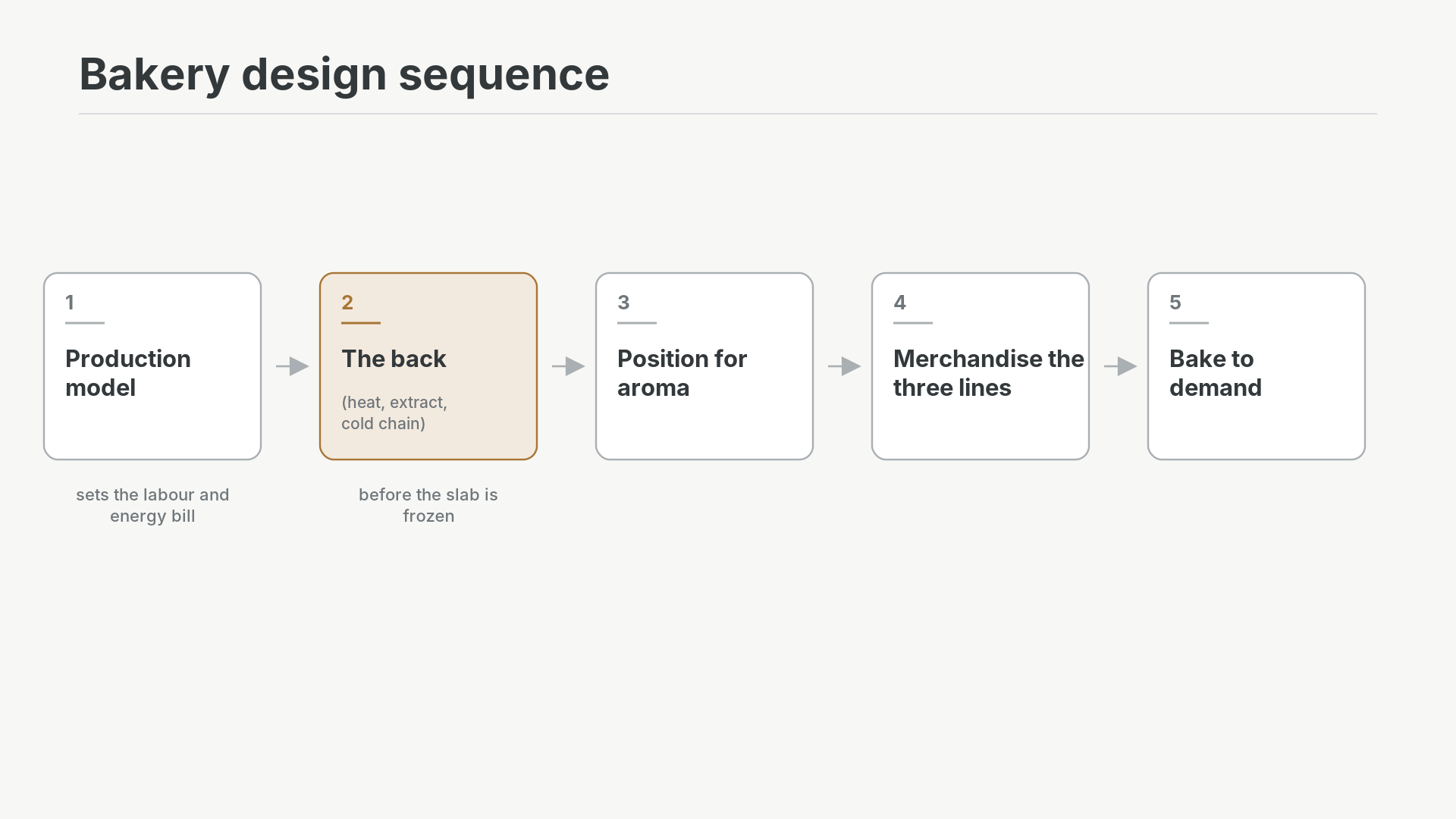
The department is designed back to front. Get the production model and the oven room right and the aroma, the merchandising and the waste all follow — start at the display and you will be revising everything behind it.
Choose the production model first, because it is really the labour bill
Before a single line is drawn, decide how this bakery is going to bake. That one choice sets the equipment, the services, the space, the staffing and the energy — everything downstream.
There are three models in common South African use, and they are a labour decision as much as a baking one:
Scratch — mixing, proving and baking from raw ingredients on site. The highest quality and the strongest theatre, but high-skill and high-labour, and the most demanding on space and services.
Bake-off (par-bake) — finishing part-baked product delivered from a bakery plant and baking it off in-store. Moderate labour and skill, and it still delivers the fresh aroma and hot bread that pull the trip, at a fraction of the labour a scratch bakery needs.
Buy-in — finished product baked off-site at a bakery plant or distribution centre and delivered ready to sell, both ambient and chilled: bread loaves and confectionery. The lowest labour and the simplest services, because those lines are not baked on site — but no baking aroma or theatre from them either.
Most stores run a mix — a bought-in bread and confectionery range alongside an in-store bake-off or scratch line for the aroma and the hot product. The real decision is how far up that scale to build, and it is a commercial call, not a technical one: in a market where skilled bakery labour is scarce or expensive, bake-off gives most of the footfall benefit of a scratch bakery for far less labour, while buy-in carries the range at the lowest cost. It has to be made and written down before anyone sizes the prep area, the proving space or the ovens. Change the model after the layout is issued and you are not tweaking a shelf — you are re-scaling the whole back and cascading a revision through every drawing in the set.
Design the back as a factory: heat, extract, and where the ovens cannot go
This is the part that gets under-built, and it is the part that decides whether the department works.
Ovens and proving make a bakery one of the highest heat and energy loads in the store. That has to be designed, not assumed:
Oven extract and heat rejection. The steam and heat the ovens throw off need a designed route out. Without it the back becomes too hot to work in, quality drops, and the staff pay for it every shift.
HVAC balance. The store's air handling has to account for the bakery's heat gain, or the department bleeds heat into the shop floor.
Heat recovery, considered. The ovens are a large, constant heat source — worth asking early whether that heat can be recovered rather than simply dumped.
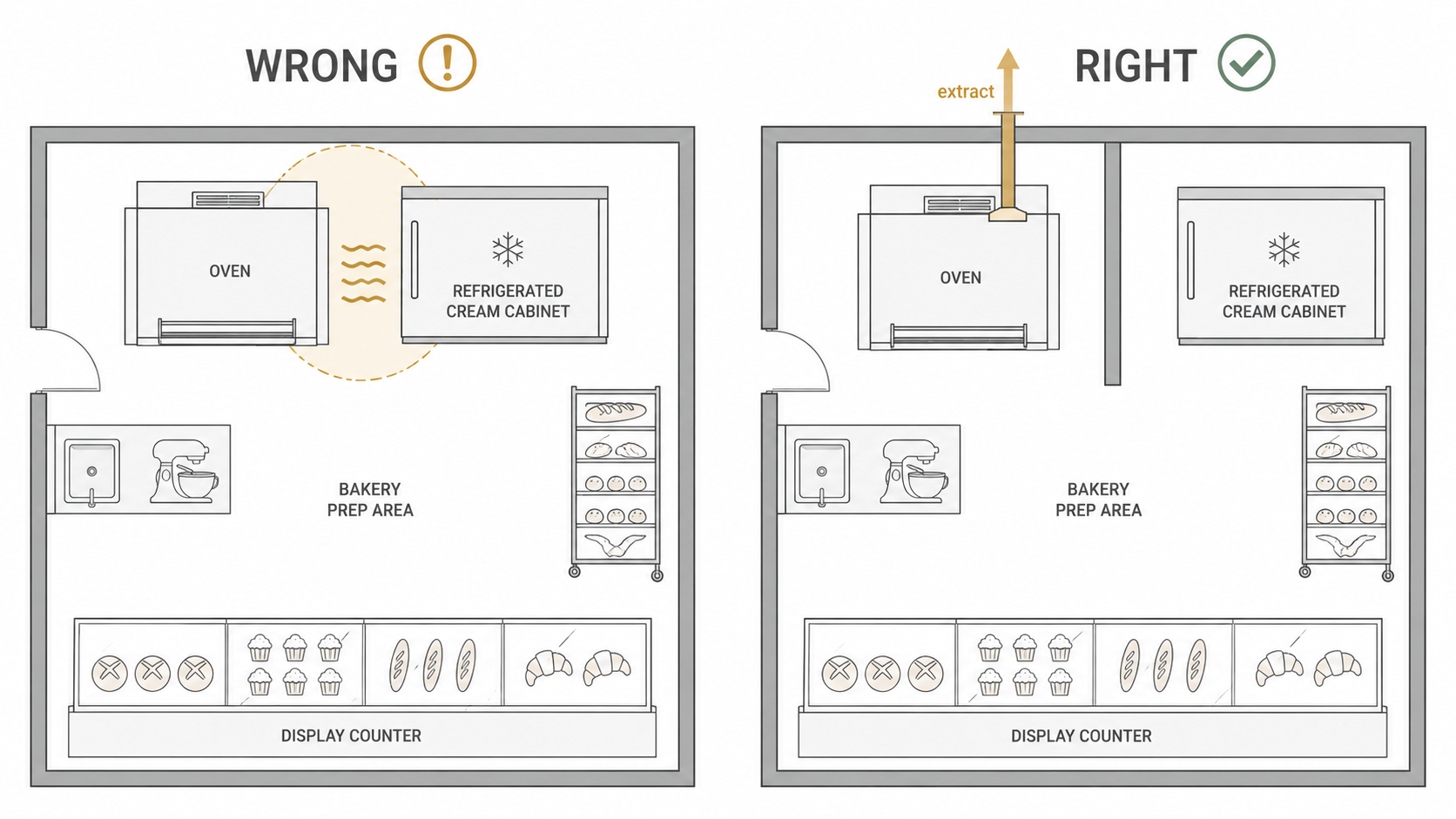
A bakery and a chilled display can share a department — the ovens and the fridges cannot share a wall. Oven heat loading a fridge is a bill the store pays every hour it trades.
And the single most consequential placement rule in the whole department: keep the ovens away from the chilled cases. Oven heat loading a nearby fridge or cream cabinet is not a one-off setup cost — it makes the refrigeration work harder every hour of every day to hold temperature, which shows up on the electricity bill for the life of the store and shortens the equipment's life on top of it. A bakery and a chilled display can share a department; the ovens and the fridges cannot share a wall.
None of the oven footprints, extract sizes or temperatures are guesses — they come from the equipment schedule for the model you have chosen. Which is exactly why the model has to be confirmed first.
Give the cream cold chain a short, cold route
Cream is where a bakery quietly loses product and trust. Cream fillings and finished cream cakes are the department's most temperature-sensitive line, and they need a proper cold chain: a chilled store for the ingredients and finished product, a chilled display to sell from, and — the part that gets missed — a short cold route between the two.
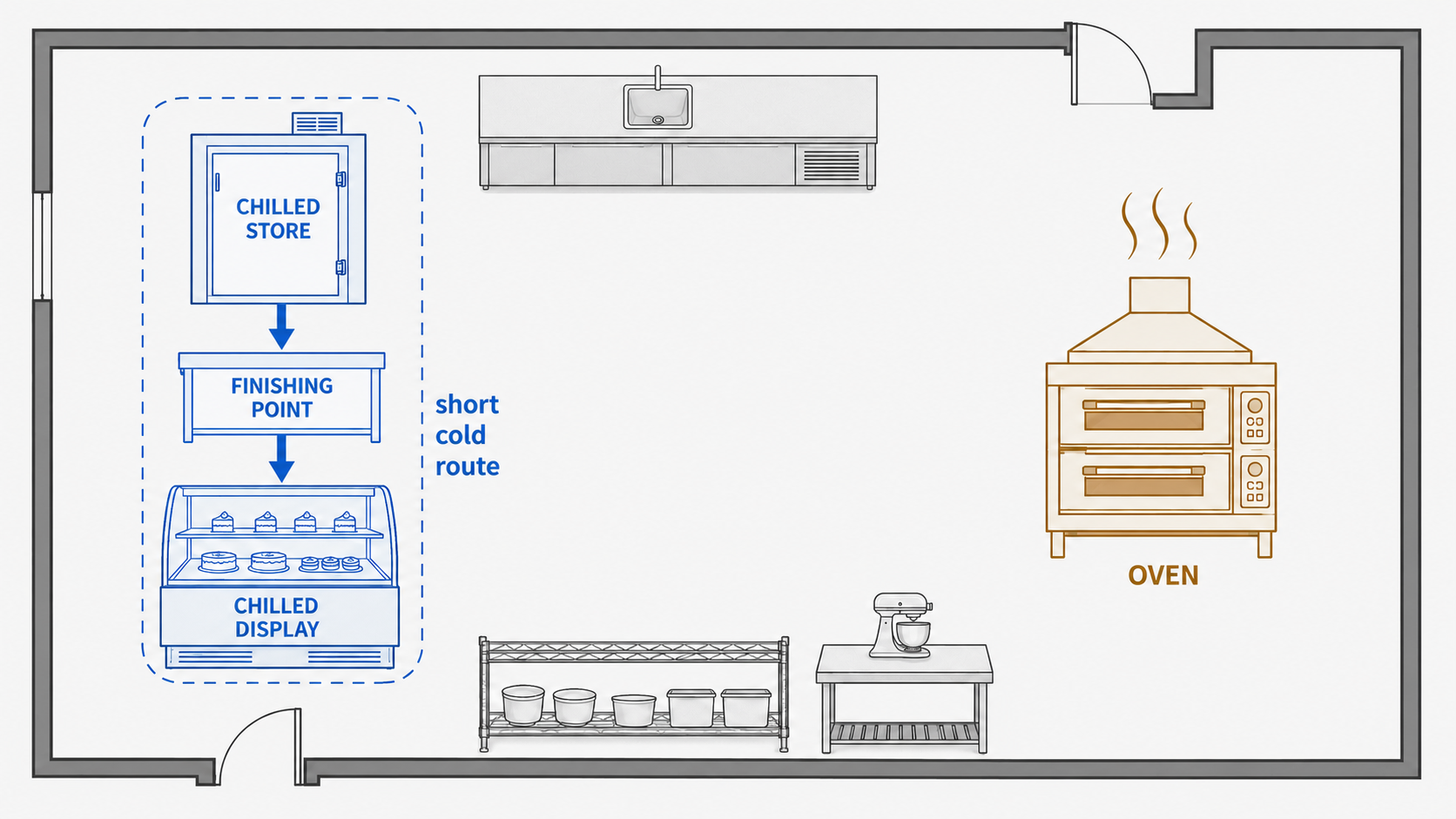
Cream cakes warm up on every metre they travel. Keep the chilled store, the finishing point and the display close together and away from the ovens, and the cold route stays cold end to end.
If the finished cream cakes have to travel across a hot production area to reach a display case three metres from the ovens, they spend that whole journey warming up, and no amount of good product survives it. Plan the chilled store, the finishing point and the chilled display close together and away from the oven heat, so the cold route is short and cold from end to end.
Control the flour dust and the allergens in the prep area
Two things a bakery generates that a bread shelf never has to think about: flour dust and allergens.
Flour dust is a housekeeping and an air-quality issue in the prep area — plan for it rather than discovering it. Allergens are more serious: a bakery handles gluten, nuts, egg, dairy and more, and the control for cross-contact is physical — separated preparation and clear labelling — not a note in a procedure. Both belong in the design of the prep area, not in the operating manual after the fact.
Put the bakery where the aroma can actually work
Now — and only now — place the department on the floor.
A bakery earns its keep on the fresh perimeter, and usually near the entrance, because the smell of baking is the cheapest and most effective marketing in the store and it only works if it reaches the shopper. Position the bakery so the aroma carries into the entrance and the front of the floor, with the production back — and its heat and extract — directly behind the display, not blocking it.
Two placement rules pull in opposite directions and both have to hold: the aroma has to reach the aisle, and the oven heat has to stay off the chilled cases. Resolve them on the plan, not on opening day. And cross-merchandise deliberately — bakery next to coffee and the deli, and celebration goods within reach of the cakes.
Merchandise the three things a bakery sells
A bakery is not one offer, it is three, and each builds the basket a different way. Merchandise all three or you are leaving money on the shelf:
The daily loaf — bread, rolls and morning goods. This is the frequency engine: a near-daily repeat trip that pulls the shopper past everything else in the store. Bake-off timing should match footfall so the shelves look full when the store is busy, because an empty bread fixture at 5pm reads as a store that has run out.
The treat — morning goods, pastries and cakes bought on impulse. This is the margin, and it sells on sight and smell, so it belongs where a shopper passing sees it and where the aroma reaches.
The celebration cake — the occasion purchase. Higher value, planned rather than impulsive, and worth its own considered display and clear ordering.
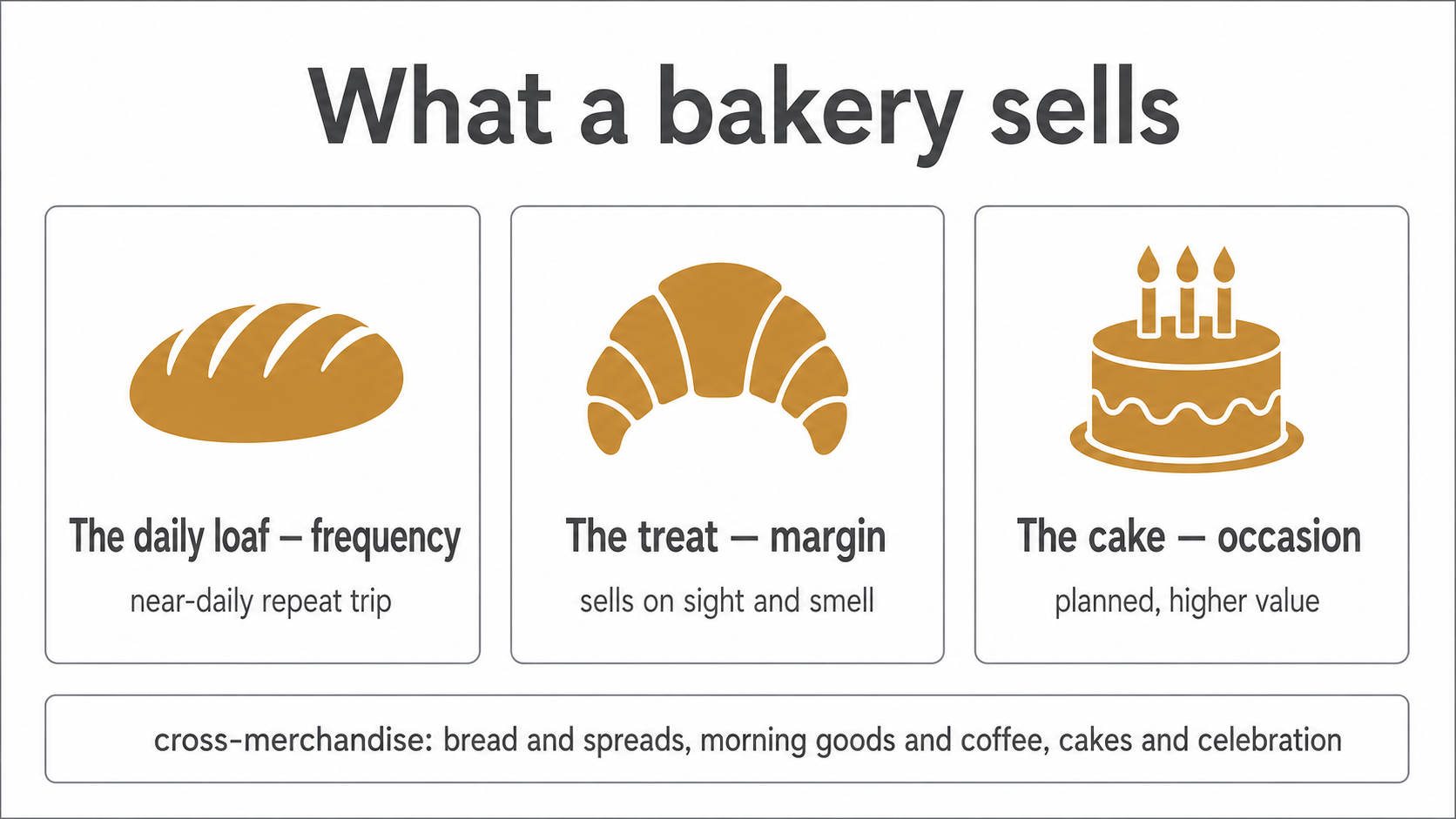
A bakery is three offers, not one. The loaf brings them back, the treat earns the margin, the cake owns the occasion — and cross-merchandising each turns one purchase into a basket.
Then cross-merchandise so one purchase becomes a basket: bread next to the spreads, morning goods next to the coffee, cakes next to the celebration and entertaining lines. None of that costs an extra square metre of floor — it is decided on the layout, and it is one of the cheapest sales levers in the store.
Bake to demand, because shelf-life is the enemy
A bakery's product has a short shelf-life, and same-day waste is where the margin goes. The department is judged on margin after shrink, labour and energy — not on the gross margin on a loaf — and the biggest lever on shrink is baking to demand.
That means baking through the day in batches that match the trading pattern, not baking everything by 8am and marking it down by 4pm. Size the ambient display to the actual turnover rather than to how much it can hold, and set a markdown routine so slow lines are cleared before they are waste, not after. A bakery that produces to demand looks fresh all day and bins less — the two go together.
Get the lighting right for baked product
Baked goods sell on colour and freshness, and the light decides how they read. Warm light — a warm colour temperature in the region of 2 700 to 3 000 K — makes crust and pastry look golden and appetising; cool, daylight-temperature light makes the same product look flat and pale. Iced and cream goods are also light- and heat-sensitive, so the lighting has to render them well without cooking them in the case.
The detailed specification belongs to the shared GRD Lighting Standard, and the bakery application should be designed to it rather than left to whoever supplies the fittings. Put the requirement on the drawing so the electrical engineer specifies against it, the same way you would for any fresh department.
The takeaway
Take one thing to your next bakery drawing: confirm the oven extract and heat-rejection route, and keep the ovens away from the chilled cases, before the slab and the services drawing are frozen. The production model, the merchandising and the display can all be revised at a cost. The heat the ovens throw off, and where it lands, cannot be re-routed cheaply once the concrete is down — and ovens next to fridges is a bill the store pays every single day it trades.
Planning or replanning a bakery department?A layout review will tell you whether the production model, the heat and extract, the cold route and the aroma reach hold up under a Saturday peak — before anything is built.
FAQ
1. How do you design a supermarket bakery department?
Design it from the oven room forwards. Choose the production model first — scratch, bake-off or buy-in — because that decision sets the equipment, the services, the space, the staffing and the energy for the whole department, and it is as much a labour decision as a baking one. Then design the back as a production space: oven extract and heat rejection, HVAC balance, flour-dust and allergen control, and a short cold route for cream goods, with the ovens kept away from the chilled cases. Only then position the department so the aroma reaches the entrance, merchandise the three things a bakery sells — the daily loaf, the treat and the celebration cake — and set the department up to bake to demand. Taking these decisions in the wrong order is what produces a bakery that looks the part on opening day and cannot hold quality on a Saturday morning.
2. What is the difference between scratch, bake-off and buy-in bakery models?
They are the three common South African ways to run a supermarket bakery, and the choice is really a labour decision. Scratch means mixing, proving and baking from raw ingredients on site — the highest quality and the strongest theatre, but high-skill, high-labour and the most demanding on space and services. Bake-off, or par-bake, means finishing part-baked product delivered from a bakery plant and baking it off in-store — moderate labour and skill, and it still delivers the fresh aroma and hot bread that pull the trip. Buy-in means finished product baked off-site at a plant or distribution centre and delivered ready to sell, both ambient and chilled — bread loaves and confectionery — with the lowest labour and the simplest services because those lines are not baked on site, but no baking aroma or theatre from them. Most stores run a mix of a bought-in range with an in-store bake-off or scratch line, so the real decision is how far up that scale to build: in a market where skilled bakery labour is scarce or expensive, bake-off gives most of the footfall benefit of a scratch bakery for far less labour, which is why the model must be confirmed in writing before the prep area, proving space and ovens are sized.
3. Why is a bakery one of the biggest heat and energy loads in a supermarket?
Because ovens and proving generate a large, constant heat and energy load, and that heat has to be designed for rather than assumed. The ovens need a designed extract and heat-rejection route, or the back becomes too hot to work in and quality drops. The store's air handling has to be balanced for the bakery's heat gain, or that heat bleeds onto the shop floor. And the ovens must be kept away from the chilled cases, because oven heat loading a nearby fridge or cream cabinet makes the refrigeration work harder every hour to hold temperature — which shows up on the electricity bill for the life of the store and shortens the equipment's life. It is also worth asking early whether the ovens' constant heat can be recovered rather than simply dumped.
4. Where should a bakery go in a supermarket layout?
On the fresh perimeter, and usually near the entrance, because the smell of baking is the cheapest and most effective marketing in the store and it only works if it reaches the shopper. Position the department so the aroma carries into the entrance and the front of the floor, with the production back and its heat and extract directly behind the display rather than blocking it. Two rules have to hold at once: the aroma must reach the aisle, and the oven heat must stay off the chilled cases — resolve both on the plan. Cross-merchandise the bakery with coffee and the deli, and keep celebration and entertaining lines within reach of the cakes.
5. How do you reduce waste in a supermarket bakery?
By baking to demand. Bakery product has a short shelf-life, and same-day waste is where the margin goes, so the department is judged on margin after shrink, labour and energy rather than on the gross margin of a single loaf. Bake through the day in batches that match the trading pattern instead of baking everything early and marking it down later. Size the ambient display to the actual turnover rather than to how much it can hold, and set a markdown routine that clears slow lines before they become waste. A bakery that produces to demand looks fresh all day and bins less — the two go together.
6. What does a bakery need for cream cakes and other chilled products?
A proper cold chain with a short cold route. Cream fillings and finished cream cakes are the department's most temperature-sensitive line, so they need a chilled store for ingredients and finished product, a chilled display to sell from, and a short route between the two that stays cold from end to end. The common failure is finished cream product having to cross a hot production area to reach a display case near the ovens — it warms up on the way and no amount of good product survives it. Plan the chilled store, the finishing point and the chilled display close together and away from the oven heat.
7. How does a bakery build a bigger basket?
By merchandising the three things a bakery actually sells and cross-merchandising each one. The daily loaf — bread, rolls and morning goods — is the frequency engine that pulls a near-daily repeat trip past the rest of the store, so the shelves must look full when the store is busy. The treat — pastries and cakes bought on impulse — is the margin, and it sells on sight and smell, so it belongs where passing shoppers see it and the aroma reaches. The celebration cake is the occasion purchase, higher value and planned, so it earns its own display and clear ordering. Then place bread next to the spreads, morning goods next to the coffee, and cakes next to the celebration and entertaining lines, so one purchase becomes a basket. None of it costs an extra square metre of floor — it is decided on the layout.
